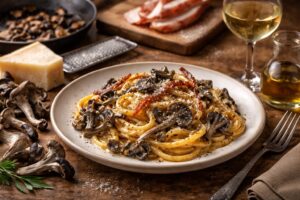
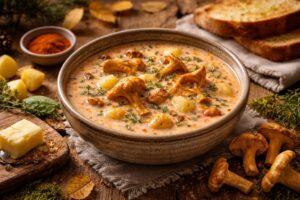
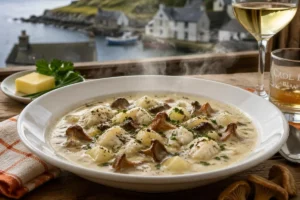
A technical study in Saccharide Caramelization and Lipid-Phase Infusion, utilizing the high-heat environment of a cast-iron skillet to facilitate the Maillard reaction between potato starches and Grey Chanterelle phenols, stabilized by the alpine richness of cured Speck.
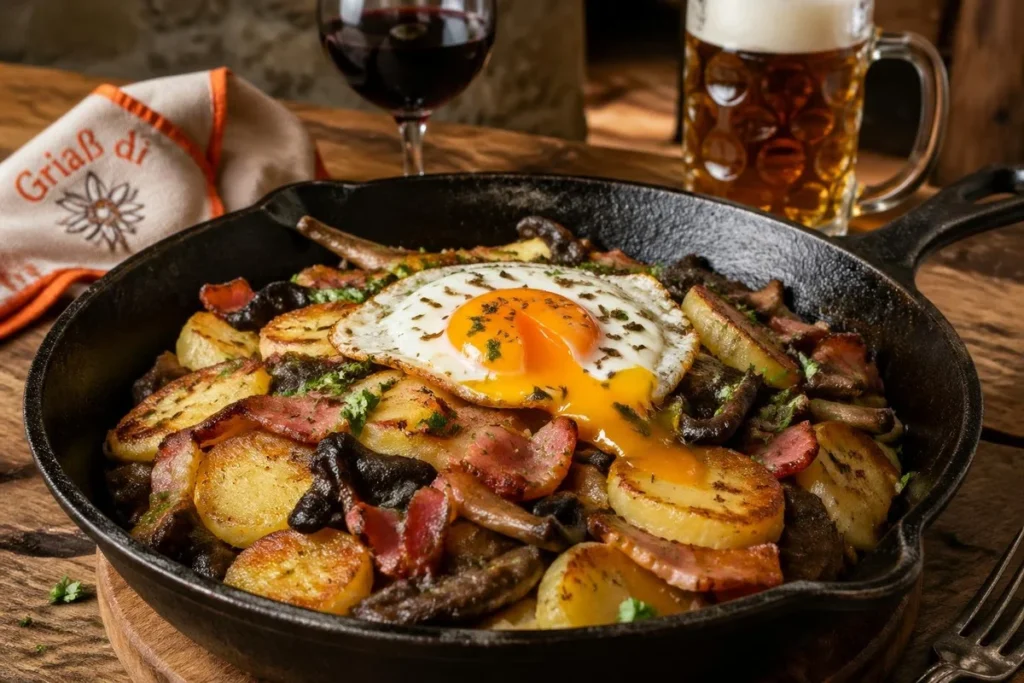
Tyrolean Gröstl with Speck and Grey Chanterelles
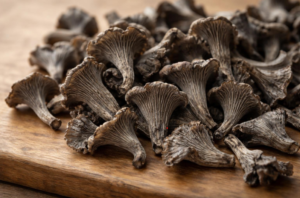
For our 127th technical formulation, we analyze Thermal Starch Transformation and Phenolic-Lipid Anchoring. Craterellus cinereus (Grey Chanterelle), locally identifying as Craterellus cinereus, acts as a structural and aromatic "smoke" engine in this Tyrolean staple. At pure-umami.cc, we utilize the Contact-Searing method. By pan-frying waxy potatoes alongside the "leathery" Grey Chanterelle in the presence of rendered Tyrolean Speck, we create a Bimodal Textural Matrix where the fungal guanylates are locked into a crisp, golden-brown starch crust.
The Culinary Physics of This Dish
The engineering of this Gröstl relies on Saccharide Dehydration and Inosinate-Guanylate Synergy. Molecularly, the potatoes (pre-boiled to ensure Starch Gelatinization) are sliced and seared. This triggers the Maillard Reaction, creating a crust rich in caramel-like flavor compounds. The Craterellus cinereus is introduced during the peak thermal phase; its low moisture content prevents the potatoes from becoming "steamed." The Tyrolean Speck (cured, smoked ham) provides Inosinates and rendered fats (lipids). These lipids act as an Aromatic Solvent, dissolving the mushroom's smoky phenols and the caraway's essential oils, redistributing them across the potato surfaces to ensure a unified flavor delivery.
Terroir Narrative
This formulation is a tribute to the Tirol and Sudtirol regions of the Alps, where the rugged mountain lifestyle demands high-energy, savory cuisine. We bridge the limestone peaks of the Karwendel with our Balkan deciduous highlands. The terroir is expressed through the marriage of the forest's "wild" Craterellus cinereus and the alpine heritage of cold-smoked Speck and butter. This follows the same technical rigor we apply to our Boletus edulis (Porcini) and Amanita caesarea (Caesar's mushroom), treating the skillet as a study in thermal precision and rustic luxury.
Quick Info Bar
Prep Time
Cook Time
Complexity
Calories
Region
20 mins
15 mins
Grand Officier
540 kcal
Tyrol, AT/IT
Master Recipe (1:10 Rule)
500g Waxy Potatoes (boiled in their skins, peeled, and sliced)
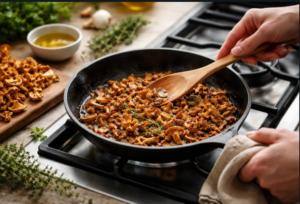
The Lipid Rendering: In a large cast-iron skillet, melt the butter and oil. Add the Speck and onions. Sauté until the fat renders and the onions reach Enzymatic Translucency.
The Starch Searing: Add the sliced potatoes in a single layer. Do not stir immediately. Allow the Contact-Browning Phase (3-4 mins) to create a crisp foundation.
The Fungal Concentration: Add the Craterellus cinereus and caraway seeds. Toss the mixture. The mushrooms will absorb the rendered Speck fat, while the caraway provides a Terpene-Based Aromatic Lift.
The Protein Component: In a separate pan, fry the eggs "Sunny Side Up" until the whites are set but the yolks remain a Viscous Emulsion.
Service: Serve the Gröstl directly in the skillet or on pre-warmed plates. Top with a fried egg and fresh parsley. The yolk acts as a sauce, coating the smoky Grey Chanterelles and crisp potatoes upon breaking.
Shop Integration
The Craterellus cinereus provides the smoky, sophisticated backbone of this alpine classic, but its umami depth can be layered. We recommend adding a fine dust of our dried Boletus edulis (Porcini) over the potatoes during searing for an added "bass note" of umami. If you seek a brighter visual contrast, garnish the skillet with sautéed Cantharellus cibarius (Chanterelle). For a luxury upgrade, finish the plate with a drizzle of Morchella conica (Morel) oil. If available, a side of raw Amanita caesarea (Caesar's mushroom) provides a necessary mineral "reset" against the rich butter and Speck. For a smoky baseline, our Marasmius oreades (Fairy Ring) can be sautéed with the onions to build a more complex savory foundation.
The Umami Profile
This dish features **Lipid-Saccharide Synergistic Umami**. The Craterellus cinereus provides 5′-guanylates, while the Tyrolean Speck and egg yolk introduce high concentrations of free glutamates and inosinates. The Smoky Phenols of the mushroom harmonize with the cured notes of the ham, resulting in a savory experience that is exceptionally heavy, persistent, and "mountain-pure."
Sommelier’s Choice
A glass of **Lagrein (Red)** or a cold **Austrian Märzen Beer**. The dark fruit and spicy tannins of the Lagrein, or the malty sweetness of the Märzen, are the technical requirement to cut through the rich butter and match the smoky intensity of the Grey Chanterelle.
The Etymological Chronicle
The term Gröstl is **Austrian/German**, from rösten (to roast/fry). In **French**, this would be a Poêlée de Pommes de Terre aux Chanterelles Grises et Speck. In **Italian**, it is Gröstl Tirolese con Cantarelli Grigi e Speck. In **Spanish**, it is Gröstl con Trompetas de la Muerte. Regardless of the language, the **Grey Chanterelle** Gröstl remains the definitive standard for technical pan-fried mycological engineering.
Pure Umami | Mycological Research & Culinary Arts | 2026
To provide the best experiences, we use technologies like cookies to store and/or access device information. Consenting to these technologies will allow us to process data such as browsing behavior or unique IDs on this site. Not consenting or withdrawing consent, may adversely affect certain features and functions.
Functional
Always active
The technical storage or access is strictly necessary for the legitimate purpose of enabling the use of a specific service explicitly requested by the subscriber or user, or for the sole purpose of carrying out the transmission of a communication over an electronic communications network.
Preferences
The technical storage or access is necessary for the legitimate purpose of storing preferences that are not requested by the subscriber or user.
Statistics
The technical storage or access that is used exclusively for statistical purposes.The technical storage or access that is used exclusively for anonymous statistical purposes. Without a subpoena, voluntary compliance on the part of your Internet Service Provider, or additional records from a third party, information stored or retrieved for this purpose alone cannot usually be used to identify you.
Marketing
The technical storage or access is required to create user profiles to send advertising, or to track the user on a website or across several websites for similar marketing purposes.