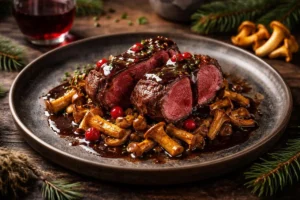
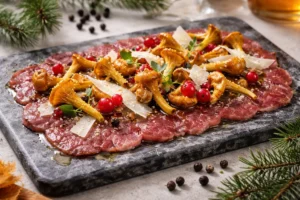
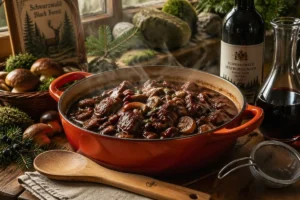
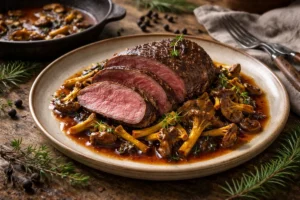
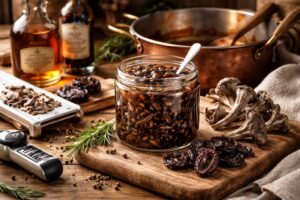
A sophisticated, raw-earth exploration of the Schwarzwald featuring hand-chopped venison loin and the smoky, peppery essence of Cantharellus cinereus.
Black Forest Venison Tartare
Gray Chanterelle Emulsion and the Primal Echo of the Schwarzwald
The Historical Prelude: The Grand Duke’s Gastronomic Chase
The Black Forest (Schwarzwald) has long been the mythical heart of German hunting culture. In the mid-19th century, the Grand Dukes of Baden transformed the rugged pursuit of game into a refined culinary art. It was during the reign of Frederick I that the "Hunter's Raw Feast" began to appear in the high lodges. Historically, hunters would consume small portions of fresh game raw to honor the spirit of the animal—a practice known as the "Jägerrecht" (Hunter's Right).
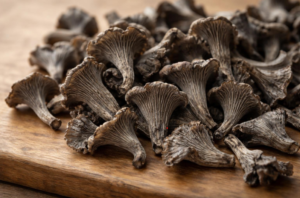
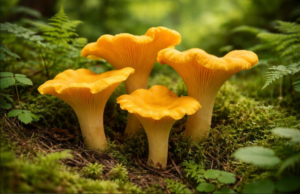
However, it was the influence of French trained chefs in the Baden-Baden spas that refined this primal act. They realized that the lean, iron-rich venison of the forest required a companion that could mirror its wild intensity without cooking out its delicate juices. They turned to the Cantharellus cinereus, or "Grauer Pfifferling," which thrives in the deep shadows of the silver firs. Unlike the golden chanterelle, the Gray variety possesses a smoky, almost leather-like aroma that bonds perfectly with raw meat.
This dish is a modern reconstruction of that 19th-century luxury—a bridge between the raw power of the hunt and the technical precision of a cold-kitchen Garde Manger. To prepare this tartare is to engage in a process of temperature control and textural layering, where the "ashen" mushroom acts as both a seasoning and a textural counterpart to the silken venison. It remains one of the most respected "Forest-to-Table" dishes in the high-end gastropubs of southwestern Germany.
Narrative Intro: The Black Forest is a landscape of density and light. Our philosophy for this tartare is "Pure Integrity"—we do not mask the venison with heavy acids or spice. Instead, we use a cold-smoked Gray Chanterelle emulsion to lengthen the flavor of the meat. This is a dish that tastes of the damp earth, the resinous fir needles, and the cold morning mist.
Sensory & Foraging Profile: The Moss and Fir Terroir
The Cantharellus cinereus of the Schwarzwald is uniquely adapted to the acidic, needle-heavy soil of the conifer forests. These mushrooms possess a concentrated peppery finish and a scent that reminds one of old library books and wild plums. Their structure is slightly more fibrous than the golden variety, making them ideal for dicing into a raw meat preparation.
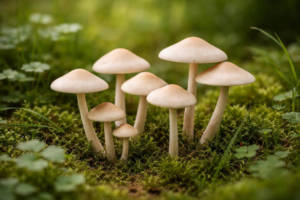
Ethical Harvesting: In the Black Forest, we follow the "Needle Protocol." Master foragers only harvest Gray Chanterelles that have fully emerged from the fir-needle bed, ensuring the cap has "trumpeted" upward to release its spores. We use a badger-hair brush for cleaning to prevent damage to the microscopic ridges of the mushroom. It is a local law of the forest to never harvest more than one "handful" per person per day in certain protected zones, a testament to the German commitment to Waldschutz (Forest Protection).
Essential Equipment: The Tools of the Garde Manger
Hand-Forged Carbon Steel Slicing Knife: Essential for a clean "cut" rather than a "crush" of the venison fibers.
Chilled Stainless Steel Mixing Bowl: To maintain the meat at 2°C during assembly.
Dehydrator: For creating the mushroom "soil" garnish.
Food Processor: To achieve a molecularly smooth mushroom emulsion.
Master Recipe: Black Forest Venison Tartare
Stage 1: The Gray Chanterelle Emulsion
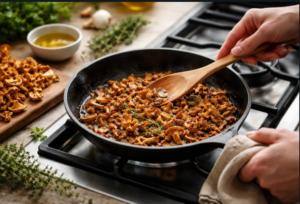
Sauté 100g of Gray Chanterelles in clarified butter until crisp. Transfer to a blender with one egg yolk, a teaspoon of Dijon mustard, and 100ml of neutral oil. Blend until a thick, smoke-colored mayonnaise forms. Season with a drop of liquid smoke or smoked salt to enhance the forest profile.
Stage 2: The Venison Preparation
Take 300g of fresh Roe Deer or Red Deer loin. Remove all silver skin and fat. Freeze the meat for exactly 15 minutes to firm it up. Using your carbon steel knife, cut the meat into 3mm cubes. **Never use a meat grinder**, as it destroys the "snap" of the game meat.
Stage 3: The Mushroom “Soil”
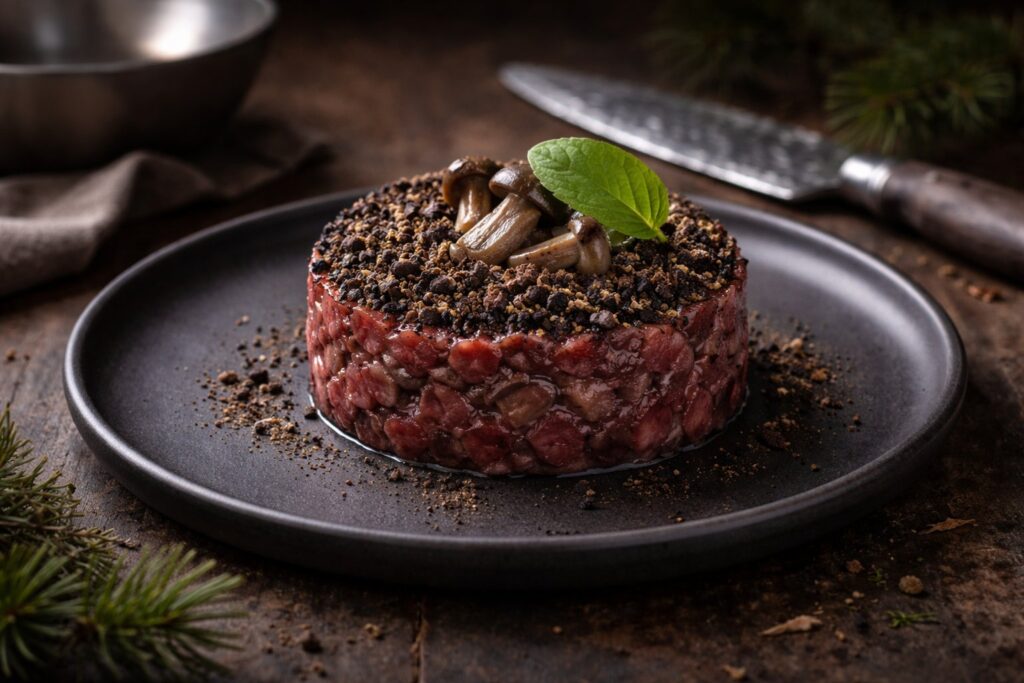
Dehydrate 50g of Gray Chanterelles until brittle. Pulse in a spice grinder with 10g of toasted rye breadcrumbs and a pinch of charcoal powder. This provides a crunchy, earthy texture that mimics the forest floor.
Stage 4: The Cold Assembly
In the chilled bowl, gently fold the diced venison with two tablespoons of the mushroom emulsion. Add finely minced shallots, pickled juniper berries, and a touch of wild mountain chives. Mix with a light hand to avoid over-working the meat.
Stage 5: The Plating
Using a circular ring mold, center the tartare on a slate or dark ceramic plate. Cover the top completely with the mushroom "soil." Garnish with a few whole, pickled Gray Chanterelles and a single leaf of **wild sorrel** for acidity.
Substitutions & Variations
The Meat: If venison is unavailable, a high-quality grass-fed beef tenderloin provides a similar lean profile.
The Acid: Instead of pickled juniper, use fermented green strawberries for a modern, sharp twist that pairs beautifully with fungi.
The Crunch: Replace rye breadcrumbs with toasted hazelnuts to lean into the deeper, woodsy flavors of the Baden region.
Pro Technique: The “Knife-Temperature” Rule
A professional secret for the perfect tartare is the temperature of the knife itself. Place your slicing knife in the freezer alongside the meat. A cold blade prevents the friction heat from melting the microscopic fats in the venison, ensuring each cube remains distinct and "shimmering" on the plate. This prevents the tartare from becoming a "mushy" paste, a common flaw in amateur preparations.
The Umami Secret: Myoglobin and Chitin Synergy
Venison is rich in **Myoglobin**, the oxygen-binding protein that gives the meat its dark color and metallic, savory depth. When this interacts with the **lipid-encapsulated guanylates** in the Gray Chanterelle emulsion, the umami signal is amplified. The emulsion acts as a "fatty bridge," allowing the water-soluble flavors of the meat to bond with the oil-soluble terpenes of the mushroom, resulting in a flavor that lasts on the palate significantly longer than traditional beef tartare.
The Art of Pairing: The Sommelier’s Selection
Sommelier's Choice: A Lemberger (Blaufränkisch) from Württemberg. Its dark berry fruit and distinctive "pencil lead" minerality are a natural match for raw game and earthy fungi.
Non-Alcoholic Alternative: A Chilled Forest Berry Shrub (vinegar-based). The sharp acidity cuts through the richness of the emulsion while the berry notes highlight the venison's wild character.
Storage & Reheating: Professional Restoration
Tartare is a "live" dish and must be consumed within 30 minutes of assembly for safety and flavor. Do not store. However, the **Gray Chanterelle Emulsion** can be kept for 48 hours and makes an incredible condiment for roast beef or as a dip for artisanal sourdough bread.
Ancestral Nutrition: The Hunter’s Vitality
Venison is one of the densest sources of Heme Iron and Vitamin B12, both critical for energy and red blood cell production. The Gray Chanterelle contributes a high dose of Potassium and Vitamin D, making this dish a traditional "power meal" for surviving the long, dark winters of the Black Forest. It is also naturally low in saturated fats compared to domestic meats.
Micro-FAQ
Q: Is raw venison safe? A: Yes, if sourced from a reputable butcher and handled with professional hygiene (chilled equipment, clean hands). Always ensure the meat is "sushi-grade" fresh.
Q: Why use charcoal powder in the mushroom soil? A: It is primarily for the visual "Black Forest" aesthetic, but it also provides a very subtle mineral bitterness that mimics charred wood.
Q: Can I use dried mushrooms instead of fresh in the emulsion? A: You must rehydrate them first in a small amount of warm water or wine, otherwise the emulsion will be grainy and unpleasantly dry.
To provide the best experiences, we use technologies like cookies to store and/or access device information. Consenting to these technologies will allow us to process data such as browsing behavior or unique IDs on this site. Not consenting or withdrawing consent, may adversely affect certain features and functions.
Functional
Always active
The technical storage or access is strictly necessary for the legitimate purpose of enabling the use of a specific service explicitly requested by the subscriber or user, or for the sole purpose of carrying out the transmission of a communication over an electronic communications network.
Preferences
The technical storage or access is necessary for the legitimate purpose of storing preferences that are not requested by the subscriber or user.
Statistics
The technical storage or access that is used exclusively for statistical purposes.The technical storage or access that is used exclusively for anonymous statistical purposes. Without a subpoena, voluntary compliance on the part of your Internet Service Provider, or additional records from a third party, information stored or retrieved for this purpose alone cannot usually be used to identify you.
Marketing
The technical storage or access is required to create user profiles to send advertising, or to track the user on a website or across several websites for similar marketing purposes.