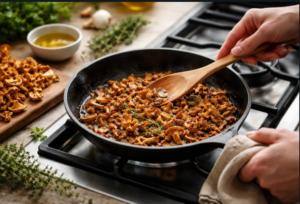
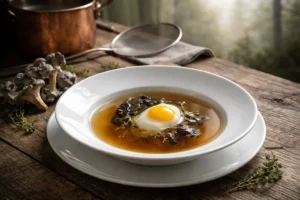
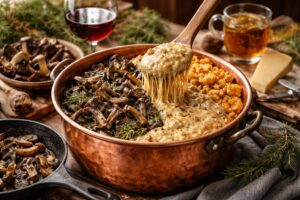
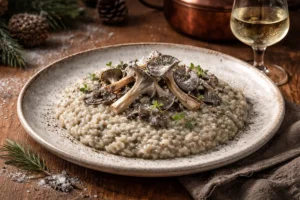
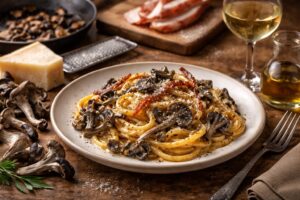
A raw and fire-kissed exploration of the Alps featuring paper-thin Cantharellus cinereus, cold-pressed pine oil, and 36-month aged mountain cheese.
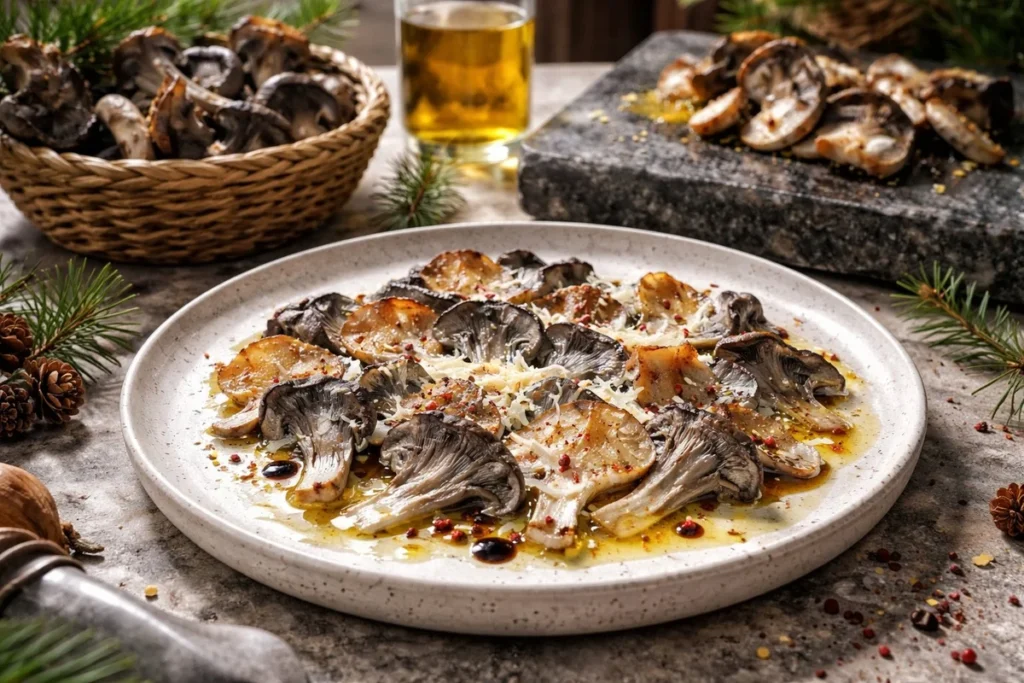
Dolomite Stone-Roasted Carpaccio
Cantharellus Cinereus and the Primal Heat of the Pale Peaks
The Historical Prelude: The Ladin Fire-Ritual
In the heart of the Italian Dolomites, specifically within the secluded valleys where the Ladin culture has survived for millennia, the relationship between fire and stone is sacred. Long before the unification of Italy, the mountain dwellers of the Val Badia practiced a unique method of culinary preparation known as "Sass-Friz". This technique involved heating flat slabs of Dolomite limestone in the embers of a larch-wood fire and using the residual heat to "whisper" across the surface of wild foraged goods.
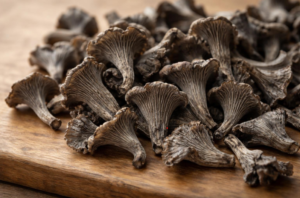
The Cantharellus cinereus, or "Gray Trumpet of the Peaks," was the primary beneficiary of this method. While the noble courts of the south were obsessed with heavily spiced ragùs, the Ladin mountain guides valued the mushroom's raw, peppery vitality. They realized that by briefly touching the mushroom to a hot, mineral-rich stone, they could unlock its deep forest aromatics without destroying its delicate cellular structure.
In the early 20th century, during the birth of Alpine tourism, this "stone-searing" was observed by a young Giuseppe Cipriani (founder of Harry's Bar in Venice). Though Cipriani would later become famous for the beef-based Carpaccio, the original inspiration for the "paper-thin" presentation was rooted in these mountain mushroom slices. This dish is a modern elevation of that primal Ladin technique—a bridge between the ancient fire-ritual of the peaks and the refined technical precision of modern Italian Alta Cucina. It is a dish that requires the chef to act as both a geologist and a craftsman, respecting the mineral ancestry of the ingredients.
Narrative Intro: The Dolomites are composed of ancient fossilized coral reefs, and this geological history is etched into every mushroom that grows in their shadow. Our culinary philosophy here is "Flash-Minimization"—using a high-temperature stone to singe the exterior of the Gray Chanterelle, creating a smoky veil that protects the cool, raw heart of the fungi. This is the essence of the high-altitude forest: fire, stone, and earth.
Sensory & Foraging Profile: The Slate and Spruce Terroir
The Cantharellus cinereus found in the South Tyrol region is noted for its exceptional structural integrity. Unlike varieties found in the Atlantic Fringes, which are often softer, the Dolomite specimens are firm, possessing a snap similar to fresh al dente pasta. Their flavor profile is dominated by pine resin, wild mint, and a lingering saltiness derived from the calcium-rich soil.
Ethical Harvesting & The "Altitude Shift": In the Dolomites, we follow the "Altitude Shift" protocol. Foragers start at the valley floor in late August and follow the moisture up the peaks as the season progresses. When harvesting the Gray Chanterelle, it is vital to leave the "Anchor Stipe" (the bottom 2mm of the stem) in the moss. This ensures the hypogeous (underground) mycelial colony remains sealed from the drying effects of the high-altitude winds. A professional Ladin forager will never carry a plastic bag; only hand-woven willow baskets are used to ensure the forest floor is re-seeded as they move across the scree slopes.
Essential Equipment: The Alpine Kitchen
Food-Safe Soapstone or Granite Slab: For the traditional "Stone-Sear."
Japanese Mandoline: To achieve 0.5mm "translucent" slices.
Kitchen Torch (Optional): To mimic the larch-fire embers if a stone is unavailable.
Ultra-Fine Tweezers: For the "Floating" assembly of the mushrooms.
Master Recipe: Stone-Roasted Carpaccio
Stage 1: The Infused Pine Oil
Take 50g of fresh Swiss Stone Pine (Cirmolo) needles and blanch them for 10 seconds. Shock in ice water, dry thoroughly, and blend with 200ml of neutral grapeseed oil. Strain through a coffee filter. This provides the "Atmospheric" dressing for the carpaccio.
Stage 2: The Precision Slice
Select 12 large, firm Gray Chanterelles. Using a mandoline, slice them vertically from cap to stem. The goal is to maintain the beautiful "trumpet" silhouette in every slice. Keep these chilled on a damp cloth until the moment of service.
Stage 3: The Stone-Sear
Heat your granite or soapstone slab until it reaches 220°C. Lightly brush the stone with a microscopic layer of bee's wax. Place 1/3 of your mushroom slices on the stone for exactly 4 seconds. You are looking for a **singe**, not a cook. The aroma should immediately shift from raw earth to toasted hazelnut.
Stage 4: The Composition
On a chilled ceramic plate, alternate the fire-kissed slices with the raw, cold slices. This creates a "Thermal Contrast" on the palate.
Stage 5: The Alpine Garnish
Dress the mushrooms with the Pine Oil and a few drops of 12-year aged **Aceto Balsamico Tradizionale**. Finish with paper-thin shavings of Trentingrana (a hard mountain cheese) and a sprinkle of crushed **pink peppercorns** to mirror the mushroom's natural spice.
Substitutions & Variations: The High-Altitude Palette
The Oil: If Pine needles are unavailable, use cold-pressed Pumpkin Seed oil from the Styrian region for a deeper, nuttier profile.
The Cheese: A 24-month Parmigiano-Reggiano is a suitable substitute, but seek out Piave Vecchio for a more authentic Dolomite saltiness.
The Heat: If a stone slab is unavailable, use a pre-heated cast-iron skillet turned upside down to provide a perfectly flat, scorching surface.
Pro Technique: The “Cryo-Flash”
To maximize the "snap" of the mushroom, place the slices in the freezer for exactly 3 minutes before the stone-sear. The extreme cold causes the water inside the cells to contract, making the surface of the mushroom "shatter" into a crisp texture the moment it hits the 220°C stone, while keeping the interior perfectly raw and succulent.
The Umami Secret: Maillard Minerality
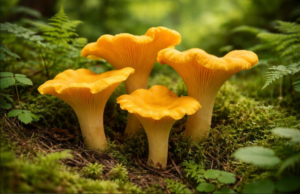
The Gray Chanterelle is rich in **Amino Acids** that react almost instantly to high heat. Because this mushroom has a lower water content than the golden variety, the **Maillard Reaction** occurs at a lower temperature on the stone. This creates Pyrazines—the compounds responsible for the roasted, savory, and "toasted" flavors. When these are paired with the **raw glutamates** in the untoasted slices, the diner experiences a "Double Umami" effect—the initial savory hit of the roast followed by the long, sweet finish of the raw fungi.
The Art of Pairing: The Sommelier’s Alpine Selection
Sommelier's Choice: A Kerner from Valle Isarco. This high-altitude white wine has a distinctive "steel" and "gunflint" minerality that vibrates at the same frequency as the stone-roasted mushrooms.
Non-Alcoholic Alternative: A Birch Sap Sparkling Infusion. The clean, woody sweetness of the birch sap acts as a perfect "cleansing" agent for the resinous pine oil and salty cheese.
Storage & Reheating: The Zero-Waste Principle
This dish is ephemeral and must be consumed within minutes of preparation. However, the Swiss Stone Pine Oil can be kept in a dark glass bottle for up to 2 weeks. Any leftover mushroom slices can be marinated in the pine oil and lemon juice to create a Mushroom Escabeche, which can be served the following day as an antipasto.
Ancestral Nutrition: The Forager’s Resilience
Raw Gray Chanterelles are a potent source of Vitamin D2 and B-complex vitamins. The Stone-Sear method preserves the heat-sensitive enzymes that aid in the digestion of complex proteins found in mountain cheese. Furthermore, the pine oil is rich in alpha-pinene, a natural anti-inflammatory that has been used by Ladin mountain dwellers for centuries to support respiratory health during the cold winter months.
Micro-FAQ
Q: Is it safe to eat Gray Chanterelles raw? A: Yes, provided they are wild-harvested from clean environments and thoroughly cleaned. The "Stone-Sear" provides enough heat to neutralize most surface bacteria while preserving the raw texture.
Q: Why does the stone need to be so hot? A: A lower temperature will cause the mushroom to "sweat" and become rubbery. We need the "Thermal Shock" to create a crust instantly.
Q: Can I use any stone? A: No. Use only food-safe granite, soapstone, or volcanic rock. Avoid stones like river rocks, which may contain trapped moisture and explode when heated.
To provide the best experiences, we use technologies like cookies to store and/or access device information. Consenting to these technologies will allow us to process data such as browsing behavior or unique IDs on this site. Not consenting or withdrawing consent, may adversely affect certain features and functions.
Functional
Always active
The technical storage or access is strictly necessary for the legitimate purpose of enabling the use of a specific service explicitly requested by the subscriber or user, or for the sole purpose of carrying out the transmission of a communication over an electronic communications network.
Preferences
The technical storage or access is necessary for the legitimate purpose of storing preferences that are not requested by the subscriber or user.
Statistics
The technical storage or access that is used exclusively for statistical purposes.The technical storage or access that is used exclusively for anonymous statistical purposes. Without a subpoena, voluntary compliance on the part of your Internet Service Provider, or additional records from a third party, information stored or retrieved for this purpose alone cannot usually be used to identify you.
Marketing
The technical storage or access is required to create user profiles to send advertising, or to track the user on a website or across several websites for similar marketing purposes.