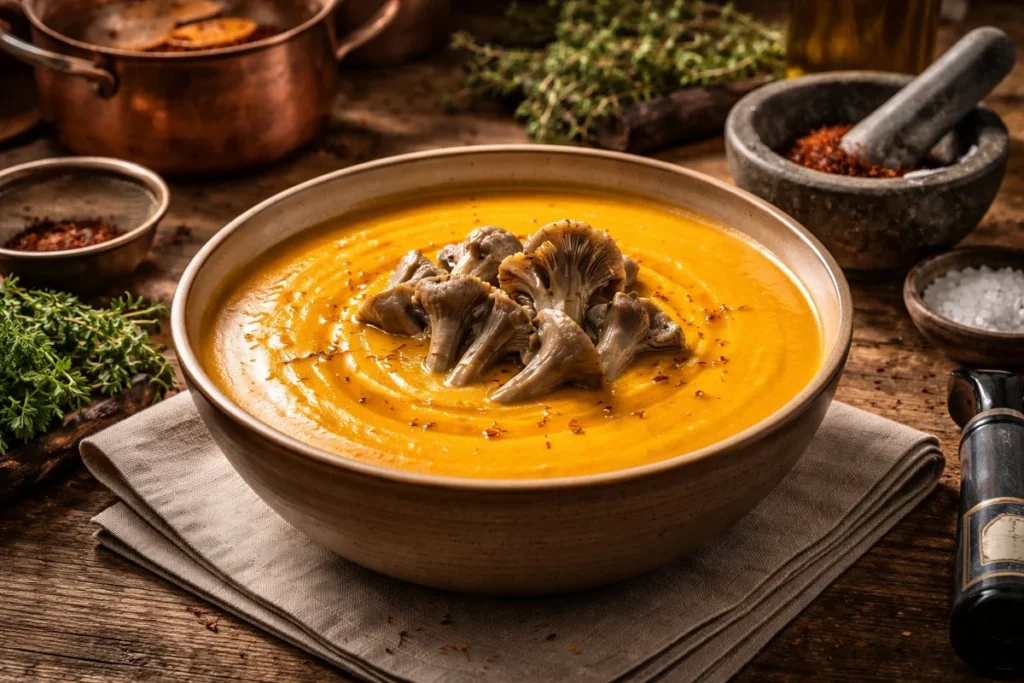
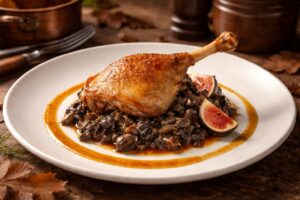
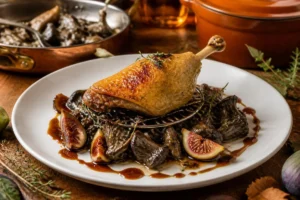
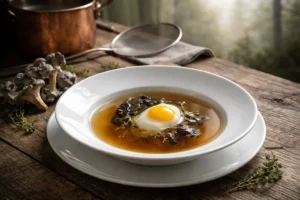
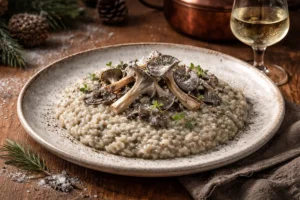
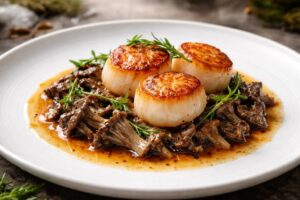
A golden Iberian infusion where the "Red Gold" of La Mancha meets the ashen, peppery mineral depths of wild Pyrenean Cantharellus cinereus.
Castilian Saffron Potage
The Saffron Veil and the Pyrenean Ghost Chanterelle
The Historical Prelude: The Alchemist’s Gift to the Escorial
The culinary history of the Iberian Peninsula is a tapestry of Roman, Moorish, and Christian influences, nowhere more evident than in the royal kitchens of Philip II at El Escorial. During the 16th century, Spain sat at the center of the world's spice trade, yet the king's personal tastes often leaned toward the wild, rugged flavors of the Spanish mountains. It was his master of the kitchens, Francisco Martínez Montiño, who first documented the pairing of "Red Gold" (Saffron) with the elusive "Grey Spirits" of the northern oak forests.
Saffron, brought to Spain by the Moors in the 8th century, had become a symbol of Castilian wealth. However, Montiño realized that its floral, metallic sweetness required a grounding element to achieve true balance. He turned to the Cantharellus cinereus, harvested from the high-altitude forests of the Sierra de Guadarrama. These mushrooms were often used as a meat substitute during the strict fasts of the Catholic Church, but in the royal potage, they served a higher purpose: providing a structural, peppery umami that prevented the delicate saffron from becoming cloying.
This dish represents a moment in history where the opulence of the spice trade met the monastic discipline of mountain foraging. It was served to visiting dignitaries as a demonstration of Spain's reach—from the cultivated plains of La Mancha to the untamed wild of the Pyrenees. In the modern professional kitchen, this potage remains a masterclass in the use of expensive aromatics, requiring a chef to treat both the mushroom and the spice with the reverence of an alchemist handling precious metals.
Narrative Intro: To cook with saffron and Gray Chanterelles is to manage a collision of two distinct worlds. The saffron provides a vibrant, ethereal top note, while the mushroom provides the deep, mineral bass. Our philosophy is the "Iberian Contrast"—using the heat of the Spanish sun captured in the spice to illuminate the cool, damp darkness of the forest fungi.
Sensory & Foraging Profile: The High-Altitude Terroir
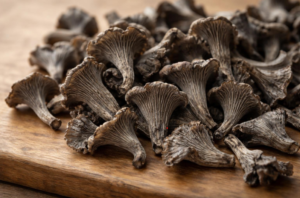
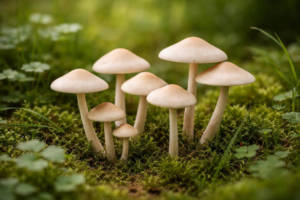
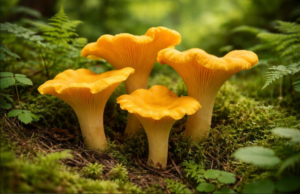
The Cantharellus cinereus of the Pyrenees grows in the shadow of limestone cliffs and ancient cork oaks. Because of the intense solar radiation in Spain, even in the shade of the forest, these mushrooms develop a significantly higher concentration of ergothioneine, a powerful antioxidant. Their flavor profile is marked by roasted nuts, bitter orange zest, and a sharp, white-pepper finish.
Ethical Harvesting & The "Dry Moon" Protocol: In the Spanish tradition, master foragers wait for the "Dry Moon"—the period after the first autumn rains when the humidity is high but the air remains crisp. They utilize a horn-handled knife to ensure no metallic interference with the mushroom's delicate stipe. The Pyrenean code of foraging dictates that the "Mother Cluster" (the largest group in a 10-meter radius) must never be touched; it serves as the genetic anchor for the entire hillside.
Essential Equipment: The Tools of the Potage
Copper Marmite: For maintaining the precise, low-impact simmer required to bloom the saffron.
Mortar and Pestle (Granite): Essential for hand-grinding the saffron threads with a pinch of salt to release the crocin.
Fine-Mesh Tamis: To ensure the silkiness of the potage base.
Hand-held Refractometer: To measure the sugar-acid balance of the reduction.
Master Recipe: Castilian Saffron Potage
Stage 1: The Saffron Activation
Take 0.5g of AOP Pimentón de la Vera (sweet) and 15 high-quality saffron threads. Toast the threads lightly in a dry pan for 30 seconds, then grind them in a mortar with a pinch of sea salt. Dissolve the resulting powder in 50ml of warm, white poultry stock. Let this sit for at least 30 minutes to fully "bloom."
Stage 2: The Mushroom Concentration
Clean 400g of fresh Gray Chanterelles. In a copper pot, sauté the mushrooms in 30g of Spanish Arbequina olive oil. Add one finely minced shallot and a clove of purple garlic. Cook until the mushrooms have released their juices and the liquid has reduced by half. This creates the "Umami Foundation."
Stage 3: The Slow Infusion
Add 800ml of high-clarity poultry stock and a bouquet garni of thyme and parsley. Simmer at exactly 88°C for 45 minutes. Remove the bouquet garni. Take 1/3 of the mushrooms out and set them aside for the garnish.
Stage 4: The Emulsion
Whisk the bloomed saffron mixture into the pot. Slowly stir in 100ml of heavy cream (Isigny) and blend until the potage is a vibrant, golden-orange. Pass through a tamis for a professional, glass-like finish.
Stage 5: The Final Presentation
Ladle the potage into warmed bowls. Place the reserved whole Gray Chanterelles in the center. Finish with a drizzle of Arbequina oil and a few raw saffron threads for visual impact.
Substitutions & Variations
The Spice: If saffron is too dominant, use turmeric for color, but you must add dried marigold petals to mimic the floral notes.
The Mushroom: Black Trumpets (*Craterellus cornucopioides*) can be used, but the color of the potage will shift from gold to a deep, dark amber.
Pro Technique: The “Saffron-Mushroom Salt”
To add an extra dimension of flavor, create a finishing salt. Dehydrate three whole Gray Chanterelles and grind them with five threads of saffron and 50g of Maldon salt. Sprinkle this over the potage at the table. The aromatic burst when the warm steam hits the salt is a hallmark of Michelin-starred service.
The Umami Secret: Safranal and Guanylate Synergy
Saffron contains **Safranal**, a volatile compound that is lipid-soluble. When the Gray Chanterelles (rich in **Guanylate**) are sautéed in olive oil with the saffron, the fat acts as a carrier, bonding the floral spice to the earthy mushroom. This chemical union creates a sensation of "volume" in the mouth, where the flavor feels three-dimensional rather than flat.
The Art of Pairing: The Iberian Sommelier’s Selection
Sommelier's Choice: A Vina Tondonia Reserva Blanco (Rioja). This aged white wine has oxidative, nutty notes that are the perfect mirror to the mushrooms, while its sharp acidity cuts through the saffron's richness.
Non-Alcoholic Alternative: A Smoked Lapsang Souchong tea, served warm. The smokiness of the tea provides a bridge to the charred, earthy profile of the Pyrenean fungi.
Storage & Reheating: The Golden Standard
Saffron is highly sensitive to light and heat. Store the potage in an airtight, opaque container for no more than 48 hours. To reheat, use a double boiler (bain-marie) to gently bring the temperature up to 75°C. Never boil, as the saffron will lose its floral top notes and become unpleasantly bitter.
Ancestral Nutrition: The Royal Fortification
Saffron is traditionally used as a mood elevator and digestive aid. Combined with the B-vitamins and high protein content of the Gray Chanterelle, this potage acts as a "tonic for the nerves." It is rich in crocin, which has neuroprotective properties, making it a functional luxury for cognitive health.
Micro-FAQ
Q: Why does my potage taste like medicine? A: You likely used too much saffron or didn't bloom it properly. Saffron must be measured by weight or threads, never by the "spoonful."
Q: Can I use olive oil instead of butter for the whole recipe? A: In the Spanish tradition, yes. A high-quality Arbequina olive oil provides a fruity, peppery finish that butter cannot match.
Q: Why pass it through a tamis? A: To remove any tiny bits of mushroom skin or saffron fiber, ensuring a perfectly smooth, professional mouthfeel.
To provide the best experiences, we use technologies like cookies to store and/or access device information. Consenting to these technologies will allow us to process data such as browsing behavior or unique IDs on this site. Not consenting or withdrawing consent, may adversely affect certain features and functions.
Functional
Always active
The technical storage or access is strictly necessary for the legitimate purpose of enabling the use of a specific service explicitly requested by the subscriber or user, or for the sole purpose of carrying out the transmission of a communication over an electronic communications network.
Preferences
The technical storage or access is necessary for the legitimate purpose of storing preferences that are not requested by the subscriber or user.
Statistics
The technical storage or access that is used exclusively for statistical purposes.The technical storage or access that is used exclusively for anonymous statistical purposes. Without a subpoena, voluntary compliance on the part of your Internet Service Provider, or additional records from a third party, information stored or retrieved for this purpose alone cannot usually be used to identify you.
Marketing
The technical storage or access is required to create user profiles to send advertising, or to track the user on a website or across several websites for similar marketing purposes.