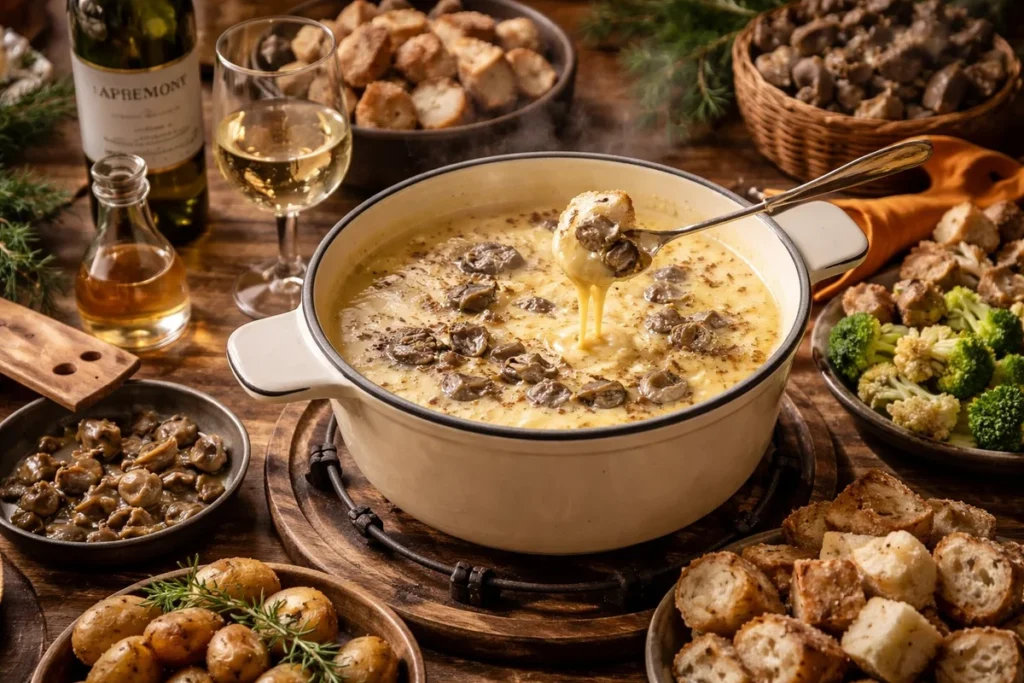
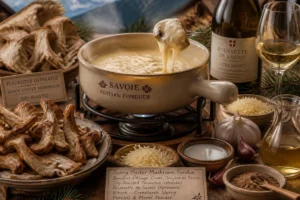
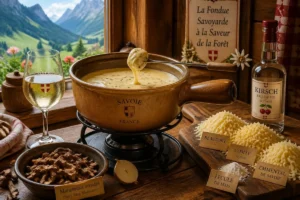
A decadent transformation of the Alpine tradition featuring AOP cheeses and the peppery mineral depth of wild Cantharellus cinereus.
Savoyard Fondue Infused
Gray Chanterelles and the Alchemical Melt of the High Savoie
The Historical Prelude: The Duke’s Winter Feast
The origins of the fondue are often attributed to the necessity of Alpine shepherds to soften hardened winter bread and cheese, but its elevation to a regal masterpiece occurred in the courts of the Dukes of Savoy. In the 17th century, the Duchy of Savoy spanned a vast territory from Lake Geneva to Nice, controlling the strategic mountain passes of the Alps. It was here that the fusion of high-pasture dairy and forest foraging first became a hallmark of diplomatic banquets.
Legend has it that during the winter of 1654, Charles Emmanuel II, Duke of Savoy, was trapped in a mountain hunting lodge during a fierce blizzard. The royal kitchens were depleted, leaving only aged wheels of Beaufort and a store of dried Cantharellus cinereus—the "Gray Ghosts" gathered during the autumn harvest. The Duke's personal chef, sensing the need for a dish that could both warm the spirit and impress the sovereign, devised a method to infuse the local white wine with the essence of these mushrooms before melting the cheese.
The result was a revelation. The natural mineral pepperiness of the Gray Chanterelle cut through the immense richness of the Alpine fat, creating a balance that transformed a survival meal into a symbol of Savoyard prestige. By the time Auguste Escoffier—himself a son of the region—began codifying French cuisine, the inclusion of wild fungi in the *Fondue Savoyarde* had become the "Secret of the Grands Hôtels," a technique reserved for the most discerning palates of the European elite. This recipe is a reconstruction of that ducal tradition, focusing on the synergy between the limestone soil of the peaks and the floral complexity of the forest floor.
Narrative Intro: In the Savoie, cheese is not just food; it is a geological record of the summer grass. To add Gray Chanterelles to a fondue is to introduce the shadow of the forest to the sunlight of the pasture. Our philosophy is the "Symphony of the Slopes"—using the acidity of Apremont wine to act as a solvent, pulling the deep, woodsy terpenes from the mushrooms into the molten heart of the Beaufort and Comté.
Sensory & Foraging Profile: Terroir of the Tarentaise
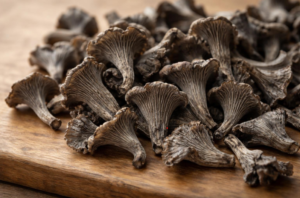
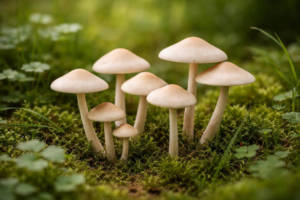
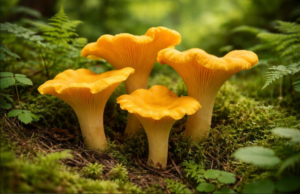
The Cantharellus cinereus of the Tarentaise Valley grows amidst the damp needles of ancient spruce and fir trees. Because the soil here is a complex mix of schist and limestone, these mushrooms develop a unique metallic edge that is often described by local foragers as "licking a cold mountain stone." Their aroma is a dark reflection of the golden chanterelle; instead of bright apricot, you find dried figs, leather, and white pepper.
Ethical Harvesting: The "Leave No Trace" protocol in the high Savoie is enforced by centuries of tradition. Foragers use a "pinch-and-twist" technique to ensure the mycelium is not ripped from its volcanic-rich bedding. In these high-altitude zones, we strictly harvest only after the first autumn dew, which triggers the maximum concentration of flavor compounds. Using a wicker basket is mandatory, as it allows the spores of the Gray Chanterelle to be distributed across the forest floor as the forager walks, essentially "seeding" future harvests with every step.
Essential Equipment: The Tools of the Caquelon
Enameled Cast-Iron Caquelon: Essential for maintaining a constant, low-vibration heat.
Wooden Spatula with a Hole: The "eight-motion" stirrer that prevents the cheese from stringing or separating.
Microplane: For creating the mushroom "dust" used in the final seasoning.
Induction Burner: For the most precise control over the 72°C "Perfect Melt" temperature.
Master Recipe: The Ducal Gray Fondue
Stage 1: The Fungi Infusion
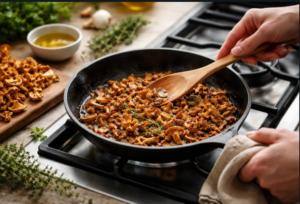
Mince 200g of fresh Gray Chanterelles. In a small copper pan, sauté them with a clove of smashed garlic in 20g of Beurre d'Isigny. Once the moisture has evaporated, deglaze with 300ml of Apremont (Cuvée Gastronomie). Simmer for 10 minutes. This creates a "Mushroom-Wine Base" where the alcohol has extracted the fat-soluble aromatics of the fungi.
Stage 2: The Cheese Selection (The Triple Crown)
Prepare the following blend: 300g of Beaufort d'Alpage (18-month), 300g of Comté Reserve, and 200g of Emmental de Savoie AOP. Grate the cheese coarsely and toss with 1 tablespoon of potato starch (Fécule) to ensure a stable emulsion.
Stage 3: The Melting Protocol
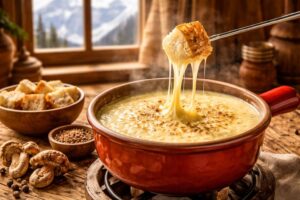
Rub the inside of the caquelon with a fresh clove of garlic. Pour in the infused mushroom-wine mixture (including the sautéed chanterelles). Bring to a gentle simmer. Add the cheese blend in small handfuls, stirring in a "figure-eight" pattern. Never allow the mixture to boil; the goal is a silken, glossy flow.
Stage 4: The Finishing Touch
Once the fondue is smooth, add a splash of Kirsch de Savoie and a generous grating of fresh nutmeg. For the final "Grand Siècle" touch, sprinkle a teaspoon of dried Gray Chanterelle powder over the surface just before serving.
Substitutions & Variations
The Cheese: If Beaufort is unavailable, a high-quality Gruyère AOP paired with Appenzeller can provide the necessary structural fat content.
The Liquid: For a non-alcoholic version, use a verjuice made from green mountain grapes, diluted with a light mushroom consommé.
The Bread: While traditional, try dipping roasted fingerling potatoes or blanched Romanesco for a modern, gluten-free texture.
Pro Technique: The “La Religieuse” Finish
The mark of a master fondue maker is the Religieuse—the thin, toasted crust of cheese that forms at the bottom of the caquelon. To achieve the perfect mushroom-infused crust, leave the last 10% of the fondue in the pot and increase the heat slightly for 2 minutes. The Gray Chanterelle particles will caramelize into the cheese, creating a "biscuit" of concentrated umami that is traditionally peeled off and shared among the guests.
The Umami Secret: Casein and Chitin Interaction
Cheese is a matrix of Casein proteins and saturated fats. When you introduce the Chitin-bound polysaccharides of the Gray Chanterelle, a chemical "clumping" is usually the risk. However, the alcohol in the wine acts as a bridge, allowing the savory glutamates from the Beaufort to bond with the guanylates in the mushrooms. This creates a "long-chain umami" that coats the tongue, making the fat feel less heavy and the flavor more persistent.
The Art of Pairing: The Sommelier’s Alpine Selection
Sommelier's Choice: A Roussette de Savoie (Marestel). This wine has a honeyed weight and exotic spice notes that stand up to the funk of the Beaufort while highlighting the peppery finish of the Gray Chanterelles.
Artisanal Alternative: A Spiced Pear Perry from Normandy. The subtle sweetness of the pear provides a magnificent counterpoint to the saltiness of the mountain cheese.
Storage & Reheating: Professional Restoration
Fondue should never be refrigerated in the caquelon. If you have leftovers, pour them onto a flat tray to cool. The resulting "Cheese Slate" can be diced and used as a base for a high-end Quiche Savoyarde. To reheat, you must add a splash of wine and whisk vigorously over a bain-marie; direct heat will cause the fat to "break" from the protein, ruining the texture.
Ancestral Nutrition: The Winter Fortification
This dish was the "fuel of the giants." Beaufort cheese is exceptionally high in Calcium and Phosphorus, which are critical for bone density in mountain climates. The Gray Chanterelles provide a massive boost of Vitamin D2 and Potassium, which helps regulate blood pressure and muscle function after a day of physical exertion in the thin Alpine air.
Micro-FAQ
Q: Why did my fondue separate into oil and clumps? A: This is usually due to high heat or a lack of acidity. The wine must be acidic enough to break down the protein chains. Add a squeeze of lemon juice next time.
Q: Can I use dried mushrooms directly? A: No. Dried mushrooms must be rehydrated in the wine first, otherwise, they will suck the moisture out of the cheese emulsion, making it grainy.
Q: Is the Kirsch necessary? A: Yes. Kirsch (cherry brandy) contains specific esters that help stabilize the cheese emulsion at lower temperatures.
The Ashen Lexicon: Global Names for Cantharellus cinereus
The Ashen Chanterelle is a sophisticated relative of the golden chanterelle, prized for its deep, fruity aroma. Its regional names often describe its elegant grey-to-black coloration and trumpet-like hollow stem:
To provide the best experiences, we use technologies like cookies to store and/or access device information. Consenting to these technologies will allow us to process data such as browsing behavior or unique IDs on this site. Not consenting or withdrawing consent, may adversely affect certain features and functions.
Functional
Always active
The technical storage or access is strictly necessary for the legitimate purpose of enabling the use of a specific service explicitly requested by the subscriber or user, or for the sole purpose of carrying out the transmission of a communication over an electronic communications network.
Preferences
The technical storage or access is necessary for the legitimate purpose of storing preferences that are not requested by the subscriber or user.
Statistics
The technical storage or access that is used exclusively for statistical purposes.The technical storage or access that is used exclusively for anonymous statistical purposes. Without a subpoena, voluntary compliance on the part of your Internet Service Provider, or additional records from a third party, information stored or retrieved for this purpose alone cannot usually be used to identify you.
Marketing
The technical storage or access is required to create user profiles to send advertising, or to track the user on a website or across several websites for similar marketing purposes.