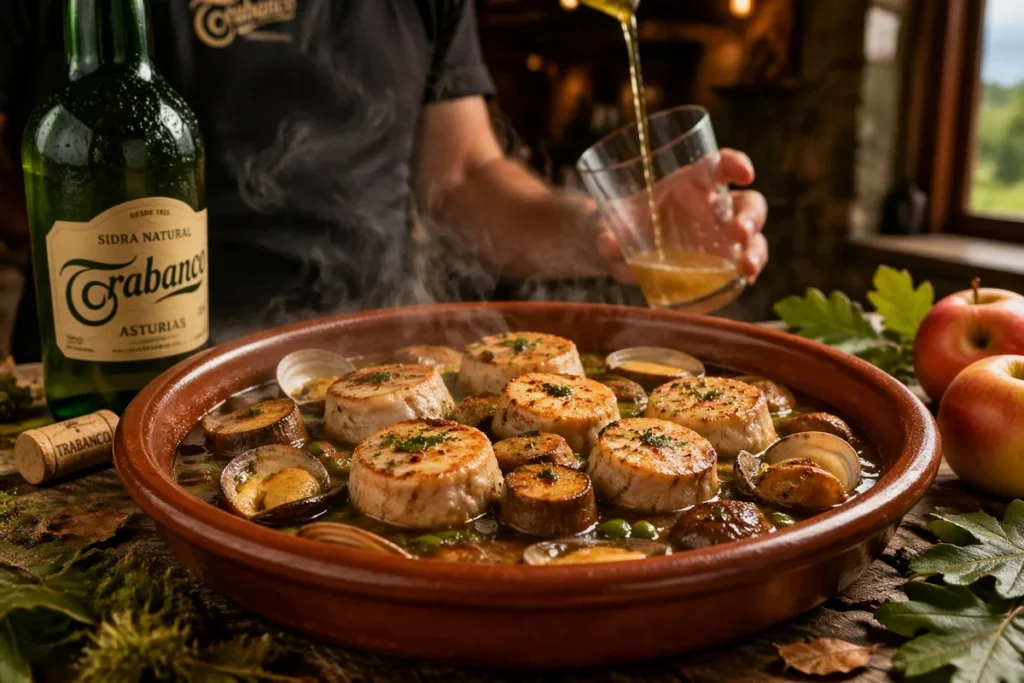
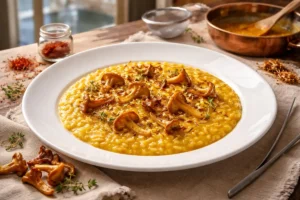
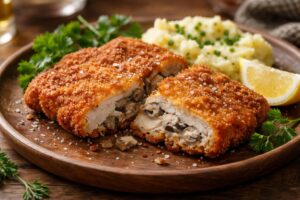
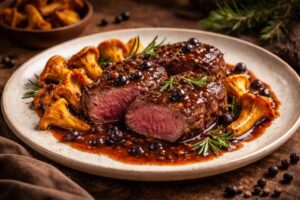
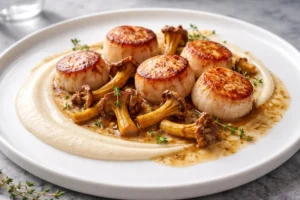
An Atlantic masterpiece featuring the firm, lobster-like medallions of monkfish (pixín) braised with wild Boletus edulis and artisanal Asturian dry cider (sidra natural).
Asturian Porcini & Sidra Monkfish
The Cantabrian Emerald: Ocean Mist, Apple Orchards, and Deep Woods
The Historical Prelude: The Pumaradas and the Deep Sea
In the Principality of **Asturias**, life is a constant balance between the sea and the apple orchards (pumaradas). Historically, the Monkfish (known locally as Pixín) was a "poor man's lobster," prized for its bone-free tail and firm texture. In the autumn, when the first heavy rains hit the Picos de Europa, the **Boletus edulis** arrives at the same time the apples are harvested for the new season's cider.
This dish is the quintessential expression of the Asturian soul. Unlike the wine-heavy sauces of the south, this braise relies on **Sidra Natural**—a flat, highly acidic, and slightly funky apple cider. The cider's natural tartness acts as a chemical tenderizer for the monkfish while cutting through the buttery richness of the Porcini. Traditionally cooked in a wide clay pot (cazuela), it represents the "Green Spain" philosophy: simple, rustic, and profoundly tied to the humidity of the Atlantic coast.
⏱ Time: 40 Minutes
📊 Difficulty: Intermediate / Regional
🔥 Calories: 310 kcal / Serving
🍄 Type: Dense Atlantic "Boleto"
Culinary Philosophy: The Malic Acid Bridge
Asturian philosophy for fish and fungi is centered on Acidic Integration. Monkfish is a "fatty" white fish with a high collagen content. Porcini is rich in glutamates. The bridge between them is **Malic Acid** found in the cider. This acid doesn't just add sourness; it interacts with the fish's collagen to create a silken, slightly thickened sauce without the need for flour or heavy cream.
Sensory & Foraging Profile: The Oak & Fern Humidity
Latin Nomenclature:Boletus edulis (The Asturian "Cepo"). Terroir Analysis: Porcini from the Somiedo Natural Park grow in extremely humid, mossy soils under Sessile Oak and Beech. These mushrooms are large and hold a significant amount of water, which they "sweat" into the cider during the braising process, creating a rich, multi-dimensional mushroom-apple stock.
Selection Protocol: We use "Large Medallions." We slice the monkfish tail and the Porcini stems into identical 2cm-thick rounds. On the plate, they appear almost indistinguishable, creating a beautiful sensory confusion where the diner must taste each piece to know if it is "Sea" or "Mountain."
Essential Equipment
🔸 Traditional Clay Cazuela: For gentle, even simmering that keeps the monkfish moist.
🔸 Asturian Sidra Natural: Must be the natural, non-carbonated version for the authentic "funky" acidity.
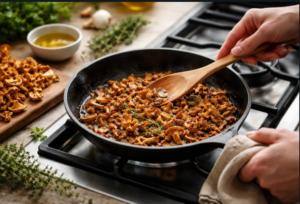
🔸 Wooden Spoon: To gently move the ingredients without breaking the delicate mushroom caps.
The Master Recipe: The Asturian Braise
Stage 1: The Golden Sear
Dust the monkfish medallions lightly with salt. In a hot cazuela with olive oil, sear the fish and the sliced Porcini simultaneously for 2 minutes per side. They should both have a light golden crust. Remove the fish, but keep the mushrooms in the pan.
Stage 2: The Aromatic Base
Add 2 finely minced cloves of garlic and a pinch of Pimentón de la Vera (Sweet) to the mushroom pan. Sauté for 30 seconds until fragrant, being careful not to burn the paprika.
Stage 3: The Sidra Reduction
Pour in 300ml of Sidra Natural. Bring to a vigorous boil for 3 minutes to cook off the raw alcohol. The liquid will begin to emulsify with the mushroom juices and olive oil.
Stage 4: The Gentle Braise
Return the monkfish to the pan. Lower the heat and simmer gently for 5–8 minutes. The sauce should reduce until it coats the fish. Finish with fresh parsley and a handful of cooked clams or peas (optional, for the "Coast" touch).
Chef’s Secret: The “Scallop” Illusion
For a high-end presentation, use only the thickest parts of the Porcini stems, cut into perfect cylinders. When braised in the cider alongside the monkfish, they take on the appearance and texture of giant sea scallops. This visual trick is a favorite in the Sidrerías of Gijón and Oviedo.
The Umami Secret: The Funky Ferment
Natural cider undergoes **Spontaneous Fermentation**, meaning it contains wild yeasts and a complex array of esters. When these "funky" aromas meet the **Glutamates** of the Porcini and the **Iodine** of the monkfish, they create a savory depth that is more intense than a standard wine sauce. The apple notes provide a "sweet-tart" background that highlights the nuttiness of the fungi.
The Art of Pairing
Drink Selection: It must be the same **Sidra Natural** used in the cooking. Poured from a height (the escanciado) to aerate the cider and activate its volatiles, it is the only soulmate for this dish.
Non-Alcoholic: A chilled, dry sparkling apple juice (no sugar added) with a squeeze of lime.
Micro-FAQ
Q: Can I use sparkling cider? A: No. Sparkling cider is often too sweet and lacks the necessary acidity and depth. Look specifically for "Sidra Natural" (the kind with a cork you have to pull, not a wire cage).
Q: My sauce is too thin. A: Increase the heat at the end for 2 minutes without the fish in the pan. The gelatin from the monkfish and the Porcini will naturally thicken the cider as it reduces.
The Porcini Directory: Global Names for Boletus edulis
The King Bolete, or simply Porcini, is arguably the most recognized wild mushroom in the culinary world. Its linguistic variety reflects its presence in forests from the Alps to the Himalayas:
Language
Regional & Folk Names
Expert Insights
Italian
Porcino, Brisa, Fungo di faggio
"Porcini" (little pigs) is the global trade name.
French
Cèpe de Bordeaux, Gros pied, Polonais
"Cèpe" comes from the Gascon word for trunk/stump.
German
Steinpilz, Herrenpilz, Edelpilz
"Steinpilz" (Stone mushroom) refers to its firm flesh.
To provide the best experiences, we use technologies like cookies to store and/or access device information. Consenting to these technologies will allow us to process data such as browsing behavior or unique IDs on this site. Not consenting or withdrawing consent, may adversely affect certain features and functions.
Functional
Always active
The technical storage or access is strictly necessary for the legitimate purpose of enabling the use of a specific service explicitly requested by the subscriber or user, or for the sole purpose of carrying out the transmission of a communication over an electronic communications network.
Preferences
The technical storage or access is necessary for the legitimate purpose of storing preferences that are not requested by the subscriber or user.
Statistics
The technical storage or access that is used exclusively for statistical purposes.The technical storage or access that is used exclusively for anonymous statistical purposes. Without a subpoena, voluntary compliance on the part of your Internet Service Provider, or additional records from a third party, information stored or retrieved for this purpose alone cannot usually be used to identify you.
Marketing
The technical storage or access is required to create user profiles to send advertising, or to track the user on a website or across several websites for similar marketing purposes.