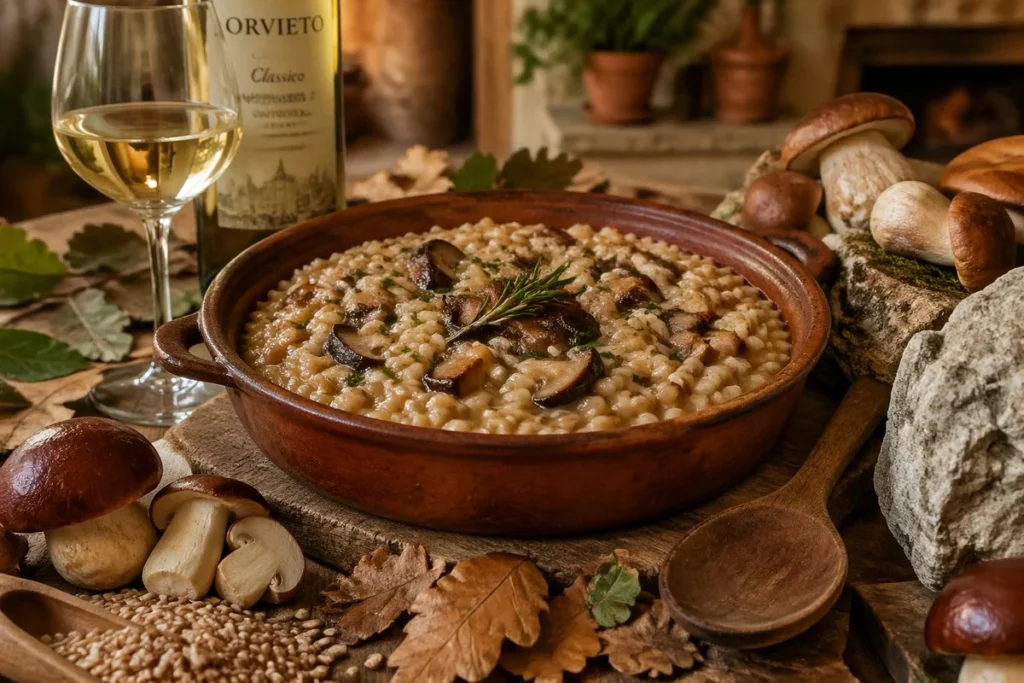
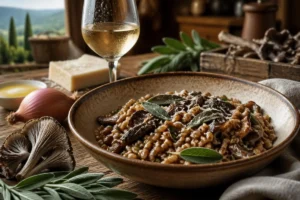
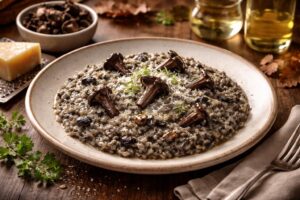
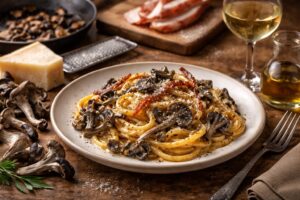
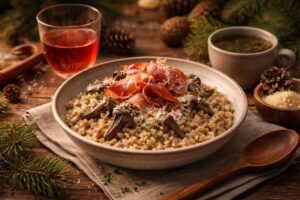
A rustic yet elegant "risotto-style" preparation using ancient Umbrian grain (Farro) instead of rice, simmered with wild Boletus edulis and finished with a touch of cold-pressed truffle oil and aged Pecorino di Norcia.
Umbrian Farro & Porcini “Risina”
The Ancient Grain: A Timeless Dialogue of Stone and Soil
The Historical Prelude: The Roman Legions and the Umbrian Woods
In the mist-covered valleys of **Umbria**, specifically around the town of Monteleone di Spoleto, the cultivation of Farro (Emmer wheat) dates back nearly 3,000 years. Historically, Farro was the primary sustenance of the Roman Legions, prized for its ability to grow in poor, rocky soil. During the autumn, the Umbrian mountain dwellers combined this resilient grain with the Boletus edulis that blanketed the floors of the region's dense oak and chestnut forests.
The technique of **"Risina"** (small rice) is a regional variation of the risotto method. Because Farro has a tougher husk than rice, it requires a longer, more aggressive simmer. This results in a dish that has a distinctive "pop" and nuttiness, which perfectly echoes the texture and flavor profile of the Porcini. This dish is the quintessence of the Cucina Umbra: honest, mineral-rich, and deeply connected to the limestone-heavy earth of the Apennines.
⏱ Time: 50 Minutes
📊 Difficulty: Intermediate / Slow Cook
🔥 Calories: 395 kcal / Serving
🍄 Type: Wild Umbrian "Porcino"
Culinary Philosophy: The Structural Nutty Balance
Umbrian philosophy focuses on Textural Persistence. Unlike a creamy rice risotto that melts away, Farro maintains its integrity. We use the "Double-Starch" method: we partially crack some of the Farro grains to release starch for creaminess, while keeping the rest whole for "bite." The Porcini are added in two stages—dried for the broth and fresh for the final sear—to ensure a multi-layered fungal experience.
Sensory & Foraging Profile: The Limestone & Oak Terroir
Latin Nomenclature:Boletus edulis (The Umbrian phenotype). Terroir Analysis: Umbria is a land of Limestone (Calcare). Porcini found in the Sibillini Mountains possess a higher mineral content and a sharper, more peppery finish. The farro grown in the same soil shares this mineral profile, creating a rare "Geological Synergy" on the plate.
Selection Protocol: We prioritize "Mature Buttons." These are mushrooms where the flavor has intensified but the pores are still firm. For a Risina, the mushrooms should be diced into cubes the size of a chickpea (approx. 1cm) to match the scale of the grain.
Essential Equipment
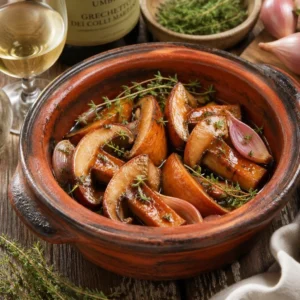
🔸 Heavy Clay or Earthenware Pot: For the slow, heat-retaining simmer traditional in Umbrian farmhouses.
🔸 Pearled Farro (Farro Perlato): To ensure the grain cooks within a 30-40 minute window.
🔸 Wooden Spoon: To constantly "massage" the starch out of the Farro grains.
The Master Recipe: The Umbrian Risina
Stage 1: The Porcini Broth
Simmer 20g of dried Porcini in 1.5 liters of water with a stalk of celery and an onion. This "Liquid Forest" will be the cooking medium for the grain, ensuring every Farro grain is saturated with umami from the inside out.
Stage 2: The Nacarar (Toasting)
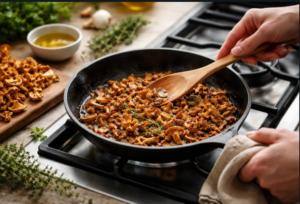
In a heavy pot, sauté 1 minced shallot in olive oil. Add 300g of Farro Perlato. Toast the grain until it smells like roasted bread. Deglaze with 100ml of dry Orvieto white wine.
Stage 3: The Slow Absorption
Begin adding the Porcini broth one ladle at a time. Halfway through (at the 15-minute mark), add 400g of fresh, diced Porcini. The mushrooms will cook down into the grains, releasing their juices to create a thick, earthy emulsion.
Stage 4: The Mantecatura Umbra
Once the Farro is "al dente" but the sauce is creamy, remove from heat. Stir in 50g of cold butter and 60g of grated Pecorino di Norcia. Let rest, covered, for 3 minutes before serving. Finish with a drizzle of Umbrian extra virgin olive oil.
Chef’s Secret: The “Cracked-Grain” Trick
Before cooking, take 1/4 cup of the dry Farro and pulse it in a spice grinder or blender for 3 seconds just to crack the husks. Add this "cracked" grain back to the whole grains. The cracked pieces will dissolve completely during the simmer, providing a natural, creamy thickness that mimics a high-starch rice risotto without the need for excessive butter.
The Umami Secret: Chitin and Fiber Interaction
Farro is high in **Insoluble Fiber**, which creates a slight friction on the tongue. When this is paired with the **Chitin** structures of the Porcini, it stimulates the mechanical receptors in the mouth. This tactile stimulation makes the brain more receptive to the **Glutamates** in the mushroom, resulting in a flavor that feels "louder" and more satisfying than a smooth rice dish.
The Art of Pairing
Sommelier's Selection: A structured white like an **Umbria Grechetto** or a light red **Sagrantino di Montefalco** (though be careful with the tannins). The Grechetto's nutty finish is the perfect echo for the grain.
Non-Alcoholic: A warm, roasted grain beverage (Orzo) served with a sprig of fresh rosemary.
Micro-FAQ
Q: Can I use Spelt instead of Farro? A: Yes, they are very similar. Spelt is slightly sweeter and softer, while Umbrian Farro (Emmer) is more robust and mineral. Both work excellently with the "Risina" technique.
Q: Why Pecorino di Norcia? A: Norcia is the capital of Umbrian charcuterie and cheese. Its Pecorino is aged in limestone caves and has a "musty" complexity that is a much better partner for wild mushrooms than a standard Roman Pecorino.
The Porcini Directory: Global Names for Boletus edulis
The King Bolete, or simply Porcini, is arguably the most recognized wild mushroom in the culinary world. Its linguistic variety reflects its presence in forests from the Alps to the Himalayas:
Language
Regional & Folk Names
Expert Insights
Italian
Porcino, Brisa, Fungo di faggio
"Porcini" (little pigs) is the global trade name.
French
Cèpe de Bordeaux, Gros pied, Polonais
"Cèpe" comes from the Gascon word for trunk/stump.
German
Steinpilz, Herrenpilz, Edelpilz
"Steinpilz" (Stone mushroom) refers to its firm flesh.
To provide the best experiences, we use technologies like cookies to store and/or access device information. Consenting to these technologies will allow us to process data such as browsing behavior or unique IDs on this site. Not consenting or withdrawing consent, may adversely affect certain features and functions.
Functional
Always active
The technical storage or access is strictly necessary for the legitimate purpose of enabling the use of a specific service explicitly requested by the subscriber or user, or for the sole purpose of carrying out the transmission of a communication over an electronic communications network.
Preferences
The technical storage or access is necessary for the legitimate purpose of storing preferences that are not requested by the subscriber or user.
Statistics
The technical storage or access that is used exclusively for statistical purposes.The technical storage or access that is used exclusively for anonymous statistical purposes. Without a subpoena, voluntary compliance on the part of your Internet Service Provider, or additional records from a third party, information stored or retrieved for this purpose alone cannot usually be used to identify you.
Marketing
The technical storage or access is required to create user profiles to send advertising, or to track the user on a website or across several websites for similar marketing purposes.