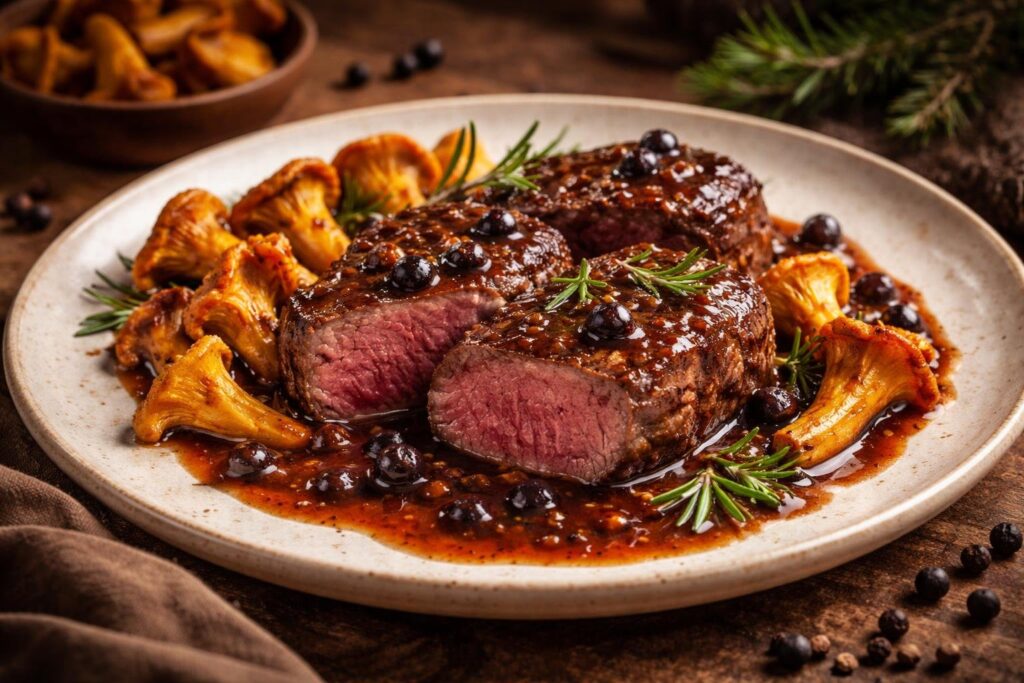
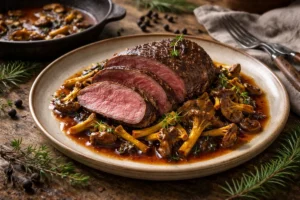
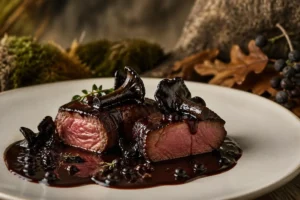
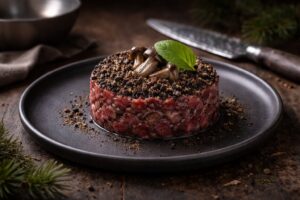
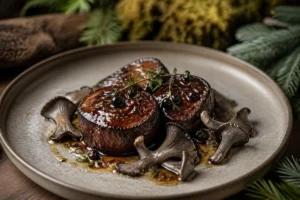
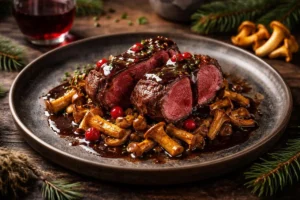
Venison Medallions with Chanterelles and Juniper Berry Sauce
The Primal Elegance of the Deep European Woodlands
⏱️ 45 min🍴 Advanced🔥 480 kcal🌱 Wild-Harvested
There is no pairing in the culinary world that speaks more directly to our ancestral roots than the union of wild game and wild fungi. In the dense, shadowed forests of Central Europe and the Balkans, the deer and the Cantharellus cibarius share the same soil, the same air, and the same mystical ecosystem. This recipe for Venison Medallions with Golden Chanterelles is a celebration of that shared terroir. It is a dish designed for those who understand that true luxury is not found in a factory, but in the patient, untamed cycles of nature. To prepare this meal is to orchestrate a meeting between the swift, lean power of the red deer and the quiet, umami-rich persistence of the forest floor.
Historically, venison was the "meat of kings," protected by royal foresters and served only at the most prestigious tables of the European aristocracy. When paired with chanterelles—the "Gold of the Forest"—it becomes a dish of unparalleled depth. The meat provides a clean, iron-rich foundation, while the mushrooms introduce a delicate fruitiness and a peppery kick that store-bought varieties simply cannot replicate. This is not just a recipe; it is a culinary masterpiece that requires precision, a high-heat sear, and a deep respect for the wild-harvested ingredients that define it. As you deglaze the pan with the scent of crushed juniper berries, you are inhaling the very scent of the wilderness itself.
CHEF’S SPECIAL OFFER
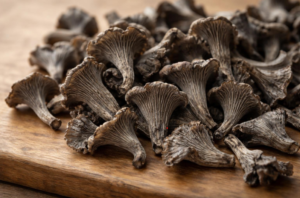
Taste the authentic wilderness. Our wild-harvested Chanterelles are hand-picked and expertly dried to preserve every drop of umami.
BUY 2, GET 1 FREE!
Standard shipping across the EU. Perfect for gourmet gifting.
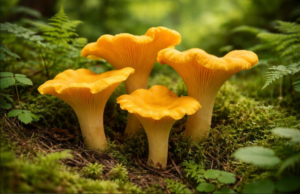
The Cantharellus cibarius brings a unique sensory profile to high-protein dishes. Unlike the heavy, muskier notes of porcini, the chanterelle offers a sophisticated balance of apricot-like fruitiness and a sharp, radish-like bite. This is due to the mushroom's unique chemical structure, forged through Mycorrhizal symbiosis with spruce and fir trees. They do not merely grow; they belong to a network. In the wild, chanterelles act as natural filters and accumulators of minerals, which is why their flavor profile is so deeply tied to the specific forest where they were gathered. A chanterelle from the Carpathian Mountains will taste subtly different from one found in the Black Forest, yet both share that signature meaty texture that remains firm even when doused in a rich red wine reduction.
Foraging for chanterelles to pair with venison requires timing. They appear most abundantly when the forest is at its most vibrant—after the summer rains and into the early autumn "rut" season of the deer. This natural synchronicity is why they complement each other so perfectly on the plate. The mushroom's vibrant orange color serves as a visual reminder of its high **Vitamin D** and **beta-carotene** content, elements it pulls directly from the filtered forest sunlight. When you handle a wild-harvested chanterelle, you will notice it feels significantly denser and more robust than any cultivated mushroom. This structural integrity is vital when pairing with a lean meat like venison, as it provides a textural counterpoint that prevents the dish from feeling one-dimensional. It is a true umami-rich powerhouse that anchors the gamey notes of the meat with forest floor elegance.
The Master Recipe: Woodland Medallions
This dish demands high heat and fast movements. Venison is lean and will toughen if overcooked; aim for a perfect medium-rare.
600g Venison Loin, cut into 2-inch medallions
400g Fresh or 40g Dried Chanterelles (Cantharellus cibarius)
10 Dried Juniper Berries, lightly crushed
100ml Dry Gin or Red Wine (for deglazing)
50g Unsalted Grass-fed Butter
150ml Venison or Beef Bone Broth (Reduced)
2 sprigs of Fresh Rosemary
2 tbsp Grapeseed Oil (High smoke point)
Flaky Sea Salt and Black Pepper
Step 1: The Forager’s Sauté
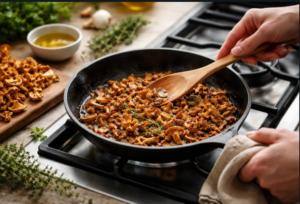
In a separate skillet, sauté the chanterelles using the dry-pan method. Once they have released their moisture, add a knob of butter and half of the crushed juniper berries. The heat will release the piney, gin-like aroma of the juniper, which binds perfectly to the apricot notes of the mushrooms. Set aside and keep warm.
Step 2: The High-Heat Sear
Season the venison medallions generously with salt and pepper only seconds before they hit the pan. Heat the oil in a cast-iron skillet until it just begins to smoke. Sear the medallions for 2-3 minutes per side. In the last minute, add butter and rosemary, spooning the foaming fat over the meat (basting). Remove the meat and let it rest for at least 5 minutes—this is non-negotiable for tenderness.
Step 3: The Juniper Reduction
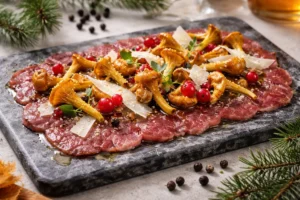
In the same pan used for the meat, pour in the gin or red wine. Scrape up all the caramelized bits (the fond). Add the broth and the remaining juniper berries. Reduce by half until the sauce coats the back of a spoon. Fold the sautéed chanterelles back into the sauce for 30 seconds to glaze them. Plate the venison and pour the mushroom-heavy sauce over the top.
Pro Technique: The Juniper Infusion
To maximize the "forest" flavor, do not just throw the juniper berries in whole. Toast them in a dry pan for 30 seconds until they become shiny (releasing oils), then crush them with a mortar and pestle. This releases the pinene compounds which are chemically similar to the terpenes found in wild chanterelles. If using dried mushrooms, rehydrate them in a mixture of warm water and a splash of gin to bridge the flavor gap between the meat and the fungi.
The Umami Secret: Iron & Nucleotides
The deep satisfaction of this dish comes from the pairing of Heme-iron in the venison with the 5′-nucleotides in the wild chanterelles. These two components engage different taste receptors simultaneously, creating a "full-mouth" flavor experience that stays on the tongue long after the meal is finished. The addition of juniper adds a tannic structure that cuts through the richness, acting as a natural flavor enhancer without the need for excessive salt.
The Art of the Pairing
This is a bold, masculine dish that requires a wine with "spine." A Syrah (Shiraz) with peppery notes or a Barolo with its high tannins and earthy bouquet will stand up to the venison. For a non-alcoholic option, a blackcurrant nectar diluted with sparkling water offers the necessary acidity and dark fruit profile to match the juniper berry sauce.
Ancestral Nutrition
This dish is a masterclass in Ancestral Nutrition. Venison is one of the leanest proteins available, packed with B12 and Iron, while chanterelles provide essential Copper and Selenium. This combination supports cardiovascular health and metabolic efficiency. By consuming wild-harvested foods, you are avoiding the hormones and antibiotics found in industrial farming, instead fueling your body with the high-density nutrients that our ancestors relied upon for thousands of years.
The Chanterelle Lexicon: Global Names for Cantharellus cibarius
The Golden Chanterelle is one of the most commercially important wild mushrooms worldwide. Its names often reflect its apricot aroma and bright yellow hue:
To provide the best experiences, we use technologies like cookies to store and/or access device information. Consenting to these technologies will allow us to process data such as browsing behavior or unique IDs on this site. Not consenting or withdrawing consent, may adversely affect certain features and functions.
Functional
Always active
The technical storage or access is strictly necessary for the legitimate purpose of enabling the use of a specific service explicitly requested by the subscriber or user, or for the sole purpose of carrying out the transmission of a communication over an electronic communications network.
Preferences
The technical storage or access is necessary for the legitimate purpose of storing preferences that are not requested by the subscriber or user.
Statistics
The technical storage or access that is used exclusively for statistical purposes.The technical storage or access that is used exclusively for anonymous statistical purposes. Without a subpoena, voluntary compliance on the part of your Internet Service Provider, or additional records from a third party, information stored or retrieved for this purpose alone cannot usually be used to identify you.
Marketing
The technical storage or access is required to create user profiles to send advertising, or to track the user on a website or across several websites for similar marketing purposes.