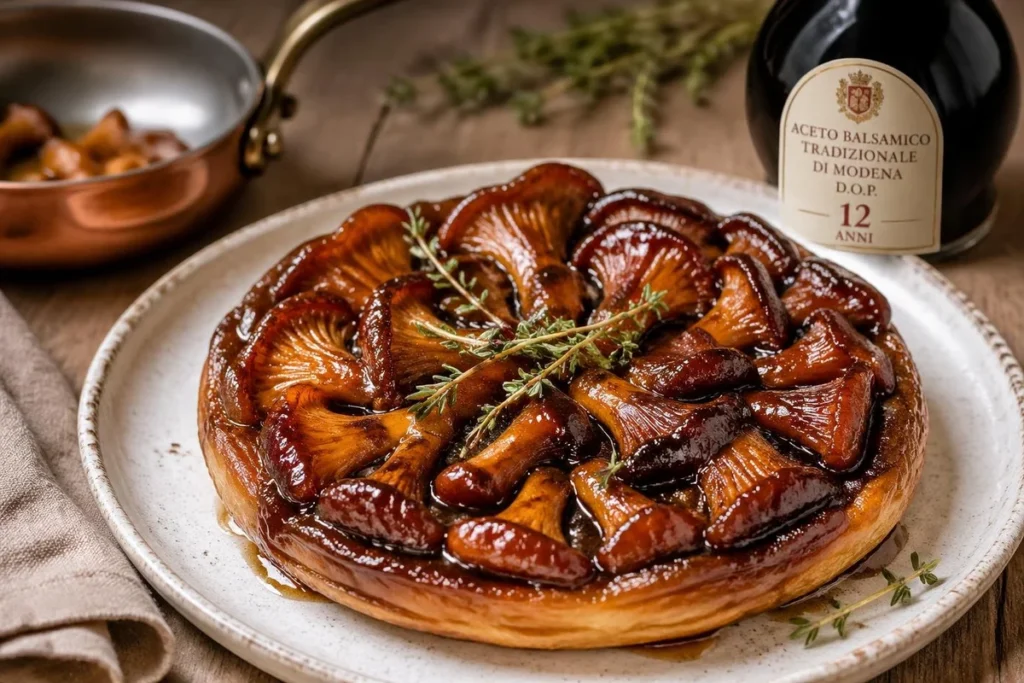
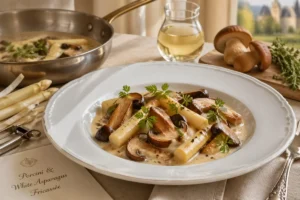
A daring inversion of the French pastry classic, utilizing the Golden Chanterelle's natural apricot-like esters to facilitate a savory-sweet caramelization with traditional Italian balsamic reduction.
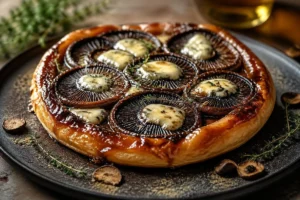
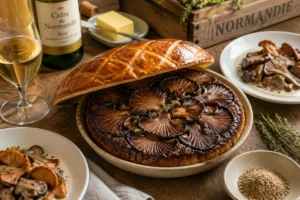
Chanterelle Tart Tatin with Balsamic Glaze
For our seventeenth technical formulation, we execute a sophisticated culinary inversion. The Cantharellus cibarius (Golden Chanterelle) is a botanical anomaly; its aromatic profile is dominated by the same lactones found in stone fruits. By replacing the traditional apple with our premium Cantharellus cibarius, we utilize the mushroom's structural parenchyma to absorb a dark, savory caramel. This Tart Tatin is a bridge between the pastry heritage of the Loire Valley and the balsamic traditions of Modena, offering a complex Umami experience that is a signature of the pure-umami.cc research lab.
The Culinary Physics of This Dish
The engineering of a savory Tart Tatin relies on High-Viscosity Caramelization. We create a gastrique-style caramel using sugar and 12-year aged Balsamic vinegar. Molecularly, as the chanterelles are baked upside-down beneath a pastry "blanket," the pressure forces the balsamic caramel into the fungal tissue. Because the Cantharellus cibarius has a higher density than fruit, it does not collapse; instead, it undergoes a Maillard-style synthesis with the sugars, concentrating its apricot esters into a dense, savory-sweet glaze while the pastry remains crisp due to the lack of excess surface moisture.
Terroir Narrative
This dish is a tribute to Emilia-Romagna, specifically the junction where the Apennine forests meet the traditional balsamic acetaias. The terroir is reflected in the contrast between the sharp, woody acidity of the vinegar—aged in oak and cherry wood—and the bright, peppery finish of the chanterelles. This is the same elite ecosystem that nurtures our Boletus edulis and Amanita caesarea, here reimagined in a format that challenges the boundary between the appetizer and the entremet.
Quick Info Bar
Prep Time
Cook Time
Complexity
Region
30 mins
25 mins
Grand Officier
Modena, Italy
Master Recipe (1:10 Rule)
Technical proportions for the savory caramel:
400g Fresh Cantharellus cibarius (Cantharellus cibarius) – uniform medium sizes
50g Granulated Sugar
30ml Aged Balsamic Vinegar of Modena (Aceto Balsamico Tradizionale)
40g Beurre d'Isigny (for the caramel base)
250g Puff Pastry (Pâte Feuilletée – chilled)
1 sprig Fresh Thyme
Maldon Sea Salt
The Technique
The Gastrique Caramel: In a copper skillet, melt the sugar until it turns a medium amber. Deglaze with the balsamic vinegar and whisk in the butter until a smooth, dark syrup forms.
Geometric Alignment: Arrange the whole chanterelles in the skillet, packed tightly in a concentric pattern. Sprinkle with thyme and a pinch of salt. Sauté for 2 minutes just to set the surface.
Pastry Application: Drape the chilled puff pastry over the mushrooms, tucking the edges firmly into the skillet sides. Prick the top to allow steam to escape.
The Bake: Bake at 200°C for 20-25 minutes until the pastry is golden-brown and rigid.
The Inversion: Allow the tart to rest for 5 minutes (critical for caramel redistribution). Place a plate over the skillet and flip in one swift motion. The Cantharellus cibarius should emerge lacquered in a brilliant balsamic glaze.
Shop Integration
For this Tatin, the aesthetic consistency of our Cantharellus cibarius is paramount; choose specimens with well-defined ridges. For a more intense, "truffle-adjacent" flavor profile, incorporating 20% of our Craterellus cinereus (Grey Chanterelle) into the concentric circles adds a stunning visual and peppery depth. While Marasmius oreades can be added to fill small gaps, avoid using Morchella conica as its hollow structure may collapse under the pastry's weight. To serve as a luxury main, garnish with seared Boletus edulis or a side of raw, thinly sliced Amanita caesarea (Caesar's Mushroom).
The Umami Profile
This dish features "Caramelized Umami." The balsamic vinegar provides a high concentration of malic and tartaric acids, which stimulate the savory receptors to perceive the Cantharellus cibarius as richer and more "meaty." The fermentation notes of the vinegar act as a flavor multiplier for the mushroom's natural guanylates, resulting in a finish that is exceptionally long and complex.
Sommelier’s Choice
A **Lambrusco di Sorbara** (Dry) or a mature **Sangiovese**. The sparkling acidity of a dry Lambrusco cuts through the buttery pastry and rich balsamic glaze, while its red-fruit notes harmonize with the apricot profile of the chanterelles.
The Etymological Chronicle
The term Tart Tatin is French, named after the Tatin sisters who famously invented the upside-down tart by accident. In Italian, this would be a Crostata Rovesciata. In German, it is a Gestürzte Pfifferlingstorte, and in Spanish, Tarta Tatin de Rebozuelos. Across all modern kitchens, the Chanterelle Tatin is regarded as a pinnacle of savory-sweet mycological innovation.
Pure Umami | Mycological Research & Culinary Arts | 2026
To provide the best experiences, we use technologies like cookies to store and/or access device information. Consenting to these technologies will allow us to process data such as browsing behavior or unique IDs on this site. Not consenting or withdrawing consent, may adversely affect certain features and functions.
Functional
Always active
The technical storage or access is strictly necessary for the legitimate purpose of enabling the use of a specific service explicitly requested by the subscriber or user, or for the sole purpose of carrying out the transmission of a communication over an electronic communications network.
Preferences
The technical storage or access is necessary for the legitimate purpose of storing preferences that are not requested by the subscriber or user.
Statistics
The technical storage or access that is used exclusively for statistical purposes.The technical storage or access that is used exclusively for anonymous statistical purposes. Without a subpoena, voluntary compliance on the part of your Internet Service Provider, or additional records from a third party, information stored or retrieved for this purpose alone cannot usually be used to identify you.
Marketing
The technical storage or access is required to create user profiles to send advertising, or to track the user on a website or across several websites for similar marketing purposes.