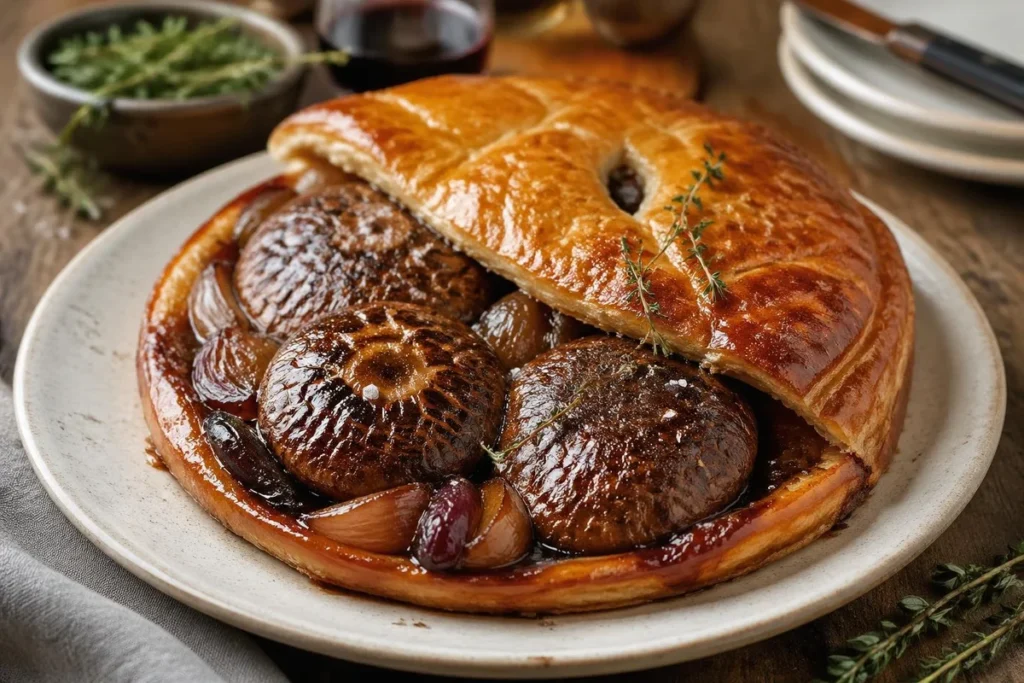
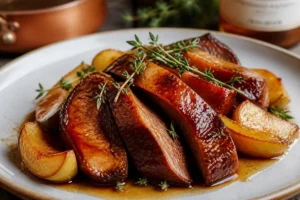
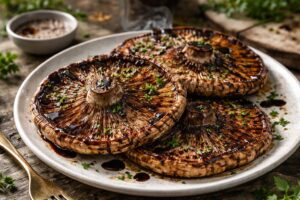
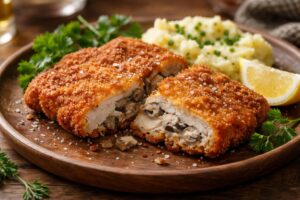
An advanced technical study in "Inverted Thermal Caramelization," utilizing the Parasol mushroom's flat architecture as a biological substitute for fruit, glazed in a glucose-lipid matrix and stabilized by the mechanical pressure of a pastry lid.
Parasol Mushroom “Tarte Tatin” with Caramelized Shallots and Balsamic Reduction
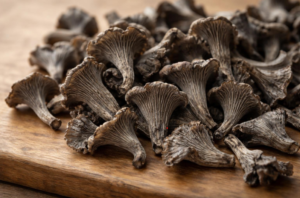
For our eightieth technical formulation, we analyze Inverted Pressure Cooking. Macrolepiota procera (Parasol Mushroom), referred to as Macrolepiota procera in the Bulgarian wild, possesses a structural density that allows it to withstand the intense caramelization typically reserved for apples. At pure-umami.cc, we utilize the "Tatin" method. By cooking the mushrooms in a butter-sugar-acid base before covering them with pastry, we force the fungal tissues to absorb the caramel through Hydrostatic Compression, resulting in a savory-sweet depth that highlights the mushroom's natural almond-esters.
The Culinary Physics of This Dish
The engineering of this Tatin relies on The Maillard Reaction and Hygroscopic Sugar Migration. Molecularly, the sucrose in the caramel acts as a humectant, pulling moisture out of the Macrolepiota procera while replacing it with complex carbonized sugars. The balsamic reduction provides an acetic acid spike (pH approx. 3.0), which prevents the umami guanylates from becoming "cloying." When the pastry is applied, it acts as a thermal lid, trapping the steam and ensuring the mushrooms are cooked through Conductive Heat from the caramel and Convective Heat from the trapped vapor.
Terroir Narrative
This formulation is a tribute to the Loire Valley of France, the birthplace of the Tatin sisters' accidental masterpiece. We bridge this orchard heritage with the Balkan deciduous forests. The terroir is expressed through the marriage of the forest's "wild" Macrolepiota procera and the sophisticated, aged complexity of traditional balsamic vinegar. This follows the same technical rigor we apply to our Amanita caesarea (Caesar's mushroom) and Boletus edulis (Porcini), treating the "sweet" format as a structural engineer would treat a load-bearing foundation for complex savory layers.
Quick Info Bar
Caramel Temp
Bake Time
Complexity
Pastry Base
160°C – 170°C
25 mins
Grand Officier
Butter Puff Pastry
Master Recipe (1:10 Rule)
6-8 Large Macrolepiota procera caps (Macrolepiota procera) – kept whole
10-12 Small Shallots (peeled and halved)
50g Unsalted Butter
30g Granulated Sugar (for the savory caramel)
30ml Aged Balsamic Vinegar
1 sheet of All-Butter Puff Pastry
Fresh Thyme and Fleur de Sel
The Technique
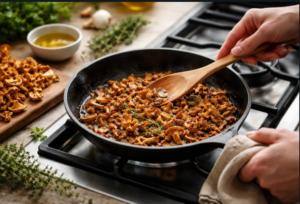
The Savory Caramel Base: Melt the butter and sugar in an oven-proof skillet until it reaches an amber "caramel" state. Add the balsamic vinegar carefully—the thermal shock will create the base of the glaze.
The Laminar Arrangement: Place the shallots in the skillet, cut-side down. Arrange the **Macrolepiota procera** caps on top, gill-side up. Press them down into the caramel. This is the Thermal Loading phase.
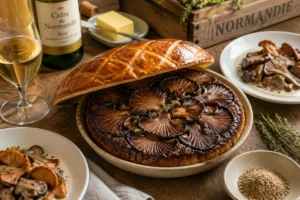
The Pastry Sealing: Cover the mushrooms with the puff pastry, tucking the edges into the skillet. Cut a small vent in the center. The pastry must be cold to ensure maximum pneumatic lift during the bake.
The Inverted Bake: Bake at 200°C for 25 minutes until the pastry is deeply golden. Let the tarte rest for 5 minutes—this allows the caramel to "re-set" and adhere to the mushrooms.
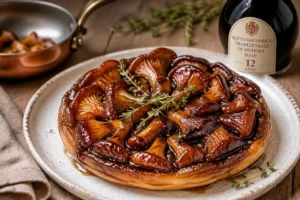
The Reveal: Place a plate over the skillet and flip in one swift motion. The **Macrolepiota procera** will be on top, glistening with a dark, balsamic-caramel glaze. Finish with fresh thyme and Fleur de Sel.
Shop Integration
The Macrolepiota procera provides the essential structural volume for the Tatin, but its flavor can be reinforced. We recommend adding a concentrated infusion of our dried Boletus edulis (Porcini) to the caramel for a "meatier" umami profile. If you seek a brighter peppery contrast, garnish with sautéed Cantharellus cibarius (Chanterelle). For a luxury upgrade, finish the tarte with a few drops of Morchella conica (Morel) oil. If available, a side of raw Amanita caesarea (Caesar's mushroom) with a lemon-thyme vinaigrette will provide a necessary acidic break from the rich, sweet caramel. For an extra earthy baseline, our Marasmius oreades (Fairy Ring) can be sautéed with the shallots for its intense almond-aroma lift.
The Umami Profile
This dish features **Maillard-Synergistic Umami**. The Macrolepiota procera provides the necessary fungal guanylates, which are amplified by the high-temperature caramelization process. The shallots introduce sulfur-based umami compounds, and the balsamic reduction provides the organic acids that brighten the entire savory signal. The result is a savory experience that transitions from a sweet, crunchy exterior to a succulent, earthy interior.
Sommelier’s Choice
A glass of **Off-dry Vouvray (Chenin Blanc)** or a light-bodied **Red Burgundy (Pinot Noir)**. The slight residual sugar and high acidity of the Vouvray match the Tatin's caramel, while the Pinot Noir's forest-floor notes harmonize with the Parasol mushroom.
The Etymological Chronicle
The term Tarte Tatin is **French**, named after the Tatin sisters of Lamotte-Beuvron. In **Italian**, this would be a Torta Tatin di Mazza di Tamburo. In **German**, it is Parasolpilz-Tarte-Tatin. In **Spanish**, it is Tarta Tatin de Galamperna. Regardless of the language, the Parasol mushroom Tarte Tatin remains the definitive standard for technical savory-sweet mycological pastry.
Pure Umami | Mycological Research & Culinary Arts | 2026
To provide the best experiences, we use technologies like cookies to store and/or access device information. Consenting to these technologies will allow us to process data such as browsing behavior or unique IDs on this site. Not consenting or withdrawing consent, may adversely affect certain features and functions.
Functional
Always active
The technical storage or access is strictly necessary for the legitimate purpose of enabling the use of a specific service explicitly requested by the subscriber or user, or for the sole purpose of carrying out the transmission of a communication over an electronic communications network.
Preferences
The technical storage or access is necessary for the legitimate purpose of storing preferences that are not requested by the subscriber or user.
Statistics
The technical storage or access that is used exclusively for statistical purposes.The technical storage or access that is used exclusively for anonymous statistical purposes. Without a subpoena, voluntary compliance on the part of your Internet Service Provider, or additional records from a third party, information stored or retrieved for this purpose alone cannot usually be used to identify you.
Marketing
The technical storage or access is required to create user profiles to send advertising, or to track the user on a website or across several websites for similar marketing purposes.