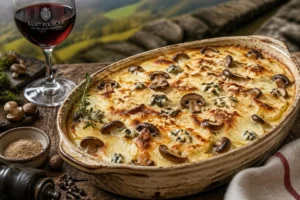
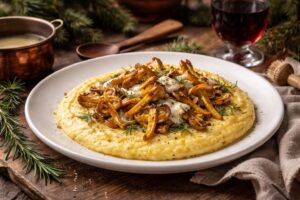
A technical study in Enzymatic-Lipid Synergy, utilizing the proteolytic enzymes of "bloomy-rind" blue mold to accelerate the savory perception of the Golden Chanterelle on a high-hydration charred dough.
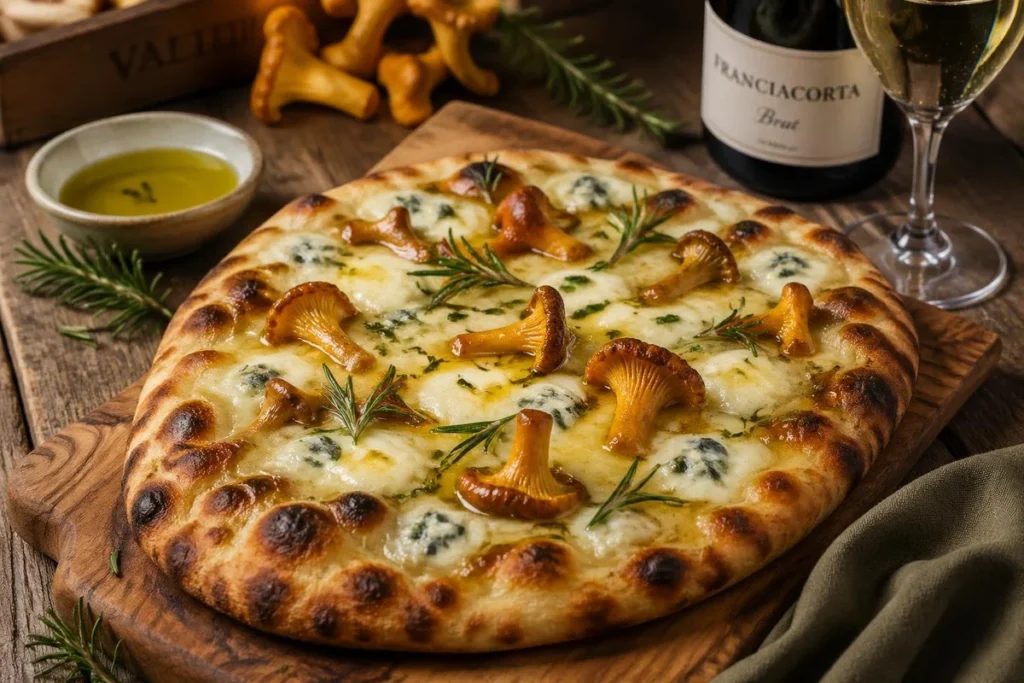
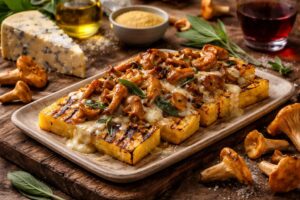
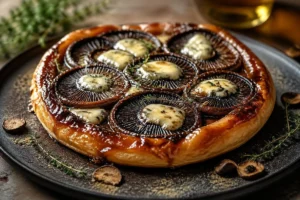
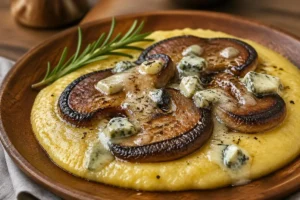
Gorgonzola Dolce & Chanterelle Flatbread
For our thirty-ninth technical formulation, we address the **aromatic overlap** between blue-veined cheese and forest fungi. Cantharellus cibarius (Golden Chanterelle) and Gorgonzola Dolce share specific ketones that, when heated, create a unified "earth-and-cream" profile. The challenge lies in the high water content of the Cantharellus cibarius; by utilizing a high-temperature stone bake (300°C+), we flash-evaporate the mushroom's moisture while simultaneously caramelizing the sugars in the dough. At pure-umami.cc, we view this flatbread as a masterclass in thermal timing—achieving a charred, leopard-spotted crust and a succulent, fungal-infused topping.
The Culinary Physics of This Dish
The engineering of this flatbread relies on Conductive Heat Transfer. A preheated baking stone acts as a thermal battery, transferring energy directly to the high-hydration dough (70% water). This causes an instantaneous expansion of gases, creating a light, aerated structure. Molecularly, the Gorgonzola Dolce (the younger, sweeter variant) melts at a lower temperature than Gorgonzola Piccante, allowing it to form a lipid-emulsion with the chanterelle juices before the mushroom tissue can desiccate. The result is a savory "liquid-gold" glaze that coats every ridge of the Cantharellus cibarius.
Terroir Narrative
This formulation is a tribute to the Lombardy region of Northern Italy, where the fog-heavy plains (home to Gorgonzola) meet the Alpine foothills where our chanterelles are harvested. The terroir is expressed through the contrast of creamy, fermented dairy and the sharp, peppery forest fungi. This mirrors the same technical rigor we apply to our Boletus edulis and Amanita caesarea preparations, ensuring that the heavy fats of the cheese serve to highlight, rather than hide, the mushroom's delicate apricot esters.
Quick Info Bar
Bake Temp
Bake Time
Complexity
Region
300°C+
4-6 mins
Grand Officier
Lombardy, IT
Master Recipe (1:10 Rule)
Technical ratios for the high-temp flatbread:
250g High-hydration sourdough or yeast dough (70% hydration)
50g Mozzarella di Bufala (for structural elasticity)
1 sprig Fresh Rosemary (finely minced)
20ml Extra Virgin Olive Oil
Honey (for the final "sweet-umami" finish)
The Technique
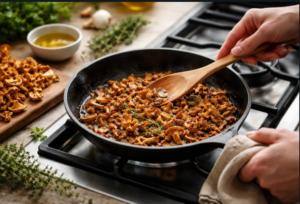
The Fungal Priming: Toss the raw **Cantharellus cibarius** in a bowl with a small amount of olive oil and the minced rosemary. Do not salt yet; salt induces water release, which we want to happen only inside the oven.
The Dough Foundation: Stretch the dough into a thin oval. Do not use a rolling pin; you want to preserve the internal gas bubbles.
The Cheese Layering: Place small dollops of Gorgonzola and shredded mozzarella on the dough. Leave ample space for the mushrooms.
The Thermal Shock: Place the chanterelles on top and slide the flatbread onto a preheated 300°C stone. Bake until the edges are charred and the mushrooms are slightly wilted but still "snappy."
The Gloss Finish: Immediately upon removal, drizzle with a tiny amount of honey. The sugar will interact with the blue cheese and chanterelle esters to create a tertiary flavor dimension. Serve instantly.
Shop Integration
The structural resilience of our **Cantharellus cibarius** is what allows it to withstand the 300°C flash-bake without turning to mush. For a more intense, "musky" profile, we recommend adding 15% **Craterellus cinereus** (Grey Chanterelle). If you seek a nutty baseline, our **Marasmius oreades** provides a spectacular aromatic lift when scattered over the cheese. For an elite presentation, finish with a few thin shavings of raw **Amanita caesarea** (Caesar's mushroom). Avoid using **Morchella conica** (Morel) in this high-heat format, as their delicate lattices can burn before the cheese is fully emulsified.
The Umami Profile
This dish features **Proteolytic Umami**. The enzymes in the Gorgonzola break down the mushroom's proteins during the brief bake, releasing free amino acids. The combination of the sweet, funky cheese and the peppery, fruit-driven **Cantharellus cibarius** creates a flavor profile that is both rustic and scientifically balanced.
Sommelier’s Choice
A glass of **Franciacorta** or a sweet **Passito di Pantelleria**. The bubbles of Franciacorta cut through the rich Gorgonzola, while the apricot notes of a Passito mirror the natural esters of the chanterelles.
The Etymological Chronicle
The term Gorgonzola is named after the **Italian** town where the cheese originated. In **French**, this would be a Fougasse aux Chanterelles et Bleu. In **German**, it is Pfifferlings-Fladenbrot mit Gorgonzola. Regardless of the language, the **Chanterelle** and blue cheese flatbread is the global standard for high-temp fungal cookery.
Pure Umami | Mycological Research & Culinary Arts | 2026
To provide the best experiences, we use technologies like cookies to store and/or access device information. Consenting to these technologies will allow us to process data such as browsing behavior or unique IDs on this site. Not consenting or withdrawing consent, may adversely affect certain features and functions.
Functional
Always active
The technical storage or access is strictly necessary for the legitimate purpose of enabling the use of a specific service explicitly requested by the subscriber or user, or for the sole purpose of carrying out the transmission of a communication over an electronic communications network.
Preferences
The technical storage or access is necessary for the legitimate purpose of storing preferences that are not requested by the subscriber or user.
Statistics
The technical storage or access that is used exclusively for statistical purposes.The technical storage or access that is used exclusively for anonymous statistical purposes. Without a subpoena, voluntary compliance on the part of your Internet Service Provider, or additional records from a third party, information stored or retrieved for this purpose alone cannot usually be used to identify you.
Marketing
The technical storage or access is required to create user profiles to send advertising, or to track the user on a website or across several websites for similar marketing purposes.