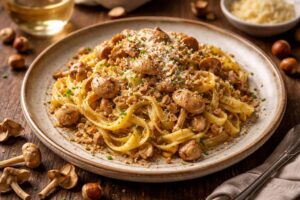
This gourmet morel mushroom cream sauce is the ultimate expression of spring luxury. Learn the professional 1:10 ratio and elite French rehydration techniques.
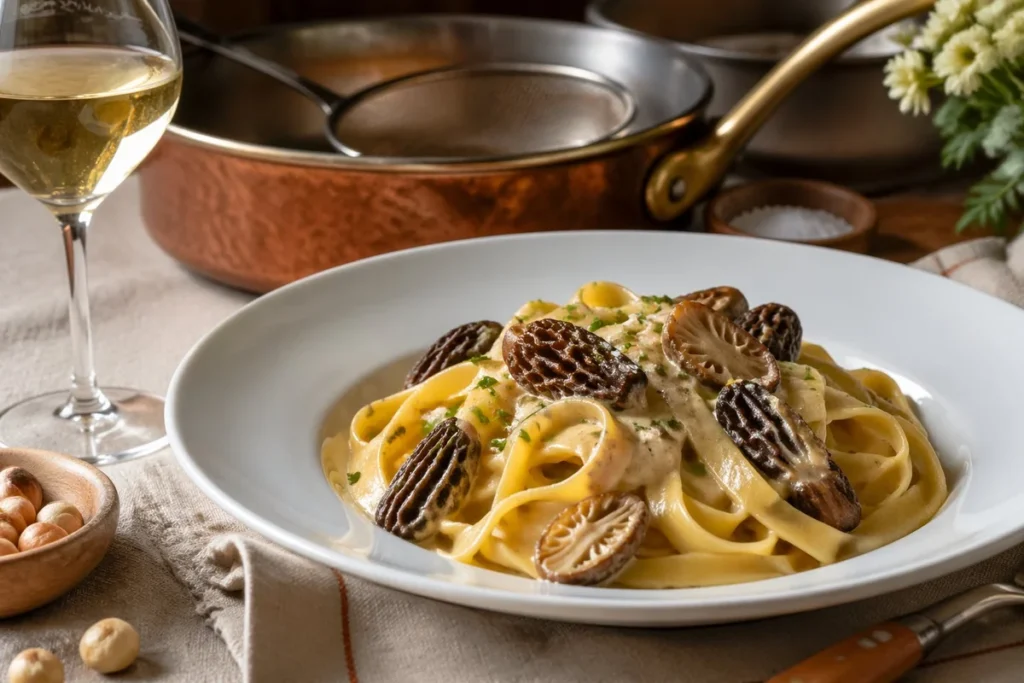
Morel Mushroom Cream Sauce Tagliatelle
The "Spring Solstice" Gourmet Masterpiece of the French Alps
Why This Recipe Works
The success of a truly gourmet morel mushroom cream sauce lies in the architectural harmony between the mushroom's honeycomb structure and the viscosity of the lipid emulsion. Morels are unique in the mycological world; their hollow caps act as natural flavor traps. When paired with high-fat French butter and cultured cream, the mushroom's fat-soluble volatiles—specifically those reminiscent of toasted hazelnuts and damp earth—are captured and held against the palate.
This recipe utilizes the 1:10 dry weight ratio to ensure consistent umami density. By integrating the rehydration liquid, often called "Forest Nectar," directly into the reduction, we preserve the water-soluble glutamates that are often lost in amateur preparations. This ensures that every ribbon of tagliatelle is coated in a sauce that is not merely a topping, but a concentrated biological essence of the spring forest. Whether you are using fresh finds or our premium dried morels, the result is a silken, high-prestige dish that satisfies the deepest umami cravings.
The Historical Prelude
The Morel Mushroom (Morchella esculenta) has long been regarded as the "Terrestrial Pearl" of Western European gastronomy. Historically, in the courts of François I and the hunting lodges of the French Alps, the appearance of the first morels signaled the end of winter's austerity and the dawn of the culinary new year. While the commoners looked to the fields for sustenance, the nobility sent foragers into the deep, ash-rich soils of the Savoie and the Dolomites to locate these elusive, honeycomb-capped treasures.
By the time of Auguste Escoffier, the morel had achieved "Imperial" status. It was the preferred mushroom for the legendary Cuisine Classique because it possessed a structural integrity that survived long, buttery reductions. In the 19th-century elite kitchens of Paris, the morel was often paired with young asparagus and spring lamb, but it was the Milles d'Or (The Golden Honeycombs) served with hand-cut pasta that became the definitive solstice feast.
This dish represents the Bourbon tradition of "Noble Simplicity." It rejects the heavy spices of the medieval era in favor of the "Pure Essence" of the product. Historically, morels were prized not just for their flavor, but for their rarity. They are the only mushrooms that refused to be tamed by the gardeners of Versailles, remaining a wild, untamed gift of the spring melt. To cook a morel is to engage with a lineage of chefs who understood that the greatest flavors are those that cannot be manufactured—only discovered and refined through technical excellence.
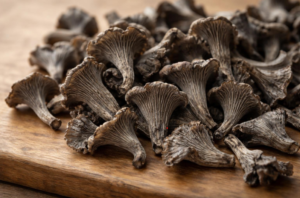
Select 300g fresh morels (or 30g dried/rehydrated). If using dried morels, submerge them in 200ml of warm spring water (40°C) for 30 minutes.
Filter the soaking liquid through a Chinois or coffee filter. Reserve this "Forest Nectar"—it is the molecular backbone of the sauce.
Slice large morels in half; leave smaller buttons whole to maintain their honeycomb aesthetic.
Stage 2: The Saucier’s Reduction
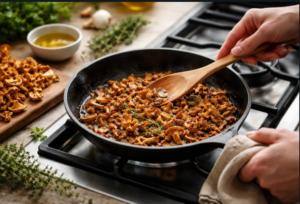
In a heavy copper pan, melt 40g of Beurre d'Isigny or high-fat cultured butter. Sauté 2 finely minced shallots until translucent.
Add the morels and sear for 5 minutes until they begin to release their nutty aroma.
Deglaze the pan with 60ml of dry Chablis. Once the alcohol has evaporated, add the reserved rehydration liquid (or 100ml of light chicken stock for fresh mushrooms).
Reduce by half over medium heat, concentrating the guanylates.
Stage 3: The Lipid Emulsion
Stir in 150ml of Crème Fraîche or double cream. Whisk gently until the sauce reaches a "Nappe" consistency (coats the back of a spoon).
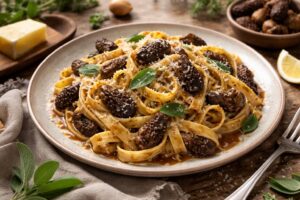
Boil 400g of fresh egg Tagliatelle until al dente. Transfer the pasta directly into the sauce using tongs.
Toss for 60 seconds, allowing the morels to "nest" within the pasta ribbons.
Finish with fresh chives and a whisper of Fleur de Sel.
Sensory & Foraging Profile
Latin Nomenclature:Morchella esculenta / conica.
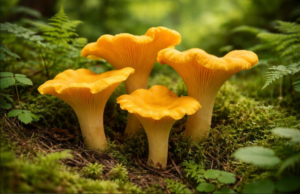
Terroir: The most prestigious morels are found in the limestone-rich soils of the Pyrenees and the Jura Mountains. They thrive in "Disturbed" soils, often appearing where a forest fire has occurred or where old apple orchards remain.
Leave No Trace Protocol: In accordance with French Mycological Ethics, always use a mesh bag to allow spores to disperse as you forage. Never rake the forest floor; surgically cut the stem at the base to protect the mycelial network for the following spring. Select only firm, dark-structured caps.
The Umami Secret: The 1:10 Honeycomb Capture
The "Incredible Umami" of the morel is achieved through Nucleotide Amplification. Morels are naturally high in inosinates. By utilizing the 1:10 rule (30g dried providing the same savory volume as 300g fresh), you ensure the aromatic density is high enough to survive the addition of cream. The lipids in the Crème Fraîche act as a "flavor cage," trapping the mushroom's smoky, nutty volatiles inside the honeycomb cells. This results in a savory frequency that is physically felt as a "velvet" coating on the palate.
Essential Equipment
Copper Sauté Pan: Essential for the precise thermal regulation required to reduce the "Forest Nectar" without scorching the cream.
Professional Chinois: For filtering the rehydration liquid, ensuring zero forest grit remains in the silk-like sauce.
Pasta Tongs: To achieve the "Aeration" required when emulsifying the pasta starch with the morel cream.
The Art of Pairing
Sommelier's Choice: A Vin Jaune from the Jura or a structured Chardonnay from the Côte de Beaune. The wine's oxidative and nutty notes are structural mirrors to the morel's earthy profile.
Non-Alcoholic: A cold-brewed White Tea with a whisper of toasted honey.
Storage & Reheating
Morel sauce must be consumed immediately to maintain the "Spring Solstice" luminosity. If necessary, reheat gently in a double-boiler with a splash of milk. Never boil, as the high heat will cause the cream to split and the delicate morel volatiles to dissipate permanently.
Ancestral Nutrition
Morels are a premier source of Vitamin D and Iron. Historically, in the mountain villages of the French Alps, morel soup was served to the convalescent to provide the metabolic energy and "Spiritual Clarity" required to transition from the lethargy of winter to the activity of spring.
Micro-FAQ
Q: Why do I need to rehydrate dried morels for 30 minutes? A: This timeframe allows the cellular structure to fully expand, ensuring the mushroom can once again act as a sponge for the cream sauce.
Q: Can I use morel oil instead of fresh mushrooms? A: For a professional result, only the whole mushroom provides the correct structural honeycomb mouthfeel and authentic "Forest Nectar."
Q: Is the 1:10 rule mandatory? A: Yes. 30g of dried morels provides the same savory volume as 300g of fresh, ensuring the "Incredible" depth of flavor is achieved.
The Morel Lexicon: Regional Names for Morchella
The Morel is the undisputed queen of the spring forest. Its honeycomb structure and deep earthy aroma have earned it legendary status in cuisines from the Himalayas to the Appalachian Mountains:
Language
Regional & Folk Names
Cultural Context
English
Morel, Yellow Morel, Sponge Mushroom, Dryland Fish
"Dryland fish" is a popular folk name in the American South.
French
Morille, Morille blonde, Morille ronde
A staple of classic French haute cuisine.
German
Speisemorchel, Rund-Morchel
Highly valued in Alpine culinary traditions.
Bulgarian
Смърчкула, Пумпалка, Корминка, Мрежовка
"Pumpalka" refers to its spinning-top shape.
Romanian
Zbârciog, Ciuciulete, Попеască
"Zbârciog" is the most common term in Romanian folklore.
Russian / Polish
Сморчок (Smorchok) / Smardz jadalny
Considered a sign of the real spring's arrival.
Italian / Spanish
Spugnola / Colmenilla, Morilla
"Spugnola" (Italy) and "Colmenilla" (Spain) refer to the sponge/honeycomb look.
Turkish
Kuzu Göbeği Mantarı
Literally "Lamb's Belly" mushroom, a gourmet export of Turkey.
Japanese / Chinese
Amigasa-take (アミガサタケ) / Yangdujun
In China, it is highly valued for its medicinal properties.
Nordic (SE/NO/DK)
Toppmurkla / Rund morkel
A highly anticipated spring find in Scandinavia.
Scientific identification: Genus: Morchella | Pure Umami Research 2026
To provide the best experiences, we use technologies like cookies to store and/or access device information. Consenting to these technologies will allow us to process data such as browsing behavior or unique IDs on this site. Not consenting or withdrawing consent, may adversely affect certain features and functions.
Functional
Always active
The technical storage or access is strictly necessary for the legitimate purpose of enabling the use of a specific service explicitly requested by the subscriber or user, or for the sole purpose of carrying out the transmission of a communication over an electronic communications network.
Preferences
The technical storage or access is necessary for the legitimate purpose of storing preferences that are not requested by the subscriber or user.
Statistics
The technical storage or access that is used exclusively for statistical purposes.The technical storage or access that is used exclusively for anonymous statistical purposes. Without a subpoena, voluntary compliance on the part of your Internet Service Provider, or additional records from a third party, information stored or retrieved for this purpose alone cannot usually be used to identify you.
Marketing
The technical storage or access is required to create user profiles to send advertising, or to track the user on a website or across several websites for similar marketing purposes.