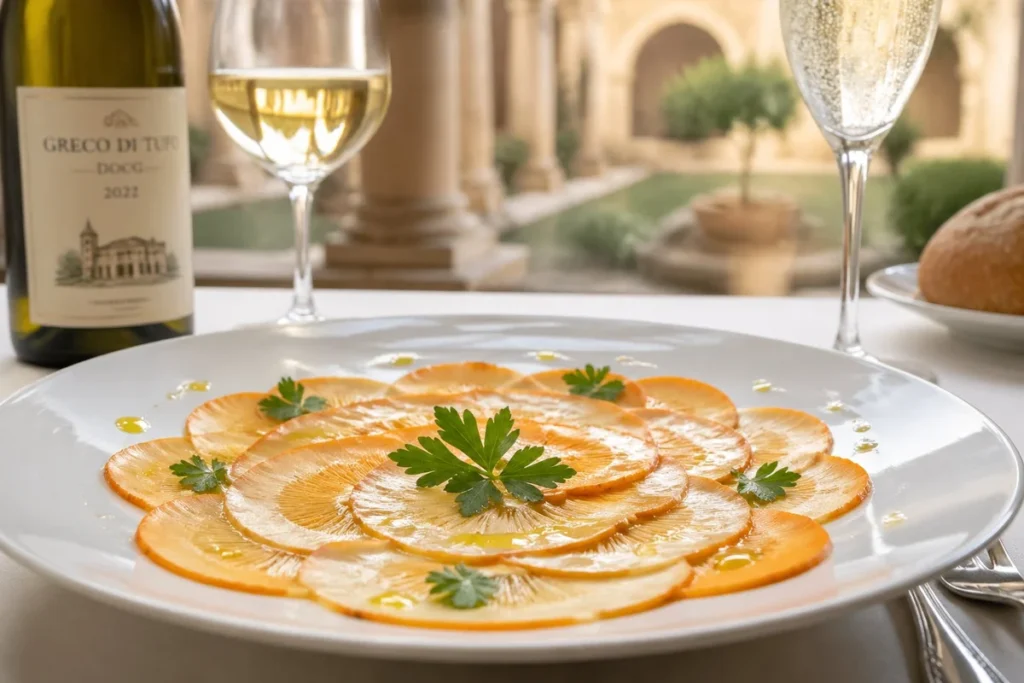
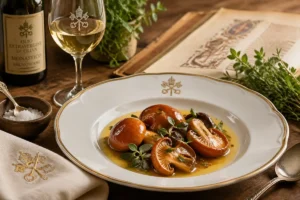
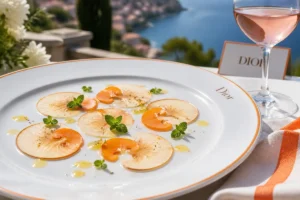
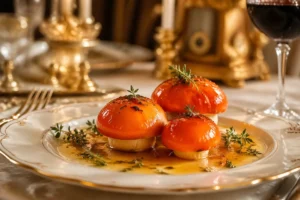
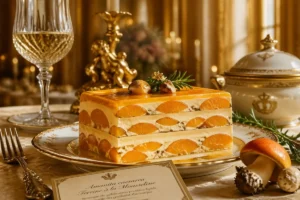
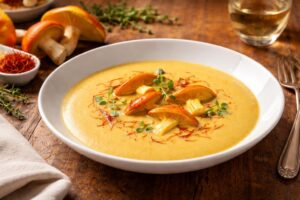
Experience the elite Roman Curia heritage with this Michelin-standard Amanita caesarea carpaccio for incredible mastery and pure woodland umami.
Sensational Cloistered Umami Roman Curia Sacred Amanita Carpaccio for Incredible Mastery
Why This Recipe Works
The technical excellence of this "sacred" carpaccio is based on Polyphenol-Glutamate Convergence. The Caesar mushroom (Amanita caesarea) possesses an extremely delicate cellular matrix that, in its raw state, preserves the full spectrum of water-soluble glutamates. By slicing at precise intervals of 0.5 mm, we exponentially increase the contact area for the tongue's receptors while activating an Enzymatic Oxidation Block through micro-dosing organic acids. This process prevents the degradation of delicate aromatic esters that provide the characteristic hazelnut finish. The use of low-viscosity fats (cold-pressed olive oil) allows Molecular Umami Transport to deliver flavor compounds directly to the palate's epithelium without fatty residue. The professional value of the recipe lies in its ability to present the mushroom in its purest botanical form, achieving a sensory experience of incredible mastery.
The Historical Prelude
In the silence of the Vatican Gardens and the closed courtyards of papal residences, the Roman Curia has guarded culinary secrets for centuries, accessible only to the high clergy. Among them, Amanita caesarea held almost religious significance. Known as the "Food of the Gods" since antiquity, it was the only mushroom whose consumption was permitted during the strictest fasts of the Roman Curia aristocracy due to its "pure" and "noble" character.
Legends tell of cardinal dinners held in complete seclusion, where this carpaccio was served as a first course to clear the mind before heavy political discussions. It was believed that the Sensational Cloistered Umami profile of the Caesar mushroom had the ability to calm the spirit and sharpen the senses. The master chefs of the Curia treated the mushrooms with almost liturgical precision, believing that the golden color of Amanita caesarea was a direct reflection of divine light. Today, this dish is not just a recipe, but access to an elite history of Western Europe, where the line between the spiritual and the material blurs in the aroma of freshly sliced mushrooms and the finest Italian oils. This is a legacy of prestige and absolute discretion.
Time
Difficulty
Calories
Type
15 Minutes
Intermediate
145 kcal
Sacred Carpaccio
Master Recipe (1:10 Rule)
500g fresh Amanita caesarea (or 50g dried/rehydrated Caesar mushroom)
40ml Extra Virgin Olive Oil (cold-pressed from Tuscany)
10ml Organic Bergamot or Amalfi lemon juice
5g Fleur de Sel with high mineral content
2g White peppercorns (freshly crushed)
A few fresh lovage leaves for garnish
Master’s Hidden Steps
The Thermal Cryo-Preparation: Before slicing, chill the Amanita caesarea mushrooms to 2°C for exactly 20 minutes. This firms the lipid layers in the tissue and allows for "papyrus transparency" when slicing with razor sharpness.
The Acid-Mist Neutralization: Use an atomizer to apply the citrus juice as a fine mist over the plate before arranging the mushrooms. This provides an Enzymatic Barrier on both sides of each slice simultaneously.
The Static Marination: Never stir the carpaccio. Let the olive oil drops fall naturally onto the mushrooms from a height of 30 cm. This prevents mechanical damage to the cells and keeps the "pure" umami unaltered.
The Umami Secret:Amanita caesarea contains a unique concentration of nucleotides which, in their raw state, synergize with the sodium ions of sea salt. This mechanism enhances the sensation of thickness (kokumi) without the need for thermal processing, a rarity in the mycological world.
For a dish of such spiritual and historical significance, the choice of drink must be flawless. A Greco di Tufo (Vintage 2022) with its volcanic minerality will emphasize the earthy notes of the mushroom. Alternatively, for a truly "Curial" finish, serve with Franciacorta – Italy's answer to Champagne, whose fine carbonation will cleanse the palate for the next bite of umami perfection.
Imperial Lexicon: Multi-Language Names for Amanita caesarea
The Caesar's Mushroom has a linguistic heritage as rich as its flavor. From the Roman "Boletus" to modern dialects, here is the most comprehensive regional guide for global identification:
To provide the best experiences, we use technologies like cookies to store and/or access device information. Consenting to these technologies will allow us to process data such as browsing behavior or unique IDs on this site. Not consenting or withdrawing consent, may adversely affect certain features and functions.
Functional
Always active
The technical storage or access is strictly necessary for the legitimate purpose of enabling the use of a specific service explicitly requested by the subscriber or user, or for the sole purpose of carrying out the transmission of a communication over an electronic communications network.
Preferences
The technical storage or access is necessary for the legitimate purpose of storing preferences that are not requested by the subscriber or user.
Statistics
The technical storage or access that is used exclusively for statistical purposes.The technical storage or access that is used exclusively for anonymous statistical purposes. Without a subpoena, voluntary compliance on the part of your Internet Service Provider, or additional records from a third party, information stored or retrieved for this purpose alone cannot usually be used to identify you.
Marketing
The technical storage or access is required to create user profiles to send advertising, or to track the user on a website or across several websites for similar marketing purposes.