Description: Master this wild-harvested gourmet recipe. An Amanita caesarea culinary masterpiece featuring a silken texture and umami-rich saffron aromatics.
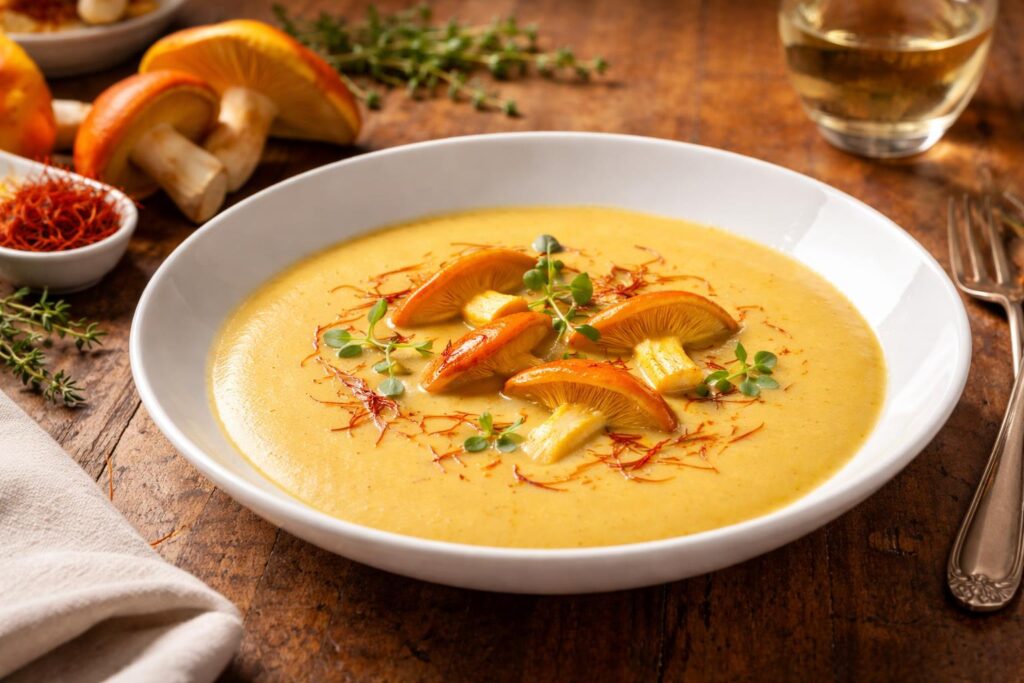
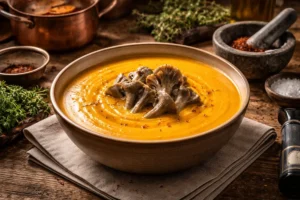
Saffron-Infused Amanita Caesarea Velouté
A Chromatic Convergence of Forest Gold and Desert Stigmas
In the rarefied world of high-end mycological cuisine, color is often as significant as flavor. The Saffron-Infused Amanita Caesarea Velouté is a study in visual and sensory harmony. Historically, Amanita caesarea was nicknamed "The Gold of the Woods" due to its brilliant orange pellicle and yellow gills. By pairing it with Saffron (Crocus sativus), the most expensive spice on Earth, we create a dish that was once reserved for the banquets of the Roman Curia and the Venetian Doges.
This wild-harvested gourmet recipe utilizes the "Velouté" technique—a French "mother sauce" base—to create a texture that is impossibly smooth. The regional spirit of this soup draws from the Balkan and Mediterranean crossroads, where wild-harvested fungi meet the ancient spice routes. It is a culinary masterpiece designed to capture the fugitive aromatics of the Caesar's mushroom, suspending them in a golden, silken matrix that warms the soul and dazzles the eye.
🌲 EXCLUSIVE FOREST HARVEST OFFER 🌲
Elevate your kitchen with the rarest Amanita caesarea, Morels, and Porcini.
Sensory & Foraging Profiles: Carotenoids and Crocin
The Amanita caesarea is uniquely rich in carotenoids, the same organic pigments found in saffron and carrots. This shared chemistry is why the two ingredients blend so seamlessly. During the Mycorrhizal symbiosis with oaks, the mushroom absorbs minerals that lend it a metallic, sweet finish, which perfectly mirrors the iodine and hay notes of high-grade saffron.
Aroma & Chemistry: The microbiology of the dish is centered on safranal—the primary aroma compound in saffron—and the mannitol found in the Caesar. Together, they create a scent profile that is nutty, floral, and deeply earthy. Because Amanita caesarea is less "fungal" and more "floral" than other mushrooms, it does not clash with the spice's delicate nature.
Texture Analysis: The goal of a true velouté is "liquid velvet." By emulsifying the mushrooms with a light stock and a touch of cream, we achieve a high-viscosity liquid that coats the palate, allowing the umami compounds to linger longer than they would in a clear broth.
Saffron Infusion: Place the saffron threads in 2 tablespoons of warm stock. Let them steep for 15 minutes to release their crocin (color) and safranal (aroma).
The Aromatics: Melt butter in a heavy pot. Sauté the leeks until soft and translucent, but do not let them brown.
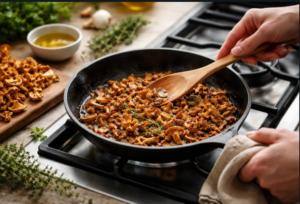
The Mushroom Sauté: Add the Amanita caesarea. Cook for 5-7 minutes until they release their juices and turn soft.
Deglaze: Pour in the white wine and let it reduce by half.
Simmer: Add the stock and the saffron infusion. Simmer gently for 15 minutes.
The Emulsion: Using a high-powered blender, process the soup until perfectly smooth. For a true "Masterpiece" finish, pass it through a chinois (fine-mesh sieve).
The Liaison: Return to the pot, stir in the cream, and heat gently (do not boil). Season with salt and white pepper.
Pro Technique: The “Saffron Bloom”
Saffron is a hydrophobic spice. To unlock its full umami and chromatic potential, you must never add the dry threads directly to the pot. Professional chefs always "bloom" the saffron in a small amount of warm liquid first. This breaks the cellular barrier of the stigma, allowing the color and the picocrocin (flavor) to migrate into the liquid phase, ensuring an even, luminous golden hue throughout the entire wild-harvested velouté.
The Umami Secret: Glutamate-Carotenoid Resonance
The L-glutamates in the Amanita caesarea act as a base layer for the palate. Saffron, while not high in umami itself, contains bitter principles that act as sensory "sharpeners." This sharpens the tongue's ability to perceive the mushroom's savory depth. Furthermore, the fats in the butter and cream act as molecular carriers for the fat-soluble carotenoids, ensuring the flavor profile is perceived as a single, harmonious unit.
The Art of the Pairing
This velouté requires a wine with "floral-honeyed" notes to match the saffron. A Viognier or an Off-dry Chenin Blanc is the sommelier's top choice. For a non-alcoholic pairing, a warm chamomile tea with a drop of orange blossom water echoes the floral aromatics of the Caesar's mushroom and the saffron stigmas.
Ancestral Nutrition
Amanita caesarea is a rare source of B-vitamins and Iron. Saffron is globally recognized for its crocetin content, which has potent antidepressant and neuroprotective properties. Historically, this golden broth was used in medieval herbalism to "cheer the heart" and provide a concentrated burst of bioavailable minerals during the seasonal transition into autumn.
Imperial Lexicon: Multi-Language Names for Amanita caesarea
The Caesar's Mushroom has a linguistic heritage as rich as its flavor. From the Roman "Boletus" to modern dialects, here is the most comprehensive regional guide for global identification:
To provide the best experiences, we use technologies like cookies to store and/or access device information. Consenting to these technologies will allow us to process data such as browsing behavior or unique IDs on this site. Not consenting or withdrawing consent, may adversely affect certain features and functions.
Functional
Always active
The technical storage or access is strictly necessary for the legitimate purpose of enabling the use of a specific service explicitly requested by the subscriber or user, or for the sole purpose of carrying out the transmission of a communication over an electronic communications network.
Preferences
The technical storage or access is necessary for the legitimate purpose of storing preferences that are not requested by the subscriber or user.
Statistics
The technical storage or access that is used exclusively for statistical purposes.The technical storage or access that is used exclusively for anonymous statistical purposes. Without a subpoena, voluntary compliance on the part of your Internet Service Provider, or additional records from a third party, information stored or retrieved for this purpose alone cannot usually be used to identify you.
Marketing
The technical storage or access is required to create user profiles to send advertising, or to track the user on a website or across several websites for similar marketing purposes.