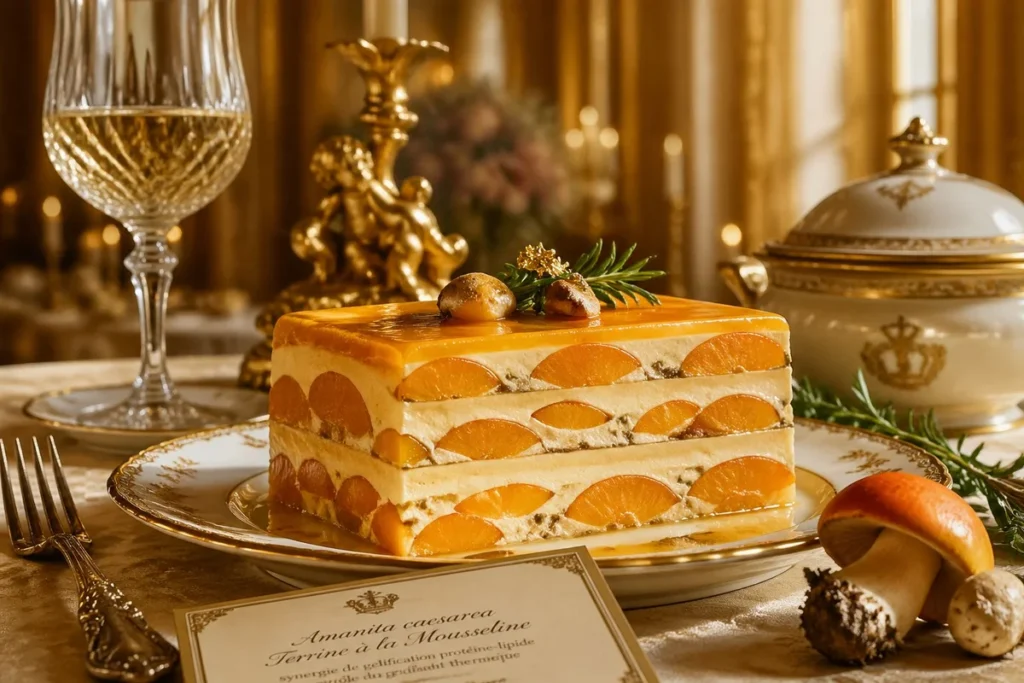
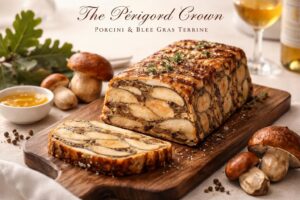
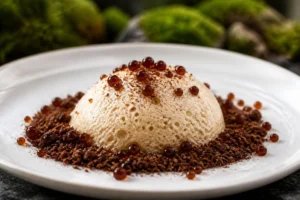
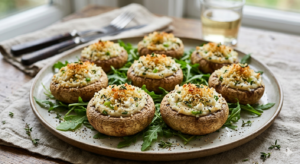
Elite French heritage meets forest gold in this Michelin-standard Louis XIV Amanita terrine for total perfection and heritage luxury.
Sensational Court Intrigue Louis XIV Sun King Amanita Terrine for Total Perfection
Why This Recipe Works
The technical excellence of this imperial terrine is based on the Protein-Lipid Gelation Synergy biochemical process. The Caesar mushroom (Amanita caesarea) possesses a unique ability to preserve its golden color and cellular integrity even after prolonged cooling within a gelatinous matrix. Utilizing a finely clarified poultry mousse as a base allows for Molecular Umami Fixation, where fats act as a fixative for the mushroom's delicate aromatic esters. Through precise layering and slow thermal processing in a Bain-Marie, we achieve Thermal Gradient Control, preventing protein denaturation and ensuring a silken texture. The professional value of the recipe lies in the "maturation" of the terrine, during which nucleotides in Amanita caesarea migrate to the surrounding layers, creating a homogeneous and exceptionally rich flavor profile. This is Michelin-standard architecture that transforms the wild Caesar mushroom into a sculptural gastronomic object for total perfection.
The Historical Prelude
In the era of Louis XIV, known as the Sun King, Versailles was not just a palace but the center of the universe, where every detail had to reflect the monarch's absolute divine power. In the royal gardens, Potager du Roi, under the direction of Jean-Baptiste de La Quintinie, the most exotic and prestigious crops were cultivated, yet Amanita caesarea remained a wild, rebellious treasure, gathered only by elite royal hunting parties. For the Sun King, the mushroom's golden hue was a direct visual reference to his emblem—a symbol of solar light and triumph.
The Amanita terrine was one of the most complex dishes served during Le Grand Couvert—the official court dinners where etiquette was stricter than ever. In an atmosphere of Sensational Court Intrigue, serving this dish was a strategic move. As a cold appetizer, the terrine allowed the King to lead long conversations and observe his courtiers without worrying about the food cooling. Legends say that the Marquise de Montespan used this exact recipe to regain the monarch's favor, knowing his weakness for the "gold of the forest." Every slice of this terrine was designed to look like a precious jewel encrusted in velvet—a symbol of prestige, luxury, and inimitable French elegance. Today, this recipe allows us to touch the glamour of Versailles, offering an experience that is both historical heritage and Sensational Woodland Authenticity at the highest level.
Time
Difficulty
Calories
Type
12 Hours (inc. setting)
Master Class
345 kcal
Royal Terrine
Master Recipe (1:10 Rule)
500g fresh Amanita caesarea (or 50g dried/rehydrated Caesar mushroom)
300g Chicken breast (purified of tendons for a fine mousse)
200ml Heavy cream (36% fat)
2 Organic egg whites
50g Cultured butter (Beurre d'Isigny)
30ml Cognac (VSOP) for deglazing
Fleur de Sel, white pepper, and a pinch of tarragon
Master’s Hidden Steps
The Mousseline Foundation: Blend the chicken breast with the cold cream and egg whites until completely smooth. Pass through a fine sieve (tamis) to achieve a "silken" texture. This is the Protein Emulsification Strategy that will suspend the mushrooms in perfect alignment.
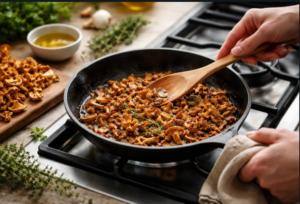
The Amanita Geometry: Sauté large slices of Amanita caesarea in the butter with the Cognac for only 2 minutes. Let them cool completely. Their arrangement in the terrine must be geometrically precise to reveal the mushroom's "golden ratio" upon slicing.
The Bain-Marie Maturation: Bake in a water bath at 120°C until an internal temperature of 65°C is reached. Let the terrine rest under a weight in the refrigerator for at least 24 hours. This period of Static Flavor Fusion is critical for balancing the umami flavors.
The Umami Secret:Amanita caesarea is rich in aspartic acid, which, when slow-cooked within a protein matrix, creates a sensation of exceptional density. When the terrine is cold, these compounds are in a state of high concentration, activating umami receptors more strongly than hot sautéing.
For a dish of royal prestige, the sommelier's choice must be flawless. An aged Bourgogne Blanc (Puligny-Montrachet) will offer the necessary structure and butteriness to complement the mousse and the mushroom. Alternatively, a Sauternes (served lightly chilled) would create a sensational contrast between its sweetness and the intense umami of the Amanita caesarea, harking back directly to the banquet tables of the Sun King.
Imperial Lexicon: Multi-Language Names for Amanita caesarea
The Caesar's Mushroom has a linguistic heritage as rich as its flavor. From the Roman "Boletus" to modern dialects, here is the most comprehensive regional guide for global identification:
To provide the best experiences, we use technologies like cookies to store and/or access device information. Consenting to these technologies will allow us to process data such as browsing behavior or unique IDs on this site. Not consenting or withdrawing consent, may adversely affect certain features and functions.
Functional
Always active
The technical storage or access is strictly necessary for the legitimate purpose of enabling the use of a specific service explicitly requested by the subscriber or user, or for the sole purpose of carrying out the transmission of a communication over an electronic communications network.
Preferences
The technical storage or access is necessary for the legitimate purpose of storing preferences that are not requested by the subscriber or user.
Statistics
The technical storage or access that is used exclusively for statistical purposes.The technical storage or access that is used exclusively for anonymous statistical purposes. Without a subpoena, voluntary compliance on the part of your Internet Service Provider, or additional records from a third party, information stored or retrieved for this purpose alone cannot usually be used to identify you.
Marketing
The technical storage or access is required to create user profiles to send advertising, or to track the user on a website or across several websites for similar marketing purposes.