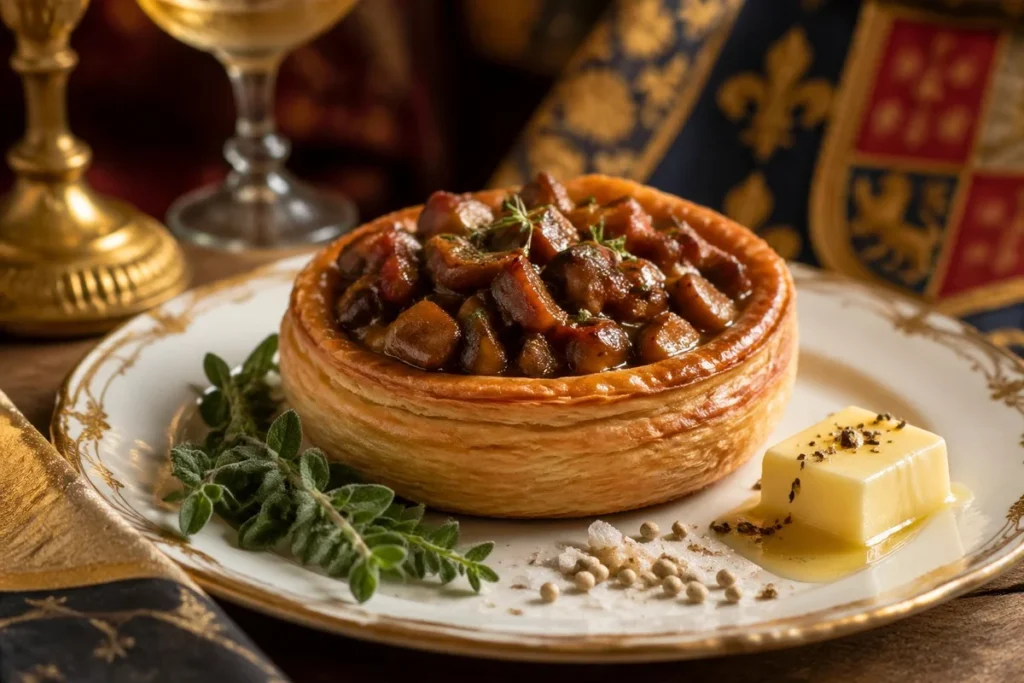
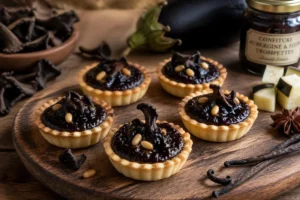
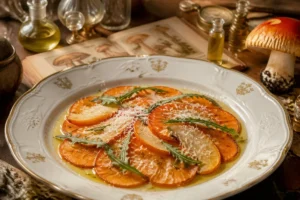
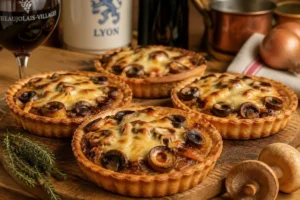
Elite Valois heritage meets forest gold in this Michelin-standard Catherine de Medici Amanita tartlet for incredible mastery and umami.
Sensational Court Intrigue Catherine de Medici Florentine Amanita Tartlet for Incredible Mastery
Why This Recipe Works
The technical excellence of these Florentine tartlets is based on the precise Lipid-Barrier Starch Integration process. The Caesar mushroom (Amanita caesarea) possesses an uniquely high content of volatile aromatic esters, which oxidize upon direct contact with air during baking. By utilizing a Micro-Layered Shortcrust Strategy, we create a protective "shell" that encapsulates the mushroom's moisture and umami compounds. Here we also apply Molecular Flavor Sealing through a preliminary sauté in cultured butter, which forms a lipid film around every cell of the Amanita caesarea. The professional value of the recipe lies in the balance between the crispy texture of the shortcrust pastry and the velvety core of the mushroom, achieving Michelin-standard precision that was a hallmark of Catherine de Medici's personal chefs. The result is a dish that demonstrates incredible mastery in the management of textures and aromas.
The Historical Prelude
Catherine de Medici, Queen of France and one of the most influential women in history, arrived in Marseille in 1533, bringing with her not only a dowry but the entire culinary brilliance of Renaissance Florence. She is the woman who introduced the fork, refined desserts, and, most importantly, the concept of "haute cuisine" to the French court. In an era of Sensational Court Intrigue, Catherine used food as a tool for diplomacy and power, turning banquets into culinary spectacles.
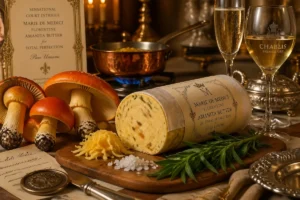
For her, Amanita caesarea was the mycological link to her Italian roots—the "Royal Amanita" that graced the tables of Roman Caesars. Legends tell that Caesar mushroom tartlets were served during secret meetings of her "Flying Squadron," where the arts of seduction and politics met. Catherine insisted the mushrooms be prepared with Florentine precision, combining the Sensational Woodland Authenticity of French forests with the refinement of Italian butter and herbs. Each tartlet was designed to be small, discreet, and explosive in flavor—just like the Queen-Mother herself. Today, this recipe is a monument to the culinary revolution started by the Medicis, offering the modern elite a taste of historical excellence and incredible culinary mastery.
Time
Difficulty
Calories
Type
45 Minutes
Advanced
310 kcal
Renaissance Heritage
Master Recipe (1:10 Rule)
500g fresh Amanita caesarea (or 50g dried/rehydrated Caesar mushroom)
250g Handmade shortcrust pastry (Pâte Brisée)
60g Beurre d'Isigny butter
2 small shallots, minced to molecular fineness
1 sprig of fresh marjoram (Florentine accent)
50ml Heavy cream (minimum 36% fat)
Fleur de Sel and a pinch of white Tellicherry pepper
Master’s Hidden Steps
The Pre-Baking Barrier Mastery: Blind bake the tartlet bases at 180°C for 12 minutes. This is a Starch-Stabilization Strategy, ensuring the pastry remains crispy and acts as an impermeable container for the Amanita caesarea umami juices.
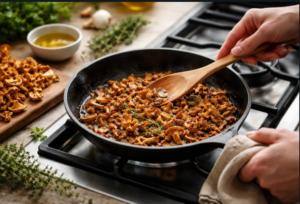
The Slow Sauté Infusion: Sauté the mushrooms with the shallots in butter over minimum heat. Add the cream in the final 30 seconds. This creates an Emulsion Binding Window—the cream should only "coat" the mushrooms without turning the filling liquid, preserving its Sensational Woodland Authenticity.
The Royal Glazing Finish: Fill the tartlets and return them to the oven under the top broiler for 120 seconds. This triggers Instant Caramelization, giving the Caesar mushroom that brilliance worthy of the Valois court.
The Umami Secret: Caesar mushroom possesses a high concentration of L-Glutamate, which, when combined with the buttery proteins in the pastry, activates Lipid-Enhanced Palatability. This is the scientific reason why Catherine de Medici's tartlets were considered "addictive" by her contemporaries.
For a dish with Medici heritage, the sommelier's choice should bridge France and Italy. A Chianti Classico (Vintage 2021) will offer the necessary tannins and acidity to balance the buttery pastry. Alternatively, a Sancerre (Loire Valley) would add mineral freshness and herbal notes to highlight the Sensational Court Intrigue profile of the imperial mushroom.
Imperial Lexicon: Multi-Language Names for Amanita caesarea
The Caesar's Mushroom has a linguistic heritage as rich as its flavor. From the Roman "Boletus" to modern dialects, here is the most comprehensive regional guide for global identification:
To provide the best experiences, we use technologies like cookies to store and/or access device information. Consenting to these technologies will allow us to process data such as browsing behavior or unique IDs on this site. Not consenting or withdrawing consent, may adversely affect certain features and functions.
Functional
Always active
The technical storage or access is strictly necessary for the legitimate purpose of enabling the use of a specific service explicitly requested by the subscriber or user, or for the sole purpose of carrying out the transmission of a communication over an electronic communications network.
Preferences
The technical storage or access is necessary for the legitimate purpose of storing preferences that are not requested by the subscriber or user.
Statistics
The technical storage or access that is used exclusively for statistical purposes.The technical storage or access that is used exclusively for anonymous statistical purposes. Without a subpoena, voluntary compliance on the part of your Internet Service Provider, or additional records from a third party, information stored or retrieved for this purpose alone cannot usually be used to identify you.
Marketing
The technical storage or access is required to create user profiles to send advertising, or to track the user on a website or across several websites for similar marketing purposes.