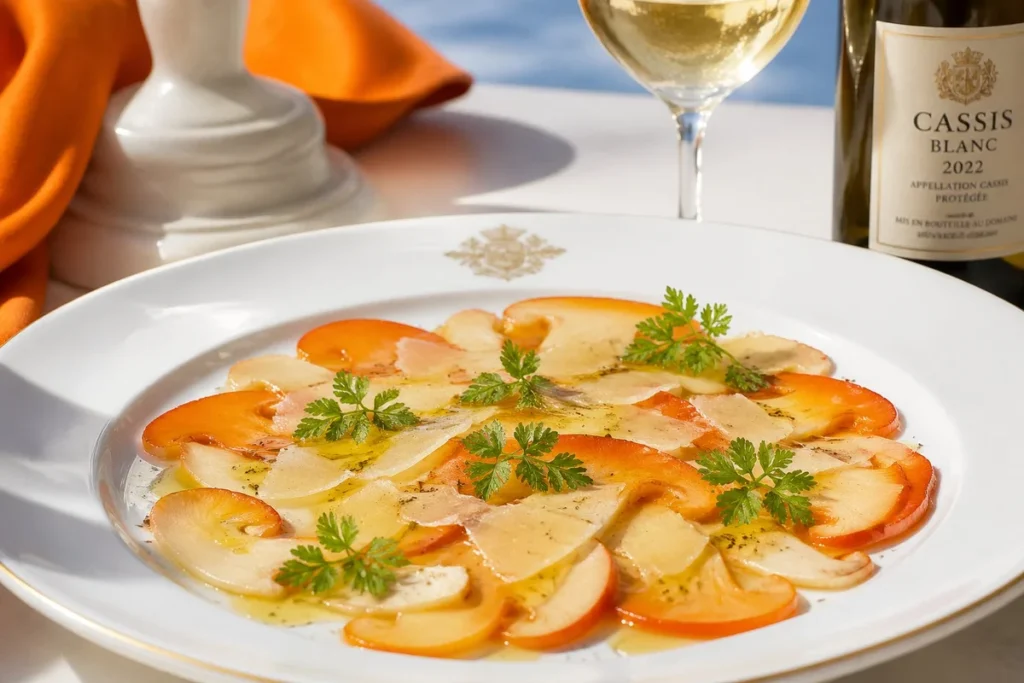
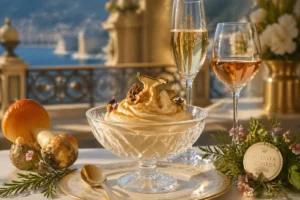
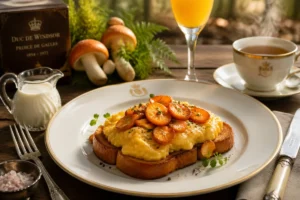
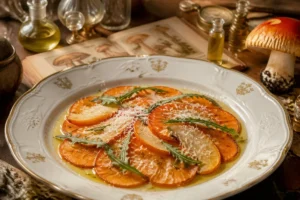
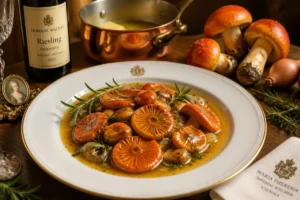
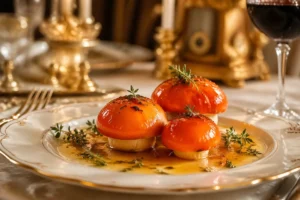
Elite Riviera heritage meets the gold of the forest in this Michelin-standard Amanita caesarea salad inspired by Auguste Escoffier for incredible mastery.
Sensational Woodland Authenticity Auguste Escoffier Riviera Salad with Amanita caesarea for Ultimate Perfection
Why This Recipe Works
The success of this Riviera-inspired masterpiece lies in Lipid-Umami Diffusion Synergy. By binding the delicate, nutty profile of Amanita caesarea with high-quality monounsaturated fats from Provençal olive oil, we create a molecular bridge that carries the mushroom's fat-soluble aromatic compounds directly to the palate. Unlike tougher species, the Caesar mushroom possesses a unique cellular structure that remains crisp yet buttery when thinly sliced. This recipe utilizes an Enzymatic Preservation Technique, where citric acid from lemon zest prevents the oxidation of the mushroom's vivid orange pigments while simultaneously refreshing the heavy glutamate charge. The result is a clean, sophisticated profile that highlights the primal essence of the forest floor, refined through the technical precision of the French Riviera's golden age.
The Historical Prelude
At the end of the 19th century, the "King of Chefs and the Chef of Kings," Auguste Escoffier, revolutionized the kitchens of the Savoy and the Ritz, but it was his time on the French Riviera that truly defined his relationship with seasonal treasures. Amanita caesarea, known since antiquity as the favorite mushroom of Roman emperors, finds its most elegant modern expression under Escoffier's guidance. Legend has it that during a gala evening at the Grand Hôtel in Monte Carlo, Escoffier insisted that the "Royal Amanita" should never be masked with heavy sauces, but rather presented in its "naked" state to honor its botanical nobility.
For the elite travelers of the Belle Époque, this salad represents the pinnacle of Sensational Woodland Authenticity. Escoffier viewed the mushroom not merely as an ingredient, but as a historical artifact connecting the wild forests of the Esterel Massif with the refined tables of European royalty. Applying the principles of Mediterranean simplicity to a mushroom usually reserved for heavy roasts, he created a dish that captures the shimmering light of the Côte d'Azur. This recipe follows his philosophy "Faites simple" (Keep it simple), while demanding the technical discipline required to balance the mushroom's intense umami with the floral notes of the Riviera's finest harvests.
Time
Difficulty
Calories
Type
20 Minutes
Intermediate
185 kcal
Haute Entrée
Master Recipe (1:10 Rule)
500g fresh Amanita caesarea (or 50g dried/rehydrated Caesar mushroom)
100ml Extra virgin olive oil (preferably from Nice or Liguria)
1 organic lemon (zest and 15ml juice)
5g Fleur de sel de Camargue
2g freshly ground white pepper
Small bunch of chervil for garnish
30g Parmigiano-Reggiano shavings (optional, for the "Modern Ritz" variation)
Master’s Hidden Steps
The Carpaccio Precision Slice: Using a ceramic mandoline, slice the Amanita caesarea into 1mm translucent shavings. This maximizes the surface area for Lipid-Umami Diffusion, which occurs instantly upon contact with the dressing.
The Essence Extraction Strategy: Whisk the lemon juice and salt together before adding the olive oil. This ensures the salt dissolves completely, allowing it to penetrate the mushroom's cell walls and "pull" moisture to the surface, intensifying the flavor profile.
The Controlled Maceration: Allow the seasoned mushrooms to rest for exactly 180 seconds before serving. Any less, and the flavors remain separate; any more, and the delicate structure of the Amanita begins to break down, losing its characteristic crunch.
The Umami Secret:Amanita caesarea is a rare biological powerhouse of free glutamates. When combined with the nucleotides found in aged cheeses or even the fine esters in premium olive oil, a synergistic effect occurs that increases the perceived intensity of "savory" nearly eightfold. This is the Pure Umami effect.
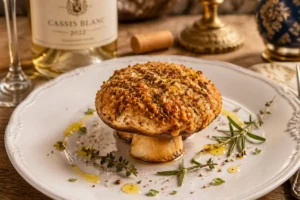
To honor the Riviera heritage, look toward fresh, mineral-rich white wines from the region. A Bellet AOC or Cassis Blanc (Vintage 2022/2023) provides the necessary acidity to cut through the olive oil while complementing the earthy, nutty undertones of the mushrooms. For a more avant-garde pairing, an ultra-dry Vintage Champagne (Extra Brut) offers carbonation that refreshes the palate between dense, umami-rich bites.
Imperial Lexicon: Multi-Language Names for Amanita caesarea
The Caesar's Mushroom has a linguistic heritage as rich as its flavor. From the Roman "Boletus" to modern dialects, here is the most comprehensive regional guide for global identification:
To provide the best experiences, we use technologies like cookies to store and/or access device information. Consenting to these technologies will allow us to process data such as browsing behavior or unique IDs on this site. Not consenting or withdrawing consent, may adversely affect certain features and functions.
Functional
Always active
The technical storage or access is strictly necessary for the legitimate purpose of enabling the use of a specific service explicitly requested by the subscriber or user, or for the sole purpose of carrying out the transmission of a communication over an electronic communications network.
Preferences
The technical storage or access is necessary for the legitimate purpose of storing preferences that are not requested by the subscriber or user.
Statistics
The technical storage or access that is used exclusively for statistical purposes.The technical storage or access that is used exclusively for anonymous statistical purposes. Without a subpoena, voluntary compliance on the part of your Internet Service Provider, or additional records from a third party, information stored or retrieved for this purpose alone cannot usually be used to identify you.
Marketing
The technical storage or access is required to create user profiles to send advertising, or to track the user on a website or across several websites for similar marketing purposes.