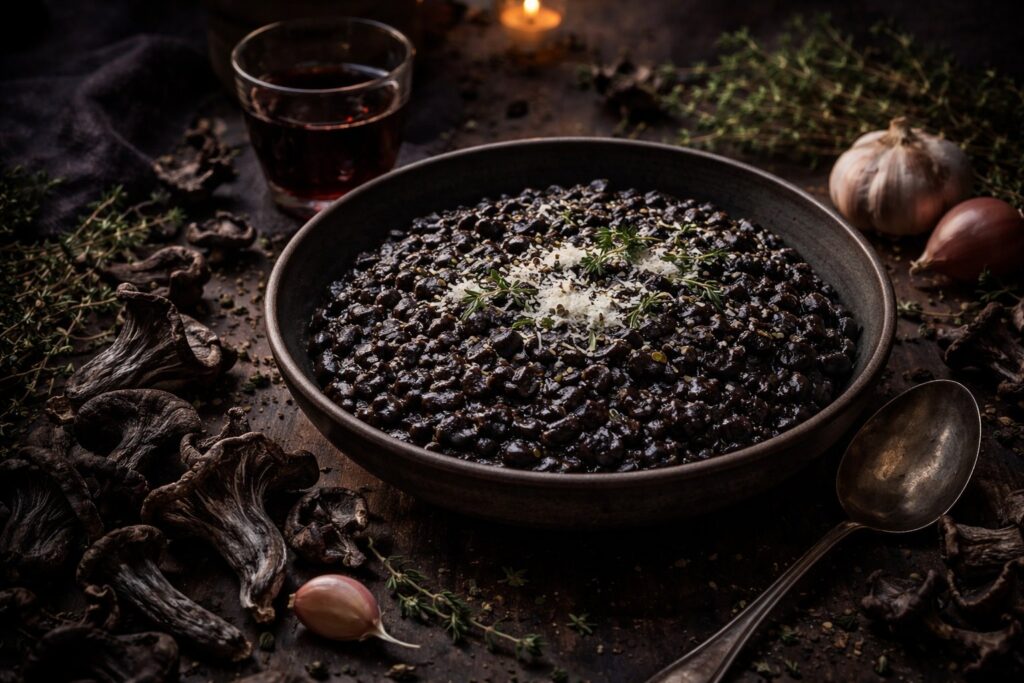
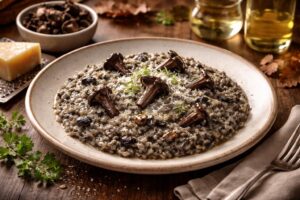
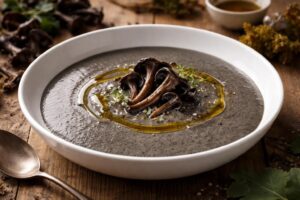
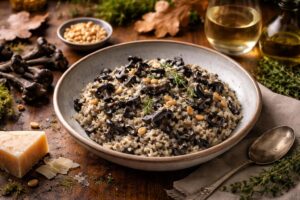
A hauntingly beautiful high umami masterpiece featuring the smoky Craterellus cornucopioides in a silken charcoal emulsion inspired by the dark aesthetics of the Romantic era.
The Truffle of the Night
Craterellus Cornucopioides "Al Nero" with Thyme-Infused Mantecatura and Forest Essence
The Historical Prelude
The Craterellus cornucopioides, known colloquially as the Black Trumpet or "Trompette de la Mort," has long occupied a space between the macabre and the magnificent. Historically, its appearance in the damp shadows of the Black Forest and the Pyrenees was viewed with a mixture of reverence and superstition. In the mid-19th century, the aesthetic of the "dark and sublime" flourished across Europe, finding its literary champion in Edgar Allan Poe.
While Poe's works explored the depths of the human psyche, the culinary world of the French Alps sought to explore the depths of the forest floor. The Black Trumpet became the "Truffle of the Night," prized by avant-garde chefs for its ability to turn a dish into a visual and aromatic shadow. Unlike the vibrant chanterelle, the Trumpet possesses a deep, smoky profile that was historically likened to the scent of ancient libraries and damp earth—a "Gothic" flavor profile that demands technical mastery to tame.
This risotto, prepared Al Nero (in the black style), is a tribute to that Romantic obsession with the dark. By utilizing the mushroom's natural ability to stain a sauce into a deep, obsidian hue, Northern Italian masters created a dish that feels as though it was pulled directly from a moonlight-drenched clearing in a Poe narrative. It is a dish of high drama, where the "deathly" name of the mushroom is contradicted by the sheer, life-affirming intensity of its umami.
Terroir: The most aromatic Trumpets are harvested from the mossy, acidic soils beneath ancient beech and oak trees in the Atlantic Fringes and the Dolomites. These specimens carry a distinct aroma of dried plum and wood-smoke, a result of the specific mycelial symbiosis in these old-growth regions.
Leave No Trace Protocol: Because the Black Trumpet is notoriously difficult to spot among dead leaves, foragers must move with "Surgical Precision." We only harvest clusters that have reached full "trumpet" flare. In accordance with the Pyrenean code, we leave the smaller pins to ensure the autumn harvest continues, never disturbing the deep moss layer that protects the mycelium from the first frosts.
Essential Equipment
Heavy Copper Risottiera: Critical for the uniform starch release required to achieve the "All'Onda" (wavy) texture.
Wooden "Girorisotto" Spoon: To aerate the rice during the mantecatura phase without fracturing the delicate Carnaroli grains.
Fine Mesh Chinois: For straining the mushroom-infused "Nectar" to ensure a grit-free, velvet emulsion.
Master Recipe
Stage 1: The Obsidian Restoration
Select 500g fresh Black Trumpets (or 50g dried/rehydrated).
If using 50g dried (the 1:10 equivalent), rehydrate in 400ml of hot vegetable blonde stock for 30 minutes. Filter the liquid through a coffee filter—this is your "Black Nectar."
Finely mince the rehydrated (or fresh) Trumpets. Sauté in a dry pan until they "squeak," then add 20g of butter to lock in the smoky esters.
Stage 2: The Tostatura
In the risottiera, toast 320g of Aquerello or Carnaroli rice until the grains are hot to the touch.
Deglaze with 100ml of dry Pinot Grigio. Once the alcohol has evaporated, begin adding the "Black Nectar" ladle by ladle.
Stage 3: The Gothic Mantecatura
Continuously stir the rice, allowing it to absorb the dark pigment. Halfway through, add the sautéed 500g fresh Trumpets (or 50g rehydrated).
When the rice is al dente, remove from heat. This is the "Moment of Poe."
Vigorously beat in 60g of ice-cold cultured butter and 80g of 24-month aged Parmigiano Reggiano DOP. Cover and rest for 2 minutes.
Serve on a flat white plate, allowing the obsidian rice to spread naturally like a shadow.
The Umami Secret: The 1:10 Smoke Extraction
The "Pure Umami" of the Black Trumpet is unique because it relies on Lipophilic Nucleotide Bonding. Unlike other mushrooms, the Trumpet's savory guanylates are intensified during the drying process. By utilizing the 1:10 ratio (50g dried to 500g fresh equivalent), you introduce a concentration of smoky volatiles that fresh mushrooms cannot provide. When these molecules hit the fats in the butter during the mantecatura, they form a "Flavor Cage," ensuring the earthy depth is physically bonded to every grain of rice.
Pro Technique: The “Black-Gold” Emulsion
To achieve a 3-star Michelin finish, ensure your "Black Nectar" is as dark as possible. If using fresh Trumpets, blitz a small handful of them with a splash of stock to create a "mushroom ink" and add it during the final stages of cooking. This ensures the risotto is not just grey, but a deep, poetic obsidian that provides the perfect visual backdrop for the gold-hued butter emulsion.
The Art of Pairing
Sommelier's Choice: A Barolo or a Gevrey-Chambertin. These wines carry "sous-bois" (forest floor) notes and tannins that mirror the mushroom's smokiness.
Non-Alcoholic: A cold-brewed Lapsang Souchong tea, providing a sophisticated smoky and tannic counterpoint.
Substitutions & Variations
Luxury Alternative: Finish with a few drops of White Truffle Oil to create a "Light in the Dark" aromatic contrast.
Herb Variant: Use Fresh Marjoram instead of thyme for a more floral, feminine lift to the heavy smoke.
Storage & Reheating
Risotto is best served immediately. If necessary, reheat using the Double-Boiler Method with a splash of fresh stock and a knob of butter to restore the emulsion. Never use a microwave, as it will cause the rice to shatter and the fats to separate.
Ancestral Nutrition
The Craterellus cornucopioides is exceptionally rich in Vitamin B12 and Phosphorus. Historically, in the French Alps, it was known as the "Miner's Mushroom," believed to provide the metabolic energy and iron required for those working in the cold, dark depths of the earth.
Micro-FAQ
Q: Is the name "Trumpet of Death" because it's poisonous? A: No. It is 100% edible and safe. The name refers purely to its dark color and trumpet shape, which was thought to resemble the horns of the underworld.
Q: Why is the 1:10 rule so critical here? A: Because the flavor of the Black Trumpet is extremely concentrated when dry. 50g of dried provides the same umami impact as 500g of fresh, allowing for a more stable risotto texture.
Q: Can I use Arborio rice? A: For this advanced recipe, Carnaroli is preferred as it maintains its structural integrity better during the long agitation required to extract the "black ink."
To provide the best experiences, we use technologies like cookies to store and/or access device information. Consenting to these technologies will allow us to process data such as browsing behavior or unique IDs on this site. Not consenting or withdrawing consent, may adversely affect certain features and functions.
Functional
Always active
The technical storage or access is strictly necessary for the legitimate purpose of enabling the use of a specific service explicitly requested by the subscriber or user, or for the sole purpose of carrying out the transmission of a communication over an electronic communications network.
Preferences
The technical storage or access is necessary for the legitimate purpose of storing preferences that are not requested by the subscriber or user.
Statistics
The technical storage or access that is used exclusively for statistical purposes.The technical storage or access that is used exclusively for anonymous statistical purposes. Without a subpoena, voluntary compliance on the part of your Internet Service Provider, or additional records from a third party, information stored or retrieved for this purpose alone cannot usually be used to identify you.
Marketing
The technical storage or access is required to create user profiles to send advertising, or to track the user on a website or across several websites for similar marketing purposes.