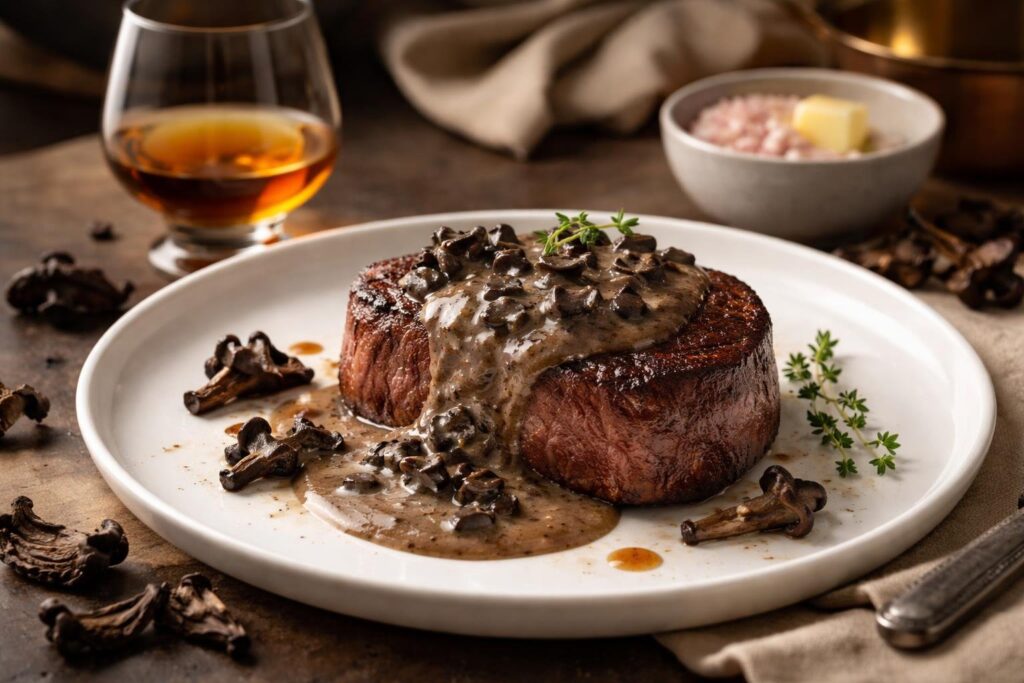
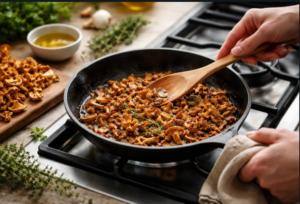
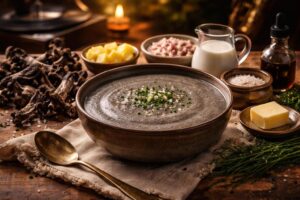
A primal high umami masterpiece pairing the lean elegance of beef with the smoky Craterellus cornucopioides in a silken Cognac reduction.
Jazz Improvisation
Center-Cut Beef Fillet with Black Trumpet "Trompettes" and a Cognac-Lipid Emulsion
The Historical Prelude
The Jazz Improvisation is a culinary tribute to the avant-garde spirit of the early 20th-century Parisian salons, where the rigid rules of Haute Cuisine began to blend with the soulful, improvisational nature of the era's music. Historically, the Craterellus cornucopioides, or Black Trumpet, was the "Rebel's Truffle." While the established aristocracy clung to the white truffle and the porcini, the bohemian circles of Montparnasse and the Atlantic Fringes celebrated the Trumpet for its smoky, eccentric depth.
The pairing of prime beef with these "Ashen Trumpets" was perfected in the kitchens of the French Savoie. It represents a departure from the heavy, flour-thickened sauces of the 19th century toward the Sauce Minute—a high-velocity reduction of alcohol, meat fond, and wild fungi. Historically, this dish was associated with the "Midnight Suppers" of jazz musicians and intellectuals; the dark, brooding color of the mushrooms provided a visual counterpoint to the vibrant, rare center of a perfectly seared fillet.
By the 1950s, the inclusion of Cognac became the "Blue Note" of the recipe. The spirit's oaky tannins act as a molecular bridge, linking the iron-rich minerals of the beef to the smoky, dried-plum volatiles of the Black Trumpet. It is a dish that requires the chef to perform like a soloist: maintaining perfect heat control (the "tempo") while allowing the natural esters of the forest to dictate the melody.
Terroir: The finest "Trumpets of Death" are found in the damp, shaded beech forests of the Pyrenees and the Black Forest. These regions produce a mushroom with a high concentration of benzaldehyde, giving the fungus its characteristic aroma of almonds and wood-smoke.
Leave No Trace Protocol: Because Black Trumpets are masters of camouflage among dead leaves, we utilize "Soft-Step" foraging. We only harvest the mature, flared caps, ensuring the base remains undisturbed. In accordance with the French Forestry Code, we use mesh bags to allow spores to disperse as we move through the terroir.
Essential Equipment
Heavy Stainless Steel Sauté Pan: Essential for creating the *fond* (browned bits) necessary for the sauce.
Digital Meat Thermometer: To ensure the beef reaches a precise 52°C (Medium-Rare).
Fine Mesh Chinois: For straining the mushroom-Cognac reduction into a silken "Silk Sauce."
Master Recipe
Stage 1: The Maillard Foundation
Prepare 2 center-cut beef fillets (200g each). Season heavily with salt.
Sear in a scorching pan with 10ml of grapeseed oil for 3 minutes per side until a dark crust forms. Remove and rest.
Stage 2: The Trumpet Extraction
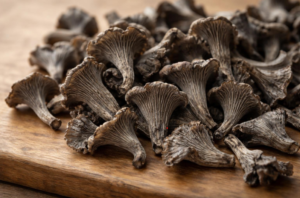
In the same pan, add 300g fresh Black Trumpets (or 30g dried/rehydrated). If using the 1:10 dried equivalent, rehydrate in warm water and reserve the "Black Essence."
Sauté the mushrooms until they release their moisture and begin to "squeak" in the beef *fond*. Add 1 minced shallot and 20g of butter.
Stage 3: The Cognac Silk Reduction
Deglaze with 40ml of Cognac AOC. Ignite carefully (flambé) to burn off the harsh alcohol.
Add 100ml of heavy cream and any reserved "Black Essence." Reduce by 50% until the sauce is thick and obsidian-glossy.
Whisk in 10g of cold butter to "mount" the sauce. Plate the beef, drape with the 300g fresh Trumpets (or 30g rehydrated), and pour the silk sauce over.
The Umami Secret: The 1:10 Nucleotide Synergy
The "Pure Umami" of this dish is achieved through Ribonucleotide Bonding. Beef is rich in inosinates, while Black Trumpets are packed with guanylates. By using the 1:10 rule (30g dried to 300g fresh equivalent), you introduce a concentration of umami that acts as a flavor multiplier. The Cognac serves as a solvent, pulling these savory molecules into the lipid-heavy cream sauce, resulting in a flavor that is physically felt as a "velvet" coating on the tongue.
Pro Technique: The “Resting Emulsion”
To achieve a 3-star Michelin finish, add the juices that escaped from the resting beef back into the sauce at the very last second. These juices contain concentrated proteins and minerals that will instantly "repair" any split in your cream emulsion, adding a final, primal depth to the Black Trumpet sauce.
The Art of Pairing
Sommelier's Choice: A Saint-Émilion (Bordeaux) or a Hermitage (Syrah). The wine's dark fruit and leather notes are structural mirrors to the beef and the smoky Trumpets.
Non-Alcoholic: A cold-brewed Pu-erh Tea, providing an earthy, fermented depth.
Substitutions & Variations
Luxury Alternative: Replace Cognac with Armagnac for a more rustic, plum-forward aromatic profile.
Mushroom Variant: If Trumpets are unavailable, use Black Truffle shards, though the smoky "jazz" profile will shift to a more musky "classical" one.
Storage & Reheating
The beef should never be reheated. The sauce, however, can be stored for 48 hours. To restore, whisk in a tablespoon of warm stock over low heat until the emulsion re-binds.
Ancestral Nutrition
Black Trumpets are exceptionally rich in Vitamin B12 and Fiber. Historically, in the Pyrenees, this combination was known as the "Hunter's Heart," believed to provide the metabolic iron and stamina required for high-altitude treks.
Micro-FAQ
Q: Why flambé the Cognac? A: To remove the alcohol's raw bite while concentrating the sugars and oaky esters that complement the smoky mushroom.
Q: Is the 1:10 rule necessary if using fresh mushrooms? A: Yes, because the 1:10 ratio guides the rehydration process, ensuring you don't over-dilute the sauce with excess water.
Q: Can I use a cheaper cut of beef? A: You can use Ribeye, but the Fillet's lean texture is the traditional "clean" canvas for the complex Black Trumpet sauce.
The Black Trumpet Lexicon: Global Names for Craterellus cornucopioides
The Black Trumpet, also known as the "Truffle of the Poor," is legendary for its intense, smoky, and buttery aroma. Its global names often reference its horn-like shape and mysterious dark appearance:
Language
Regional & Folk Names
Expert Insights
Bulgarian
Черна Craterellus cornucopioides, Тръбенка, Рог на изобилието
Highly valued for drying and grinding into an "Umami powder."
English
Black Trumpet, Horn of Plenty, Trumpet of the Dead
"Trumpet of the Dead" is a direct translation from French.
French
Trompette de la mort, Corne d'abondance
A cornerstone of classic French haute cuisine.
Italian
Trombetta dei morti, Cornucopia
Often used in Northern Italy to flavor rich risottos and sauces.
German
Herbsttrompete, Totentrompete
"Herbsttrompete" (Autumn Trumpet) refers to its late season.
Spanish / Catalan
Trompeta de los muertos / Trompeta de la mort
Considered a delicacy in both Basque and Catalan cuisines.
To provide the best experiences, we use technologies like cookies to store and/or access device information. Consenting to these technologies will allow us to process data such as browsing behavior or unique IDs on this site. Not consenting or withdrawing consent, may adversely affect certain features and functions.
Functional
Always active
The technical storage or access is strictly necessary for the legitimate purpose of enabling the use of a specific service explicitly requested by the subscriber or user, or for the sole purpose of carrying out the transmission of a communication over an electronic communications network.
Preferences
The technical storage or access is necessary for the legitimate purpose of storing preferences that are not requested by the subscriber or user.
Statistics
The technical storage or access that is used exclusively for statistical purposes.The technical storage or access that is used exclusively for anonymous statistical purposes. Without a subpoena, voluntary compliance on the part of your Internet Service Provider, or additional records from a third party, information stored or retrieved for this purpose alone cannot usually be used to identify you.
Marketing
The technical storage or access is required to create user profiles to send advertising, or to track the user on a website or across several websites for similar marketing purposes.