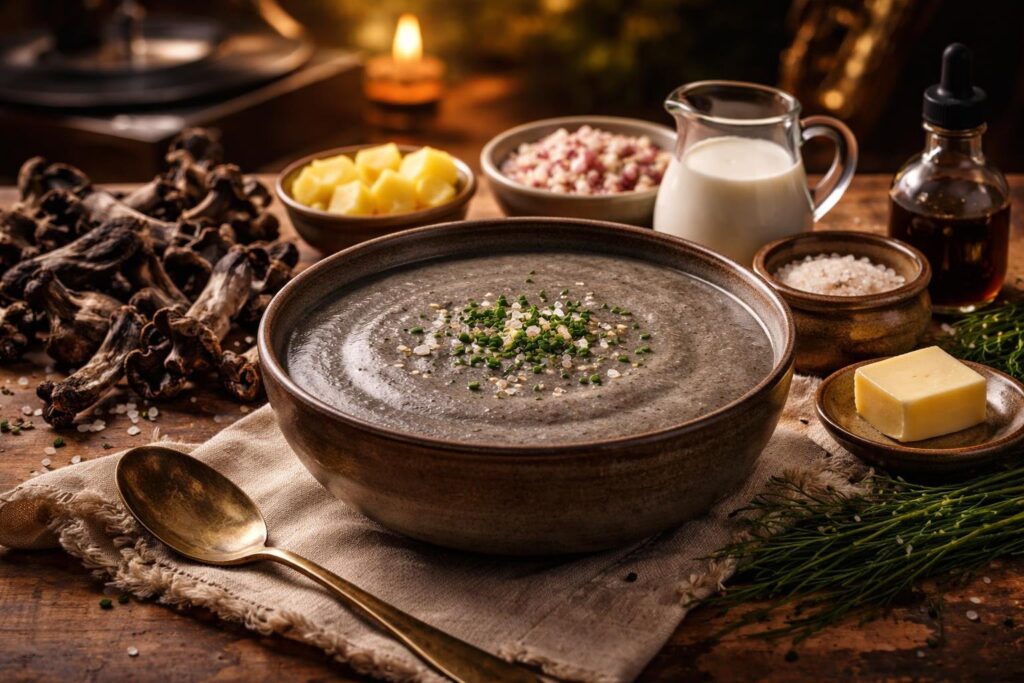
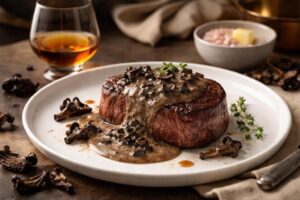
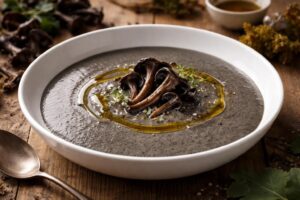
A hauntingly beautiful high umami masterpiece featuring the smoky Craterellus cornucopioides in a silken lipid emulsion finished with a whisper of oak smoke salt.
Smoky Blues
Black Trumpet Velouté with Crème Fraîche, Smoked Sea Salt, and Chive Infusion
The Historical Prelude
The Smoky Blues velouté is a culinary tribute to the "Lady Day" of jazz, Billie Holiday, and the melancholic beauty of the 1930s Atlantic Fringes. Historically, the Craterellus cornucopioides, or Black Trumpet, has been known as the "Trumpet of Death," but in the high-end bistros of Paris and Lyon, it was reimagined as a symbol of soulful luxury. Its dark, brooding appearance hides an aromatic complexity that mirrors the deep, raspy texture of a jazz vocal—earthy, smoky, and profoundly moving.
The pairing of this mushroom with Smoked Salt and heavy cream represents a transition in the French Alps from rustic, clear mushroom broths to the molecularly dense emulsions of the mid-20th century. This soup was designed to capture the "Noir" aesthetic: a liquid that is physically dark but emotionally bright. Historically, it was served in late-night jazz clubs where the scent of wood-smoke and expensive perfume met the damp, mushroomy aroma of the autumn forest floor.
By utilizing the Black Trumpet, chefs could achieve a visual depth that no other mushroom could provide. Unlike the bright, солнечный chanterelle, the Trumpet absorbs light, making the soup look like liquid silk. The Smoky Blues is more than a dish; it is a structural narrative of the forest's most mysterious fungus, refined through the elite technical lens of the Escoffier tradition.
Terroir: The finest Black Trumpets for a smoky velouté are harvested from the mossy, acidic soils beneath ancient beech and oak trees in the Black Forest and the Pyrenees. These regions produce a mushroom with a high concentration of octen-3-ol and smoky volatiles.
Leave No Trace Protocol: Because Black Trumpets are masters of camouflage, we use "Soft-Foot" foraging to avoid crushing the mycelium. We only harvest the mature, flared "horns," ensuring the forest floor remains undisturbed for the next generation of the "Noir Harvest."
Essential Equipment
High-Speed Immersion Blender: For achieving the molecularly smooth, "silk" texture characteristic of a true velouté.
Professional Chinois: For straining out every chitin fiber, ensuring a flawless mouthfeel.
Cast Iron Skillet: For the initial "Dry-Sear" of the mushrooms to concentrate the smoky esters.
Master Recipe
Stage 1: The Obsidian Base
Select 400g fresh Black Trumpets (or 40g dried/rehydrated). If using the 1:10 dried equivalent, rehydrate in warm milk for 30 minutes. Filter the milk—this is your "Smoky Nectar."
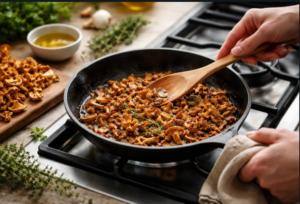
In a dry pan, sear the 400g fresh Trumpets (or 40g rehydrated) until they release their water and begin to "squeak."
Add 40g of cultured butter and 2 finely minced shallots. Sauté until translucent.
Stage 2: The Emulsion Build
Add 1 starchy potato (peeled and diced) and 500ml of blonde vegetable stock.
Simmer for 20 minutes until the potato is meltingly soft.
Pour in 150ml of Crème Fraîche and the "Smoky Nectar."
Stage 3: The Velvet Transformation
Blend on high speed for 3 minutes until the soup is an obsidian-grey velvet.
Pass through the Chinois into a clean pot.
Season with a generous pinch of Oak-Smoked Sea Salt and a whisper of white pepper.
Serve in pre-warmed bowls, garnished with a swirl of chive oil and a few reserved whole Trumpets.
The Umami Secret: The 1:10 Smoke Extraction
The "Pure Umami" of the Smoky Blues relies on Lipid-Nucleotide Bonding. Black Trumpets contain a high density of guanylates which are lipid-soluble. By utilizing the 1:10 rule (40g dried to 400g fresh equivalent) and rehydrating in milk, you create a "Flavor Cage" in the cream base. The Smoked Salt acts as a catalyst, opening the taste buds to receive the mushroom's wood-smoke volatiles with a tenfold increase in intensity.
Pro Technique: The “Sieve-and-Aeration”
To achieve a 3-star Michelin finish, don't just blend—aerate. After passing the soup through the Chinois, use the blender at an angle on the surface to create a light "Smoky Cloud" of foam. These air bubbles act as delivery vehicles for the forest volatiles, hitting the diner's nose before the spoon ever touches their lips.
The Art of Pairing
Sommelier's Choice: A Pinot Noir or a Chardonnay from the Jura. The wine's earthy and oxidative notes structural mirrors the smoky Trumpets.
Non-Alcoholic: A cold-brewed Lapsang Souchong tea, providing a sophisticated smoky counterpoint.
Substitutions & Variations
Luxury Alternative: Add a drop of Truffle Oil to the final foam for a "Shadow on Shadow" aromatic profile.
Dairy-Free Variant: Use Coconut Cream; its natural sweetness provides an interesting tropical contrast to the wood-smoke.
Storage & Reheating
This soup stores exceptionally well for 48 hours. To reheat, use the Slow-Simmer Method; avoid the microwave, as it will break the delicate cream emulsion and dull the smoky volatiles.
Ancestral Nutrition
Black Trumpets are a premier source of Vitamin B12 and Phosphorus. Historically, in the Pyrenees, this velouté was known as "The Restorer," served to those needing a metabolic and cognitive boost during the damp transition from autumn to winter.
Micro-FAQ
Q: Why use Smoked Salt? A: It amplifies the natural wood-smoke volatiles of the Black Trumpet without the need for aggressive liquid smoke, maintaining a professional, balanced profile.
Q: Is the 1:10 rule necessary for soup? A: Yes. 40g of dried provides the same aromatic weight as 400g of fresh, ensuring the "Blues" flavor isn't diluted by the cream and stock.
Q: Can I use leeks instead of shallots? A: Yes, but only the white part, as shallots provide a sharper, more refined allium base for this specific jazz-inspired dish.
To provide the best experiences, we use technologies like cookies to store and/or access device information. Consenting to these technologies will allow us to process data such as browsing behavior or unique IDs on this site. Not consenting or withdrawing consent, may adversely affect certain features and functions.
Functional
Always active
The technical storage or access is strictly necessary for the legitimate purpose of enabling the use of a specific service explicitly requested by the subscriber or user, or for the sole purpose of carrying out the transmission of a communication over an electronic communications network.
Preferences
The technical storage or access is necessary for the legitimate purpose of storing preferences that are not requested by the subscriber or user.
Statistics
The technical storage or access that is used exclusively for statistical purposes.The technical storage or access that is used exclusively for anonymous statistical purposes. Without a subpoena, voluntary compliance on the part of your Internet Service Provider, or additional records from a third party, information stored or retrieved for this purpose alone cannot usually be used to identify you.
Marketing
The technical storage or access is required to create user profiles to send advertising, or to track the user on a website or across several websites for similar marketing purposes.