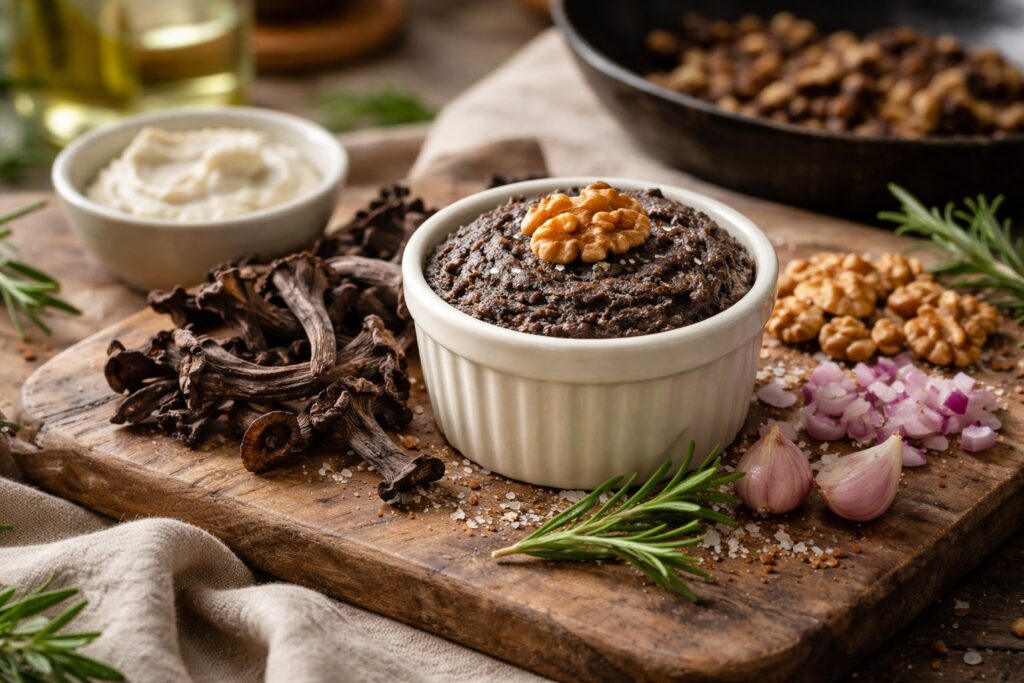
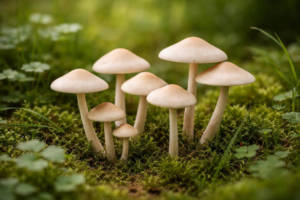
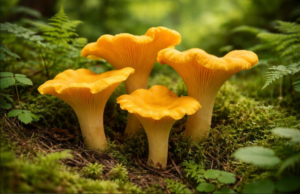
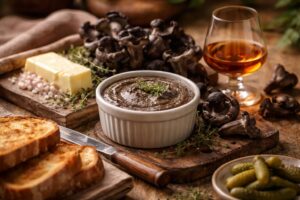
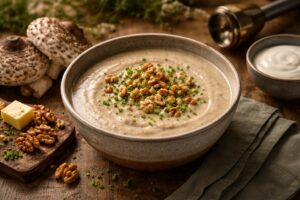
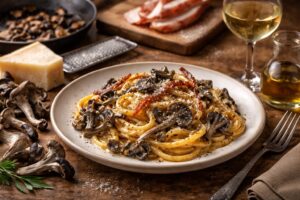
A hauntingly beautiful high umami masterpiece featuring the smoky Craterellus cornucopioides and toasted walnuts in a silken lipid emulsion inspired by the alchemical heritage of Paris.
The Forest Alchemy
Black Trumpet and Toasted Walnut Pâté with Cognac and Wild Thyme
The Historical Prelude
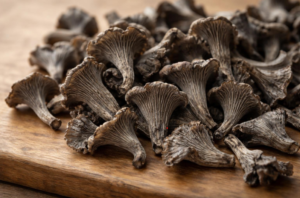
The Forest Alchemy is a culinary tribute to the legendary Parisian scribe and alchemist Nicolas Flamel. In the narrow, timber-framed streets of the 14th-century Marais, the transition of base materials into gold was not just a pursuit of metal, but a philosophy of the kitchen. Historically, the Craterellus cornucopioides, or Black Trumpet, was the alchemist's favorite fungus. Its ability to vanish into the shadows of the Atlantic Fringes and the French Jura, only to reappear as a potent, smoky essence in the pan, was seen as a literal transmutation of the forest floor into gastronomic gold.
In the medieval and Renaissance periods, Walnuts were often paired with "dark" ingredients to represent the brain and intellectual vigor. By the time the French culinary school reached its zenith under Escoffier, this pairing was refined into the Pâté de la Forêt Noire. The Black Trumpet, often called the "Poor Man's Truffle," was utilized by the cleverest chefs to achieve a musky, smoky depth that rivaled the Périgord truffle at a fraction of the weight.
Historically, this pâté represents the "Great Work" of the charcutier. It requires the chemical bonding of Cognac's oaky tannins, the walnut's bitter oils, and the trumpet's smoky nucleotides. When served on toasted brioche in the salons of Paris or the chateaus of the Pyrenees, it was more than a spread; it was a sensory riddle—an obsidian-colored emulsion that tasted of ancient woods, campfire, and the deep, damp secrets of the earth.
Terroir: Sourced from the ancient, moss-heavy beech forests of the Black Forest and the Pyrenees. These regions provide the acidic, high-humus soil required for the Trumpet to develop its signature "Noir" profile, characterized by wood-smoke and dried-plum volatiles.
Leave No Trace Protocol: Because Black Trumpets are hollow and delicate, we utilize Soft-Touch Extraction. In accordance with the French Forestry Code, we only harvest fully flared specimens. This ensures the mushroom has reached its maximum aromatic potential and has already dispersed its spores into the surrounding mossy terroir.
Essential Equipment
Heavy Cast Iron Skillet: To achieve the "Dry-Squeak" dehydration phase without burning the mushrooms.
High-Speed Blender: For creating a molecularly stable, silken emulsion of fats and fibers.
Ceramic Ramekins: For the traditional "set" and maturation of the pâté.
Master Recipe
Stage 1: The Obsidian Base
Select 400g fresh Black Trumpets (or 40g dried/rehydrated). If using the 1:10 dried equivalent, rehydrate in a mix of warm water and 20ml of Cognac for 30 minutes.
Filter and reserve the liquid—this is your "Alchemist's Broth."
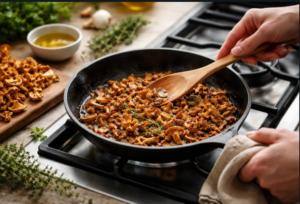
In a dry skillet, sear the 400g fresh Trumpets (or 40g rehydrated) until they "squeak." Add 30g of cultured butter and 1 minced shallot. Sauté until golden.
Stage 2: The Walnut Transmutation
Toast 60g of Walnut Halves in a dry pan until mahogany and fragrant.
Deglaze the mushroom skillet with 30ml of Cognac AOC. Ignite carefully to flambé.
Add 100ml of heavy cream and 20ml of the "Alchemist's Broth." Reduce by 50%.
Stage 3: The Silken Emulsion
Transfer the mushroom and walnut mixture to the blender while still warm.
Add 100g of cold, cubed butter and a teaspoon of fresh thyme leaves.
Blend on high until perfectly smooth. Season with a pinch of smoked salt.
Pour into ramekins and seal with a thin layer of clarified butter. Chill for at least 6 hours to allow the flavors to fuse.
The Umami Secret: The 1:10 Tannin Bond
The "Pure Umami" of the Forest Alchemy is achieved through Tannin-Nucleotide Synergy. Black Trumpets are rich in guanylates, which are amplified by the 1:10 rehydration process. When these savory molecules meet the tannins in the Cognac and the Walnut skins, a chemical bridge is formed. This "Alchemy" prevents the flavors from dissipating, creating a savory "bass note" that physically lingers on the palate for up to five minutes after the first bite.
Pro Technique: The “Sieve-and-Set”
To achieve a 3-star Michelin finish, pass the warm blended mixture through a fine-mesh sieve (tamin) before pouring into ramekins. This removes any tiny fragments of walnut skin or mushroom chitin, ensuring a texture that is as smooth as silk. The clarified butter seal is essential; it prevents oxidation of the obsidian-colored pâté, keeping the "Black Diamond" color vibrant.
The Art of Pairing
Sommelier's Choice: A Vin Jaune from the Jura or a mature Pinot Noir. The nutty, oxidative notes of the Vin Jaune are structural mirrors to the toasted walnuts.
Non-Alcoholic: A cold-brewed Pu-erh Tea, providing an earthy, fermented depth.
Substitutions & Variations
Luxury Alternative: Add a thin layer of Black Truffle oil to the clarified butter seal.
Alpine Variant: Replace walnuts with Hazelnuts (DOP Piedmont) for a sweeter, more floral profile typical of the Italian Alps.
Storage & Reheating
Pâté should be stored in the refrigerator for up to 5 days. Never reheat. Serve at room temperature for 20 minutes before consuming to allow the fats to soften and the volatiles to bloom.
Ancestral Nutrition
Black Trumpets are a premier source of Vitamin B12 and Phosphorus. Historically, in the French Jura, this pâté was known as "Philosopher's Bread," served to scholars to maintain cognitive focus and metabolic iron during the dark winter months.
Micro-FAQ
Q: Why rehydrate in Cognac? A: The alcohol acts as a solvent, pulling out the fat-soluble smoky volatiles of the Trumpet that water alone cannot extract.
Q: Can I use butter with salt? A: Only if it is high-quality cultured butter. Otherwise, use unsalted butter and control the salinity with smoked sea salt for a professional finish.
Q: Is the 1:10 rule mandatory for the walnuts? A: No, the 1:10 rule strictly applies to the mushroom weight; for walnuts, we use the 1:6 ratio (60g to 400g) to ensure the nuttiness doesn't overpower the mushroom's smoke.
To provide the best experiences, we use technologies like cookies to store and/or access device information. Consenting to these technologies will allow us to process data such as browsing behavior or unique IDs on this site. Not consenting or withdrawing consent, may adversely affect certain features and functions.
Functional
Always active
The technical storage or access is strictly necessary for the legitimate purpose of enabling the use of a specific service explicitly requested by the subscriber or user, or for the sole purpose of carrying out the transmission of a communication over an electronic communications network.
Preferences
The technical storage or access is necessary for the legitimate purpose of storing preferences that are not requested by the subscriber or user.
Statistics
The technical storage or access that is used exclusively for statistical purposes.The technical storage or access that is used exclusively for anonymous statistical purposes. Without a subpoena, voluntary compliance on the part of your Internet Service Provider, or additional records from a third party, information stored or retrieved for this purpose alone cannot usually be used to identify you.
Marketing
The technical storage or access is required to create user profiles to send advertising, or to track the user on a website or across several websites for similar marketing purposes.