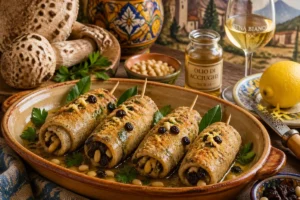
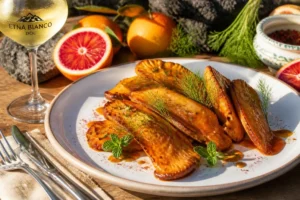
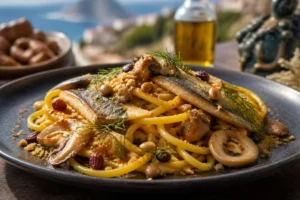
A technical study in Glucose-Acetous Reduction and Thermal Lipid Infusion, utilizing the Parasol mushroom's expansive gill surface as a high-density absorbent for a caramelized vinegar glaze, stabilized by the structural crunch of local hazelnuts.
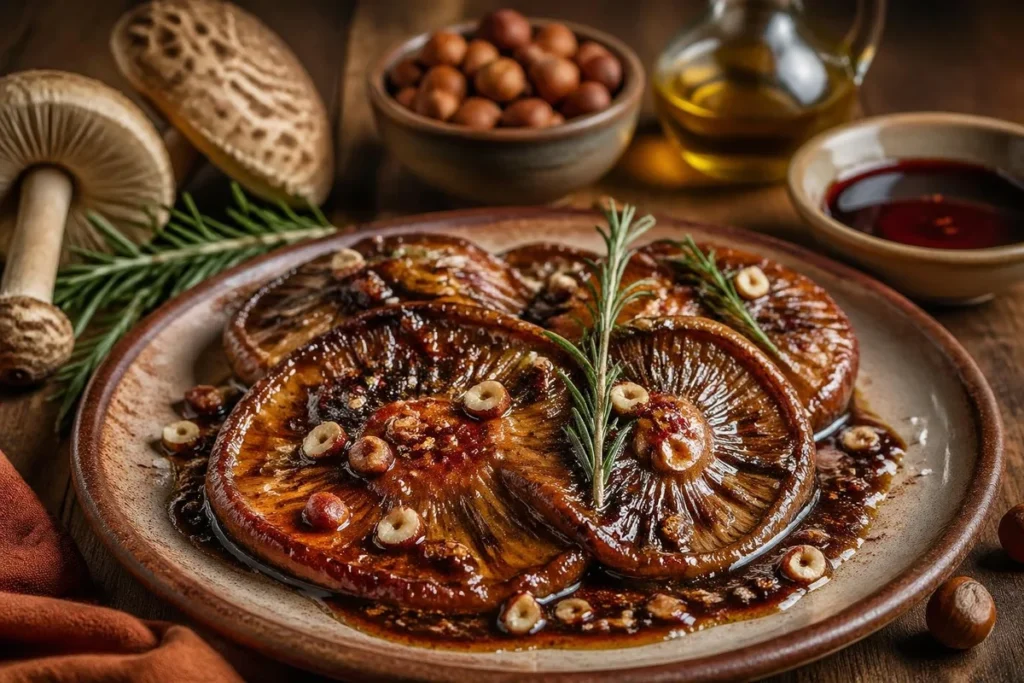
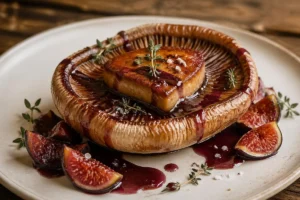
Agrodolce Glazed Parasol Caps with Toasted Hazelnuts
For our ninety-fourth technical formulation, we analyze Saccharide-Acidic Osmosis. Macrolepiota procera (Parasol Mushroom), locally known as Macrolepiota procera, possesses a radiating gill structure that functions as a high-performance flavor reservoir. At pure-umami.cc, we utilize the Sicilian Agrodolce technique. By reducing high-quality vinegar with honey or sugar, we create a high-viscosity glaze that penetrates the mushroom's cellular walls, replacing internal water with a concentrated sweet-and-sour matrix that highlights the mushroom's natural almond-like esters.
The Culinary Physics of This Dish
The engineering of this dish relies on Evaporative Concentration and Lipid-Saccharide Bridging. Molecularly, the "Agrodolce" glaze is a solution of Acetic Acid and Glucose/Fructose. When applied to the seared Macrolepiota procera caps, the heat drives the evaporation of water, forcing the thick glaze into the gill interstices through Hydrostatic Suction. The hazelnuts, rich in Oleic Acid and Filbertone (the primary aroma compound of hazelnuts), provide a lipid-based bridge that anchors the sharp acidic notes, creating a rounded mouthfeel and preventing "acidic fatigue" on the palate.
Terroir Narrative
This formulation is a tribute to Sicily (Sicilia), particularly the inland regions where wild nuts and volcanic soils define the landscape. We bridge the sun-drenched hills of the Madonie with the Balkan deciduous forests. The terroir is expressed through the marriage of the forest's "wild" Macrolepiota procera and the sophisticated, sharp-sweet tension of the Mediterranean. This follows the same technical rigor we apply to our Amanita caesarea (Caesar's mushroom) and Boletus edulis (Porcini), treating the glaze as a chemical tool for enhancing fungal umami.
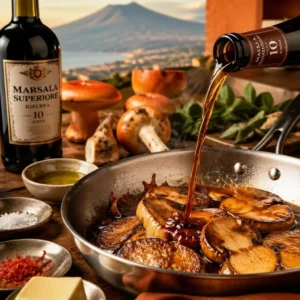
The Fungal Sear: In a wide skillet, sear the **Macrolepiota procera** caps in olive oil over high heat until they are golden and have released most of their moisture. This creates the Structural Porosity needed for the glaze.
The Agrodolce Synthesis: In a small saucepan, combine the vinegar, honey, rosemary, and chili flakes. Simmer until the volume is reduced by half and the liquid is syrupy (approx. 105°C).
The Osmotic Infusion: Pour the hot glaze over the mushrooms in the skillet. Toss gently over medium heat for 2 minutes. The mushrooms will absorb the glaze like a sponge—this is the Thermal Saturation phase.
The Lipid Integration: Add the toasted hazelnuts at the final moment. This ensures they maintain their Structural Crunch while being lightly coated in the sticky glaze.
Service: Serve warm or at room temperature as a Contorno or Antipasto. The flavor deepens as it cools.
Shop Integration
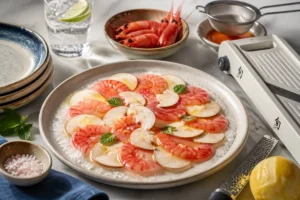
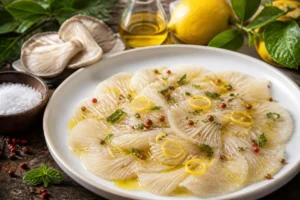
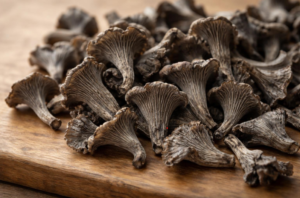
The Macrolepiota procera provides the essential volume and flavor-sponge properties, but the profile can be fortified. We recommend adding a few slices of our dried Boletus edulis (Porcini) to the glaze reduction for a "meatier" aromatic base. If you seek a brighter peppery contrast, garnish with sautéed Cantharellus cibarius (Chanterelle). For a luxury upgrade, finish the dish with a few drops of Morchella conica (Morel) oil. If available, a side of raw Amanita caesarea (Caesar's mushroom) with a simple lemon dressing will provide a necessary mineral contrast to the intense agrodolce glaze. For an extra earthy baseline, our Marasmius oreades (Fairy Ring) can be added to the initial sear for its intense almond-aroma lift.
The Umami Profile
This dish features **Acid-Amplified Fungal Umami**. The Macrolepiota procera provides the necessary guanylates, which are perceived as more intense when paired with the acetic acid of the vinegar. The honey introduces Maillard-Derived Furans that harmonize with the roasted hazelnut notes. The result is a savory experience that is exceptionally vibrant, with a "long" finish driven by the interplay of sweet, sour, and deep-forest umami.
Sommelier’s Choice
A glass of **Nero d'Avola** or a bold **Grillo**. The dark fruit and spicy notes of the Nero d'Avola match the intensity of the agrodolce, while the full-bodied Grillo provides a stone-fruit acidity that balances the honey and toasted hazelnuts.
The Etymological Chronicle
The term Agrodolce is **Italian**, from agro (sour) and dolce (sweet). In **French**, this would be Coulemelle à l'Aigre-Doux. In **German**, it is Süß-saurer Parasolpilz. In **Spanish**, it is Galamperna en Agridulce. Regardless of the language, the Parasol mushroom in agrodolce glaze remains the definitive standard for technical acid-sugar mycological engineering.
Pure Umami | Mycological Research & Culinary Arts | 2026
To provide the best experiences, we use technologies like cookies to store and/or access device information. Consenting to these technologies will allow us to process data such as browsing behavior or unique IDs on this site. Not consenting or withdrawing consent, may adversely affect certain features and functions.
Functional
Always active
The technical storage or access is strictly necessary for the legitimate purpose of enabling the use of a specific service explicitly requested by the subscriber or user, or for the sole purpose of carrying out the transmission of a communication over an electronic communications network.
Preferences
The technical storage or access is necessary for the legitimate purpose of storing preferences that are not requested by the subscriber or user.
Statistics
The technical storage or access that is used exclusively for statistical purposes.The technical storage or access that is used exclusively for anonymous statistical purposes. Without a subpoena, voluntary compliance on the part of your Internet Service Provider, or additional records from a third party, information stored or retrieved for this purpose alone cannot usually be used to identify you.
Marketing
The technical storage or access is required to create user profiles to send advertising, or to track the user on a website or across several websites for similar marketing purposes.