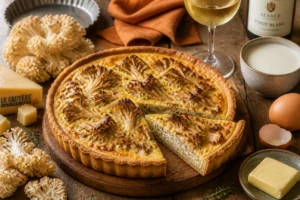
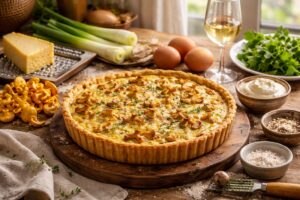
A technical study in Shortcrust Lipid Barrier Engineering and Protein-Colloid Suspension, utilizing the structural integrity of the Parasol mushroom to reinforce a dense, smoked-lipid custard within a friable pastry shell.
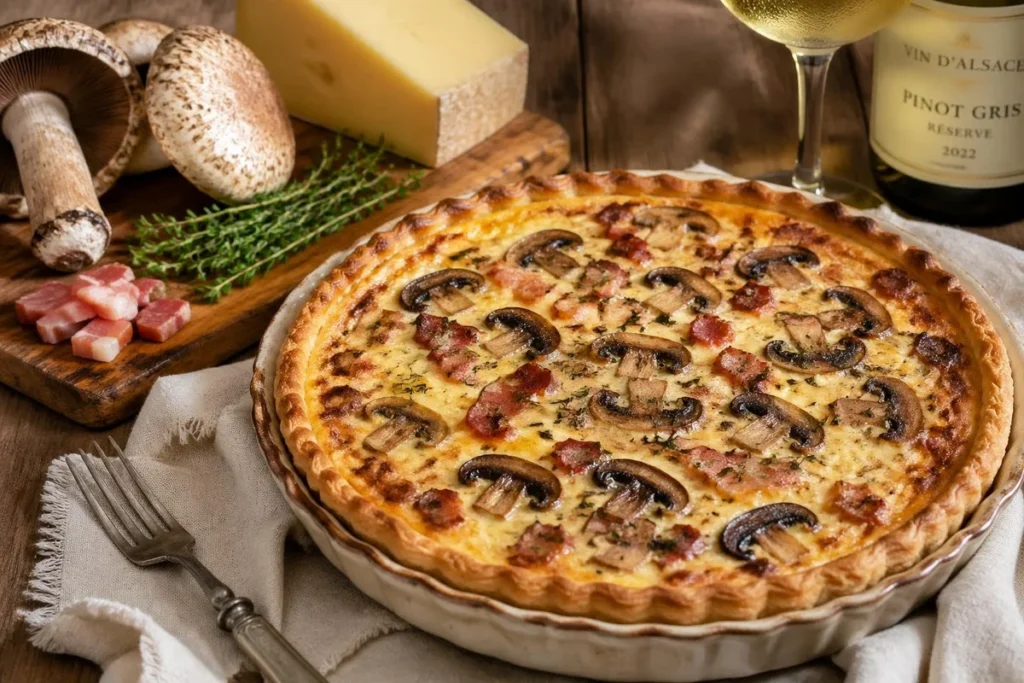
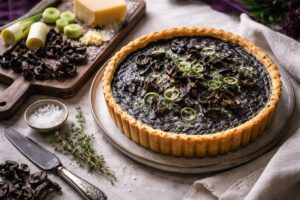
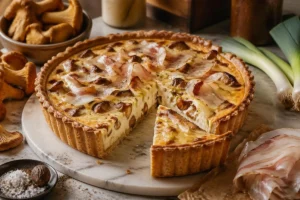
Quiche Forestière with Parasol & Smoked Lardons
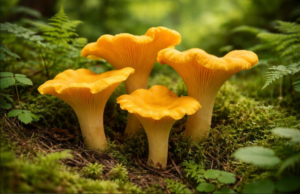
For our ninety-fifth technical formulation, we analyze Biphasic Moisture Management. Macrolepiota procera (Parasol Mushroom), known in Bulgaria as Macrolepiota procera, presents a unique challenge in pastry applications due to its high surface area and potential for liquid release. At pure-umami.cc, we utilize the Forestière variation of the classical Lorraine quiche. By engineering a "Blind-Bake" lipid barrier and pre-dehydrating the mushroom tissue through high-heat searing, we create a stable, non-soggy interface between the delicate pâte brisée and the rich, umami-laden custard.
The Culinary Physics of This Dish
The engineering of this quiche relies on Lipid Barrier Formation and Albumin Coagulation. Molecularly, the pastry crust (pâte brisée) must be blind-baked to facilitate the Retrogradation of Starches, creating a hydrophobic layer. The Macrolepiota procera is seared to trigger the Maillard reaction and expel cellular water. When the egg-and-cream mixture (the custard) is introduced, it acts as a Colloidal Suspension. As the temperature rises to 82°C, the egg proteins denature and form a cross-linked network that traps the smoked lardons and mushroom petals in a state of suspended animation, preventing the ingredients from sinking to the bottom of the vessel.
Terroir Narrative
This formulation is a tribute to the Lorraine region and the vast forests of Eastern France. We bridge the traditional "pork-and-pastry" culture of the French borderlands with the Balkan highland meadows. The terroir is expressed through the marriage of the forest's "wild" Macrolepiota procera and the deep, smoky resonance of salt-cured lardons. This follows the same technical rigor we apply to our Boletus edulis (Porcini) and Cantharellus cibarius (Chanterelle), treating the quiche as a volumetric study in flavor density and textural layering.
3 Large Eggs + 200ml Crème Fraîche (or Heavy Cream)
50g Gruyère or Comté cheese (grated)
1 small Leek (white part only, sautéed)
Fresh Thyme, Fleur de Sel, and Nutmeg
The Technique
The Pastry Armor: Line a tart tin with the pastry and blind-bake (with weights) at 190°C for 15 minutes. Brush with a thin layer of egg wash for the final 2 minutes to seal the surface. This is the Hydrophobic Barrier Technique.
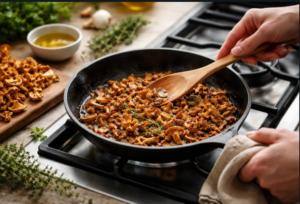
The Ingredient Pre-Treatment: Sauté the lardons until the fat renders. In the same pan, sear the **Macrolepiota procera** until golden and significantly reduced in volume. Add the leeks at the final moment to soften.
The Custard Synthesis: Whisk eggs, crème fraîche, nutmeg, and pepper. Do not over-whisk; we want a dense, creamy custard without excessive air bubbles.
The Volumetric Assembly: Scatter the mushrooms, lardons, leeks, and half the cheese into the pre-baked shell. Pour the custard over the top and finish with the remaining cheese.
The Coagulation Bake: Lower oven to 175°C. Bake for 35-40 minutes until the center has a "slight wobble" but is set. Let rest for 10 minutes to allow the Protein Matrix to firm up before slicing.
Shop Integration
The Macrolepiota procera provides the essential fungal architecture, but its complexity can be reinforced. We recommend adding a handful of our dried Boletus edulis (Porcini) to the cream for an infused custard base. If you seek a brighter peppery contrast, garnish with sautéed Cantharellus cibarius (Chanterelle). For a luxury upgrade, finish the quiche with a drizzle of Morchella conica (Morel) oil. If available, a side of raw Amanita caesarea (Caesar's mushroom) shavings with a lemon-chive vinaigrette will provide a necessary mineral contrast. For an extra earthy baseline, our Marasmius oreades (Fairy Ring) can be sautéed with the lardons for its intense almond-aroma. For a smoky visual depth, our Craterellus cinereus (Grey Chanterelle) can be minced into the custard itself.
The Umami Profile
This dish features **Lipid-Bound Fungal Umami**. The Macrolepiota procera provides the necessary guanylates, while the smoked lardons contribute inosinates and heterocyclic compounds from the smoking process. The high-fat cream acts as a solvent that binds these savory signals together, while the Gruyère adds a layer of free glutamates. The result is a savory experience that is exceptionally rich, persistent, and thermally stable.
Sommelier’s Choice
A glass of **Pinot Gris (Alsace)** or a dry **Riesling**. The stone-fruit notes and structural acidity of the Pinot Gris are the technical requirement to cut through the rich cream and smoked fats, while the minerality of the Riesling highlights the delicate almond notes of the Parasol mushroom.
The Etymological Chronicle
The term Quiche is of **German** origin (Kuchen), though famously refined in **French** (Lorraine). In **Italian**, this would be a Torta Salata ai Funghi e Pancetta. In **Spanish**, it is Quiche de Galamperna. Regardless of the language, the **Parasol mushroom** Quiche Forestière remains the definitive standard for technical savory-custard pastry engineering.
Pure Umami | Mycological Research & Culinary Arts | 2026
To provide the best experiences, we use technologies like cookies to store and/or access device information. Consenting to these technologies will allow us to process data such as browsing behavior or unique IDs on this site. Not consenting or withdrawing consent, may adversely affect certain features and functions.
Functional
Always active
The technical storage or access is strictly necessary for the legitimate purpose of enabling the use of a specific service explicitly requested by the subscriber or user, or for the sole purpose of carrying out the transmission of a communication over an electronic communications network.
Preferences
The technical storage or access is necessary for the legitimate purpose of storing preferences that are not requested by the subscriber or user.
Statistics
The technical storage or access that is used exclusively for statistical purposes.The technical storage or access that is used exclusively for anonymous statistical purposes. Without a subpoena, voluntary compliance on the part of your Internet Service Provider, or additional records from a third party, information stored or retrieved for this purpose alone cannot usually be used to identify you.
Marketing
The technical storage or access is required to create user profiles to send advertising, or to track the user on a website or across several websites for similar marketing purposes.