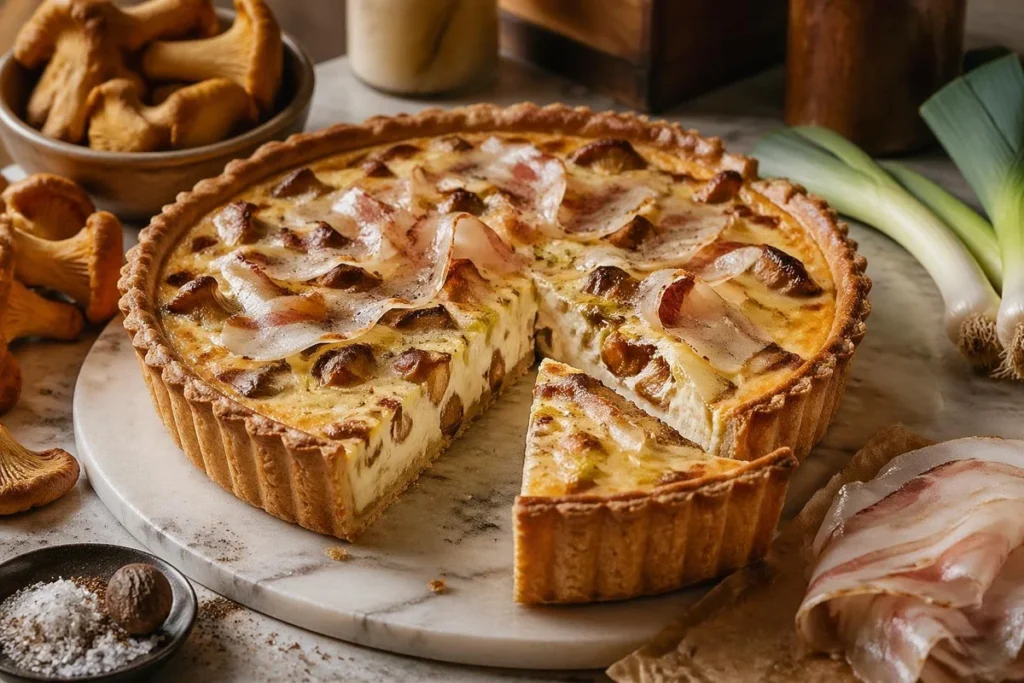
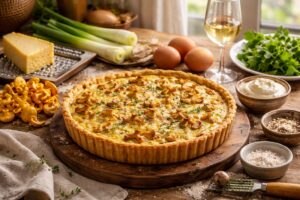
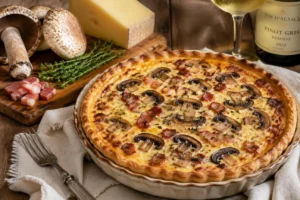
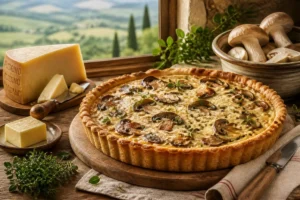
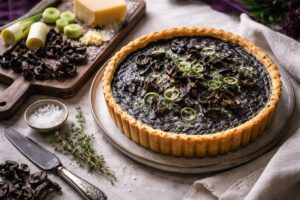
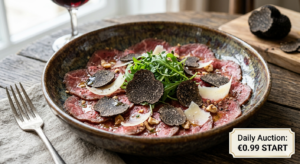
A sophisticated reimagining of the French classic, integrating the buttery parenchyma of the Golden Chanterelle with the silk-textured fat of Tuscan Lardo within a crisp, shortcrust pastry.
Chanterelle & Leek Quiche with Lardo di Colonnata
For our fourteenth technical formulation, we bridge the rustic traditions of Tuscany with the refined techniques of French pastry. The Cantharellus cibarius (Golden Chanterelle) is often lost in heavy egg batters; however, by pairing it with Lardo di Colonnata—an ultra-pure, herb-cured backfat aged in marble basins—we create a lipid-based delivery system for the mushroom's aromatics. This quiche is not a mere breakfast tart, but a complex study in fat-solubility and textural contrast. At pure-umami.cc, we utilize our premium Cantharellus cibarius to anchor this cross-border masterpiece.
The Culinary Physics of This Dish
The success of this quiche depends on Moisture Migration Control. Chanterelles are notorious for releasing water during the baking process, which can lead to a "soggy bottom" or a broken custard. We mitigate this through a preliminary "Dry Searing" phase, removing 30% of the mushroom's water weight before it enters the tart. Molecularly, the Lardo contains specialized fatty acids that melt at room temperature; when layered between the sautéed Cantharellus cibarius and the leeks, it encapsulates the volatile apricot-esters, ensuring they permeate the egg matrix without evaporating into the oven air.
Terroir Narrative
This formulation celebrates the "Marble Route" between the quarries of Carrara in Italy and the culinary schools of Lyon. The terroir is reflected in the use of sweet, white-stemmed leeks, which provide a sulfurous baseline that elevates the earthy notes of the chanterelles. By incorporating Lardo di Colonnata, we introduce a mineral, rosemary-scented salinity that mirrors the pine-needle floors where our Boletus edulis and Amanita caesarea are harvested. It is a dish that tastes of the mountains—both Alpine and Apennine.
Quick Info Bar
Prep Time
Cook Time
Complexity
Region
40 mins
35 mins
Grand Officier
Tuscany / France
Master Recipe (1:10 Rule)
Technical ratios for a stable, creamy custard:
300g Fresh Cantharellus cibarius (Cantharellus cibarius) – sautéed and drained
50g Lardo di Colonnata (sliced paper-thin)
150g White Leeks (finely sliced ciselé)
3 Large Eggs + 2 Egg Yolks (for a richer bind)
250ml Heavy Cream (min. 35% fat)
1 Savory Shortcrust Pastry Shell (blind-baked)
Fleur de Sel, White Pepper, and grated Nutmeg
The Technique
The Blind Bake: Bake your pastry shell at 180°C for 15 minutes with weights, then 5 minutes without, until the base is sealed and crisp.
The Filling: Sauté the chanterelles and leeks in a hot pan until all liquid has evaporated. Let the mixture cool to room temperature.
Lipid Layering: Lay the paper-thin slices of Lardo across the bottom of the baked pastry shell. The residual heat will slightly soften the fat.
The Custard: Whisk the eggs, yolks, and cream together. Season with nutmeg and pepper (go light on the salt, as the Lardo is cured). Fold in the mushroom and leek mixture.
The Bake: Pour the custard into the shell and bake at 160°C for 30-35 minutes. The low temperature is crucial to prevent the eggs from curdling, ensuring a silky, "flan-like" texture.
Shop Integration
The firm texture of our Cantharellus cibarius is essential for providing "bite" within the soft custard. For a more intense, peppery variant, we recommend substituting 20% of the filling with Craterellus cinereus (Grey Chanterelle). If you desire a nutty finish, adding a handful of our Marasmius oreades to the sauté provides a spectacular aromatic lift. For those seeking the ultimate Pure Umami experience, serve the quiche with a garnish of seared Boletus edulis (Porcini) or a side of fresh Amanita caesarea (Caesar's Mushroom) carpaccio.
The Umami Profile
This dish features "Fat-Enhanced Umami." The long-cured fats of the Lardo are rich in free amino acids, which act as a catalyst for the savory guanylates in the Cantharellus cibarius. The leeks contribute a subtle sweetness that balances the intensity, while the lactic acid in the cream provides a rounded finish that resets the palate after each bite.
Sommelier’s Choice
A structured **Chablis** or a **Vernaccia di San Gimignano**. The high acidity and mineral backbone of these wines are necessary to cut through the richness of the Lardo and cream, while their subtle floral notes complement the chanterelle's esters.
The Etymological Chronicle
The term Quiche comes from the German Kuchen (cake), but it was perfected in the French Lorraine region. In Italian, this style of savory tart is a Torta Salata. In German, it is a Herzhafter Kuchen, and in Spanish, Quiche de Rebozuelos. Across all culinary borders, the Chanterelle remains the undisputed queen of the savory tart.
Pure Umami | Mycological Research & Culinary Arts | 2026
To provide the best experiences, we use technologies like cookies to store and/or access device information. Consenting to these technologies will allow us to process data such as browsing behavior or unique IDs on this site. Not consenting or withdrawing consent, may adversely affect certain features and functions.
Functional
Always active
The technical storage or access is strictly necessary for the legitimate purpose of enabling the use of a specific service explicitly requested by the subscriber or user, or for the sole purpose of carrying out the transmission of a communication over an electronic communications network.
Preferences
The technical storage or access is necessary for the legitimate purpose of storing preferences that are not requested by the subscriber or user.
Statistics
The technical storage or access that is used exclusively for statistical purposes.The technical storage or access that is used exclusively for anonymous statistical purposes. Without a subpoena, voluntary compliance on the part of your Internet Service Provider, or additional records from a third party, information stored or retrieved for this purpose alone cannot usually be used to identify you.
Marketing
The technical storage or access is required to create user profiles to send advertising, or to track the user on a website or across several websites for similar marketing purposes.