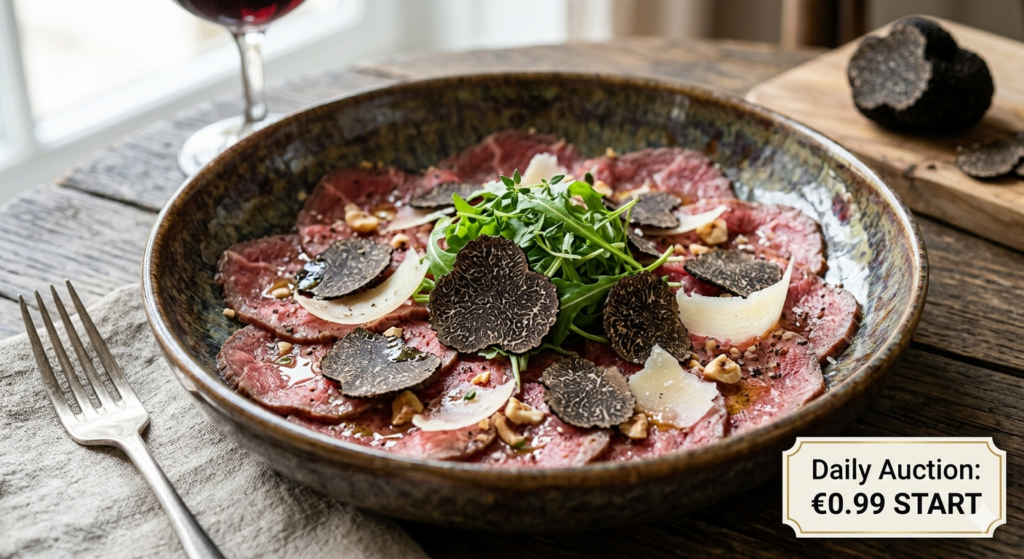
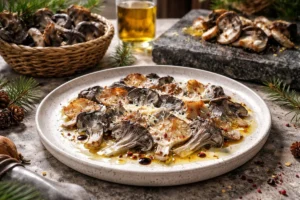
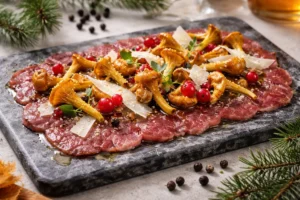
Gourmet Beef Carpaccio featuring the earthy depth of Black Winter Truffles and aged Parmigiano Reggiano.
The Sovereign’s Carpaccio
An Ethereal Union of Piedmontese Beef and the Black Diamond of Périgord
The Historical Prelude
The genesis of Beef Carpaccio is a testament to the intersection of art and gastronomy in post-war Europe. While the consumption of raw beef dates back to the nomadic Tartars, the dish as we know it was christened in 1950 at Harry's Bar in Venice. Giuseppe Cipriani created the dish for the Countess Amalia Nani Mocenigo, who had been advised by doctors to avoid cooked meat. The vibrant red of the raw beef reminded Cipriani of the bold palettes used by the Renaissance painter Vittore Carpaccio, whose works were being exhibited in Venice at the time.
However, the integration of the Tuber melanosporum (Black Winter Truffle) elevates this Venetian classic to the heights of French haute cuisine. Historically, the Black Truffle was the darling of King Francis I and later, the legendary Auguste Escoffier, who referred to it as the "gem of the kitchen." In the royal courts of the 19th century, the pairing of raw, marbled beef with the intense, musky aroma of truffles was considered the ultimate display of culinary decadence, reserved for visiting monarchs and the highest strata of the European aristocracy.
This recipe is not merely a dish; it is a study in texture and aromatic volatile compounds. The goal is to achieve "transparency" in the beef, allowing the truffle's lipid-soluble flavors to penetrate the meat fibers. We embrace the Cucina Povera luxury—taking simple, raw ingredients and treating them with technical reverence.
Sensory & Foraging Profile
Nomenclature:Tuber melanosporum (Black Winter Truffle) and Bos taurus (Chianina or Piedmontese Beef).
Terroir: The finest truffles for this dish are sourced from the limestone-rich soils of the Périgord region or the French Alps. The soil pH must be strictly alkaline (7.5 to 8.5) to develop the complex notes of damp earth, cocoa, and hazelnut.
Professional Protocol: Truffles must be harvested using trained lagottos or pigs to ensure ripeness. Our "Leave No Trace" protocol dictates that the soil must be aerated and the root system of the host oak (Quercus robur) left undisturbed to ensure future mycelial expansion.
Essential Equipment
Japanese Precision Knife (Suijihiki): For slicing the beef to a thickness of exactly 1.5mm.
Professional Truffle Shaver (Mandoline): With an adjustable micro-blade for paper-thin carpaccio-style truffle slices.
Chilled Marble Platter: To maintain the beef's cellular integrity during assembly.
Master Recipe
Stage 1: The Protein Preparation
400g Prime Beef Tenderloin (Center-cut, Chateaubriand).
Wrap tightly in parchment and blast-chill for 40 minutes (do not freeze) to firm the muscle fibers.
Stage 2: The Truffle Component
40g Fresh Black Truffle (or 4g Dried Black Truffle slices, carefully rehydrated in neutral grapeseed oil).
Clean the truffle with a soft brush under cold running water. Pat dry with lint-free linen.
Stage 3: The Emulsion & Assembly
Slice the beef against the grain into translucent sheets. Arrange in a single layer on the chilled marble.
Drizzle with a cold-pressed extra virgin olive oil (preferably a Taggiasca variety for its buttery profile).
Shave the 40g of Fresh Black Truffle (or the 4g rehydrated equivalent) directly over the meat. The heat from the beef (even chilled) will begin to release the truffle's aromatics.
Garnish with 24-month aged Parmigiano Reggiano shards and a whisper of Fleur de Sel.
The Umami Secret: Synergistic Nucleotides
The profound "Pure Umami" experience in this dish comes from the Synergy Effect. The beef provides Glutamate, while the Black Truffle is rich in Guanylate. When these two molecules meet, the umami perception is not just doubled, but increased eightfold. The addition of aged cheese adds Inosinate, completing the "Umami Trinity."
Pro Technique: The Cold-Sear Infusion
To enhance the flavor without cooking the meat, rub the marble platter with a halved clove of garlic and a single slice of truffle before laying down the beef. This "Ghost Infusion" ensures every millimeter of the meat is perfumed from the bottom up.
The Art of Pairing
Sommelier's Choice: A mature Barolo (2010-2015) from the Serralunga d'Alba region. The tannins have softened into silk, and the wine's natural "tar and roses" notes mirror the truffle's earthiness.
Non-Alcoholic: A cold-brewed Pu-erh Tea served in a Burgundy glass. Its fermentation notes provide a sophisticated earthy bridge to the fungi.
Micro-FAQ
Q: Can I use truffle oil instead of fresh? A: No. Commercial truffle oils are synthetic. For the Pure Umami experience, use only the 1:10 ratio of fresh to dried/rehydrated truffles.
Q: Why use a marble platter? A: Marble retains cold better than ceramic, preventing the beef fat from oxidizing and becoming "heavy" on the palate.
To provide the best experiences, we use technologies like cookies to store and/or access device information. Consenting to these technologies will allow us to process data such as browsing behavior or unique IDs on this site. Not consenting or withdrawing consent, may adversely affect certain features and functions.
Functional
Always active
The technical storage or access is strictly necessary for the legitimate purpose of enabling the use of a specific service explicitly requested by the subscriber or user, or for the sole purpose of carrying out the transmission of a communication over an electronic communications network.
Preferences
The technical storage or access is necessary for the legitimate purpose of storing preferences that are not requested by the subscriber or user.
Statistics
The technical storage or access that is used exclusively for statistical purposes.The technical storage or access that is used exclusively for anonymous statistical purposes. Without a subpoena, voluntary compliance on the part of your Internet Service Provider, or additional records from a third party, information stored or retrieved for this purpose alone cannot usually be used to identify you.
Marketing
The technical storage or access is required to create user profiles to send advertising, or to track the user on a website or across several websites for similar marketing purposes.