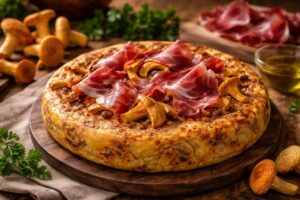
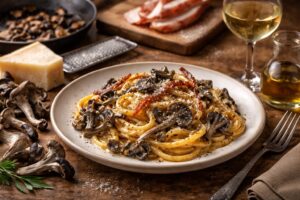
A technical study in Saccharide Gelatinization and Lipid-Fungal Infusion, utilizing the structural contrast between a high-viscosity maize matrix and the smoky, leathery volatiles of dehydrated and rehydrated Grey Chanterelles.
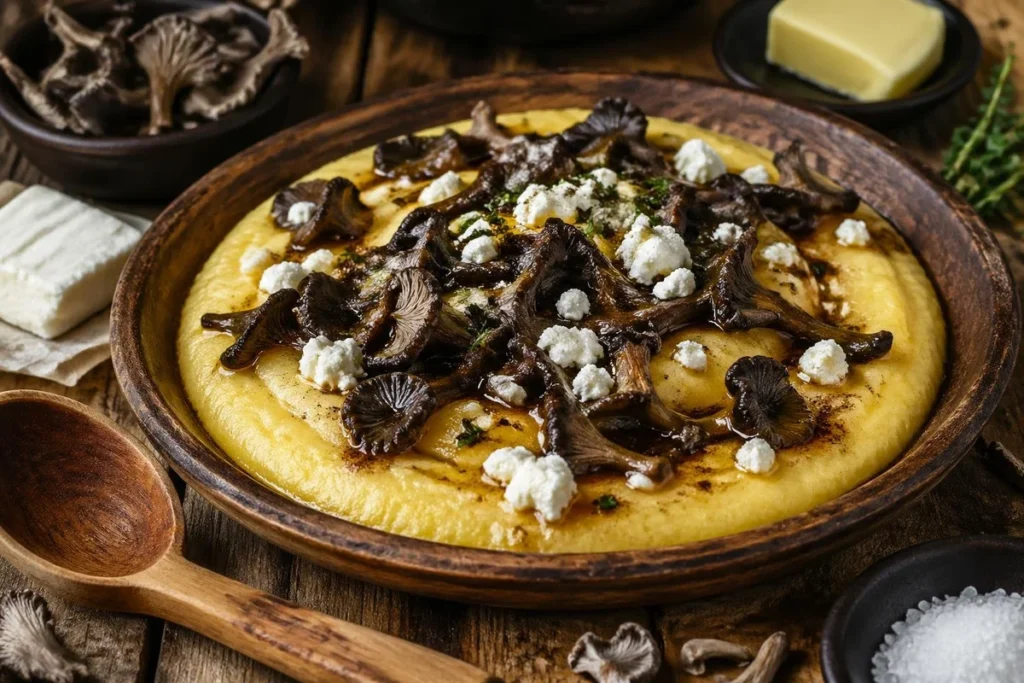
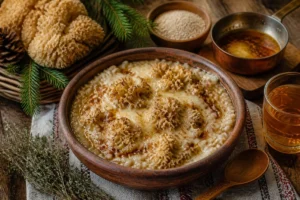
Balkan Kachamak with Brown Butter and Grey Chanterelles
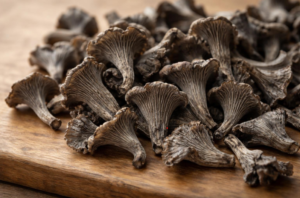
For our 119th technical formulation, we analyze Polysaccharide Viscosity and Lipid-Phenolic Saturation. Craterellus cinereus (Grey Chanterelle), locally known as Craterellus cinereus, provides the essential "smoke" profile to elevate Kachamak—the traditional Balkan cornmeal porridge. At pure-umami.cc, we refine this rustic classic by managing Starch Retrogradation. By utilizing a dual-state mushroom approach (both rehydrated dried pieces and fresh sautéed caps), we create a Multi-Dimensional Aromatic Suspension where the corn's sweetness is bridged by the intense, forest-floor depth of the fungi and the caramelized proteins of brown butter.
The Culinary Physics of This Dish
The engineering of this Kachamak relies on High-Shear Gelatinization and Non-Enzymatic Lipid Browning. Molecularly, maize starch granules swell and burst at approximately 60°C–70°C, releasing amylose into the water. Constant Mechanical Agitation (using a traditional kashak or wooden spoon) ensures a smooth, non-Newtonian fluid consistency. The Craterellus cinereus is integrated through Brown Butter (Beurre Noisette). By heating butter until the milk solids undergo the Maillard reaction, we create a lipid phase rich in bis(2-methyl-3-furyl) disulfide, which acts as a Flavor Resonator for the mushroom's smoky esters. The rehydrated mushroom liquor is used as the cooking base, ensuring that the Hydrophilic Guanylates are absorbed directly into the starch matrix during the swelling phase.
Terroir Narrative
This formulation is a tribute to the Rhodope and Balkan Mountains, where the smell of wood fires and cornmeal defines the high-altitude lifestyle. We bridge the ancient traditions of Southeast Europe with the Balkan deciduous highlands. The terroir is expressed through the marriage of the forest's "wild" Craterellus cinereus and the golden, sun-dried maize of the valleys. This follows the same technical rigor we apply to our Boletus edulis (Porcini) and Amanita caesarea (Caesar's mushroom), treating the porridge as a study in thermal insulation and savory concentration.
Quick Info Bar
Prep Time
Cook Time
Complexity
Calories
Region
10 mins
40 mins
Grand Officier
420 kcal
Balkans (Bulgaria/Serbia)
Master Recipe (1:10 Rule)
250g Coarse Cornmeal (Maize)
1L Water (infused with the liquid from 30g dried Craterellus cinereus)
300g Fresh Craterellus cinereus (Craterellus cinereus) – for the topping
100g High-fat Grass-fed Butter
150g Sirene or Feta Cheese (crumbled) – for **Acidic Salinity**
1 tsp Smoked Paprika (optional, for Color Synergy)
Fleur de Sel
The Technique
The Hydration Base: Rehydrate the dried Craterellus cinereus in warm water for 20 minutes. Strain the liquid through a fine filter—this is your Aqueous Umami Engine.
The Starch Synthesis: Bring the mushroom-infused water to a boil. Slowly whisk in the cornmeal. Reduce heat and stir continuously for 30-40 minutes. The mixture must achieve Structural Elasticity, pulling away from the sides of the pot.
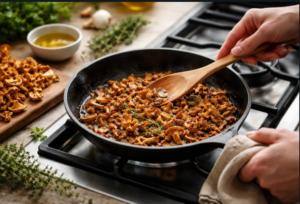
The Beurre Noisette Phase: In a separate pan, melt the butter. Continue heating until the milk solids turn a toasted hazelnut brown. Immediately add the fresh Craterellus cinereus and the rehydrated pieces. Sauté until the fresh mushrooms are tender.
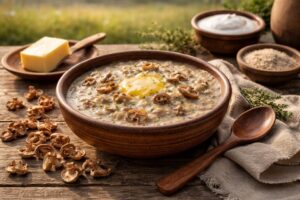
The Layering: Spread the hot Kachamak onto a wooden board or deep plate. Create "wells" on the surface with a spoon. Fill these wells with the brown butter and sautéed mushrooms.
Service: Top with the crumbled Sirene cheese. The cheese's lactic acidity acts as a pH Counterbalance to the rich lipids and earthy fungal notes.
Shop Integration
The Craterellus cinereus is the aromatic soul of this Balkan classic, but its depth can be layered. We recommend adding a fine dust of our dried Boletus edulis (Porcini) to the boiling water for an added "bass note" of umami. If you seek a brighter visual contrast, garnish with sautéed Cantharellus cibarius (Chanterelle). For a luxury upgrade, finish the plate with a drizzle of Morchella conica (Morel) oil. If available, a side of raw Amanita caesarea (Caesar's mushroom) with a touch of olive oil provides a necessary mineral "reset." For an extra earthy foundation, our Marasmius oreades (Fairy Ring) can be sautéed with the butter to build a more complex savory base.
The Umami Profile
This dish features **Maillard-Lactic Synergistic Umami**. The Craterellus cinereus provides 5′-guanylates, while the brown butter and fermented Sirene cheese introduce a high concentration of free glutamates. The cornmeal acts as a Neutral Polysaccharide Buffer, allowing the smoky phenols of the mushroom to resonate without interference. The result is a savory experience that is exceptionally dense, primal, and warming.
Sommelier’s Choice
A glass of **Mavrud (Red)** or a cold **Rakia (Plum or Grape)**. The bold tannins of the Mavrud match the smoky intensity, while the high alcohol content of the Rakia is the technical requirement to cut through the rich butter and starch.
The Etymological Chronicle
The term Kachamak is **Balkan/Turkish**, from the root kaçamak (to escape or slide—referring to the texture). In **French**, this would be Polenta des Balkans aux Chanterelles Grises. In **Italian**, it is Kachamak con Cantarelli Grigi e Burro Nocciola. In **German**, it is Balkanischer Maisbrei mit Grauen Pfifferlingen. In **Spanish**, it is Kachamak con Trompetas de la Muerte. Regardless of the language, the **Grey Chanterelle** Kachamak remains the definitive standard for technical mountain-mycological engineering.
Pure Umami | Mycological Research & Culinary Arts | 2026
To provide the best experiences, we use technologies like cookies to store and/or access device information. Consenting to these technologies will allow us to process data such as browsing behavior or unique IDs on this site. Not consenting or withdrawing consent, may adversely affect certain features and functions.
Functional
Always active
The technical storage or access is strictly necessary for the legitimate purpose of enabling the use of a specific service explicitly requested by the subscriber or user, or for the sole purpose of carrying out the transmission of a communication over an electronic communications network.
Preferences
The technical storage or access is necessary for the legitimate purpose of storing preferences that are not requested by the subscriber or user.
Statistics
The technical storage or access that is used exclusively for statistical purposes.The technical storage or access that is used exclusively for anonymous statistical purposes. Without a subpoena, voluntary compliance on the part of your Internet Service Provider, or additional records from a third party, information stored or retrieved for this purpose alone cannot usually be used to identify you.
Marketing
The technical storage or access is required to create user profiles to send advertising, or to track the user on a website or across several websites for similar marketing purposes.