This technical execution explores the preservation of volatile aromatic esters in Clitopilus prunulus through zero-thermal processing. By utilizing ultra-thin vertical laminations and a high-integrity lipid infusion, we maintain the mushroom's pristine white aesthetics and its signature "farinaceous" scent, creating a refreshing, high-contrast appetizer where the forest's raw essence meets the bright acidity of cold-pressed citrus.
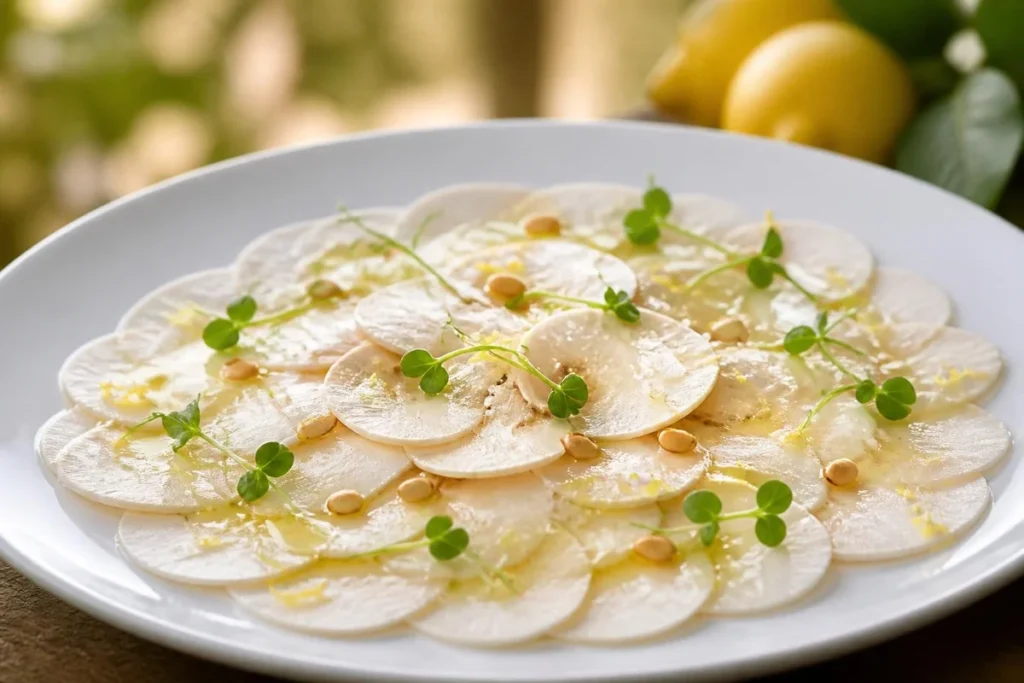
Miller Mushroom Carpaccio with Lemon Oil
This technical execution explores the preservation of volatile aromatic esters in Clitopilus prunulus through zero-thermal processing. By utilizing ultra-thin vertical laminations and a high-integrity lipid infusion, we maintain the mushroom's pristine white aesthetics and its signature "farinaceous" scent, creating a refreshing, high-contrast appetizer where the forest's raw essence meets the bright acidity of cold-pressed citrus.
The Culinary Physics of This Dish
The Clitopilus prunulus is structurally unique; when raw, it possesses a soft, almost brittle integrity that dissolves elegantly on the tongue. We utilize Cold Acid-Denaturation. By applying a high-grade lemon-lipid emulsion, the citric acid gently breaks down the mushroom's external chitinous fibers without the application of heat. This allows the internal 2-acetyl-1-pyrroline (the "bread" scent) to remain intact, while the lemon oil acts as a hydrophobic carrier, coating the palate and extending the duration of the mushroom's delicate, nutty finish.
Terroir Narrative
This dish is inspired by the Ligurian Coast of Italy, where the mountains meet the sea. In the humid oak forests above the lemon groves, foragers harvest the "Prugnolo bastardo" in the early morning dew. The recipe reflects the Mediterranean philosophy of Crudo—allowing the ingredient to speak for itself. It is a minimalist composition that bridges the gap between the alpine forest floor and the vibrant, sun-drenched citrus orchards of the coast.
Prep Time
Rest Time
Complexity
Calories
Region
20 Mins
3 Mins
Grand Officier
110 kcal
Liguria, Italy
Master Recipe (1:10 Rule)
300 g Fresh Miller Mushrooms (Select young, firm specimens with white gills)
40 ml Extra virgin olive oil (Taggiasca variety preferred for its mildness)
10 ml Freshly squeezed Amalfi lemon juice
1 g Lemon zest (Micro-planed)
2 g Sea salt (Maldon flakes)
Micro-greens (Shiso or Pea shoots) for structural garnish
Optional: 5 g Toasted pine nuts for textural contrast
The Technique
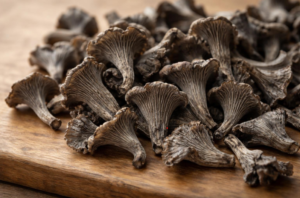
1. Selection & Preparation: Use only the most pristine, white specimens. Clean the Clitopilus prunulus using a dry artisan brush. Any contact with water will compromise the mushroom's delicate raw texture.
2. Precision Slicing: Using a professional-grade mandoline or a razor-sharp sushi knife (Yanagiba), slice the mushrooms vertically from cap to stem at a thickness of 1.0mm. The slices should be translucent.
3. The Emulsion: Whisk the olive oil, lemon juice, and lemon zest in a glass bowl until a light, temporary emulsion forms. The ratio of 4:1 (oil to juice) is critical to prevent over-acidification.
4. Plating: Arrange the slices in a concentric, overlapping pattern on a chilled plate. The visual purity of the white mushroom is the primary aesthetic goal.
5. The Maceration: Lightly brush the emulsion over the mushrooms. Allow to rest for exactly 180 seconds. This brief "cold-cook" softens the slices just enough to become silken on the tongue.
6. Finishing: Sprinkle with sea salt flakes and garnish with micro-greens and pine nuts. The salt must be added at the final second to maintain its crystalline crunch.
Shop Integration
The raw elegance of the Miller mushroom carpaccio provides a neutral, aromatic base that can be accented with other treasures from our collection. For a more intense forest profile, add a few drops of our truffle-infused oil, or pair with a small portion of raw, thinly sliced Amanita caesarea (Amanita caesarea) for a regal color contrast. While Boletus edulis (Boletus edulis) and Cantharellus cibarius (Cantharellus cibarius) are traditionally cooked, their presence in the same menu highlights the "white" purity of the Miller. Don't forget to explore our Marasmius oreades (Marasmius oreades) for a sweeter aromatic profile.
The Umami Profile
This dish relies on Pure Glutamates. In its raw state, Clitopilus prunulus delivers a clean, linear umami hit that is not masked by fats or sugars. The lemon's acidity serves as a "brightener," lowering the pH of the palate and making the mushroom's savory notes feel more vibrant and immediate. The pine nuts provide a secondary source of fatty acids, adding a layer of creamy umami to the finish.
Sommelier’s Choice
Vermentino di Sardegna: A crisp, mineral-driven white wine with salty undertones and citrus notes. Its vibrant acidity mirrors the lemon oil, while its light body doesn't overpower the delicate, doughy esters of the raw Miller mushroom.
THE ETYMOLOGICAL CHRONICLE
English:Miller Mushroom – Referencing the scent of fresh flour found in a miller's workspace.
French:Meunier – A traditional name reflecting the floury appearance and scent of the mushroom's cap.
German:Mehlräsling – Combining the word for flour ("Mehl") with a classic mycological suffix.
Spanish:Molinera – A name that connects the mushroom to the milling trade and the smell of raw dough.
To provide the best experiences, we use technologies like cookies to store and/or access device information. Consenting to these technologies will allow us to process data such as browsing behavior or unique IDs on this site. Not consenting or withdrawing consent, may adversely affect certain features and functions.
Functional
Always active
The technical storage or access is strictly necessary for the legitimate purpose of enabling the use of a specific service explicitly requested by the subscriber or user, or for the sole purpose of carrying out the transmission of a communication over an electronic communications network.
Preferences
The technical storage or access is necessary for the legitimate purpose of storing preferences that are not requested by the subscriber or user.
Statistics
The technical storage or access that is used exclusively for statistical purposes.The technical storage or access that is used exclusively for anonymous statistical purposes. Without a subpoena, voluntary compliance on the part of your Internet Service Provider, or additional records from a third party, information stored or retrieved for this purpose alone cannot usually be used to identify you.
Marketing
The technical storage or access is required to create user profiles to send advertising, or to track the user on a website or across several websites for similar marketing purposes.