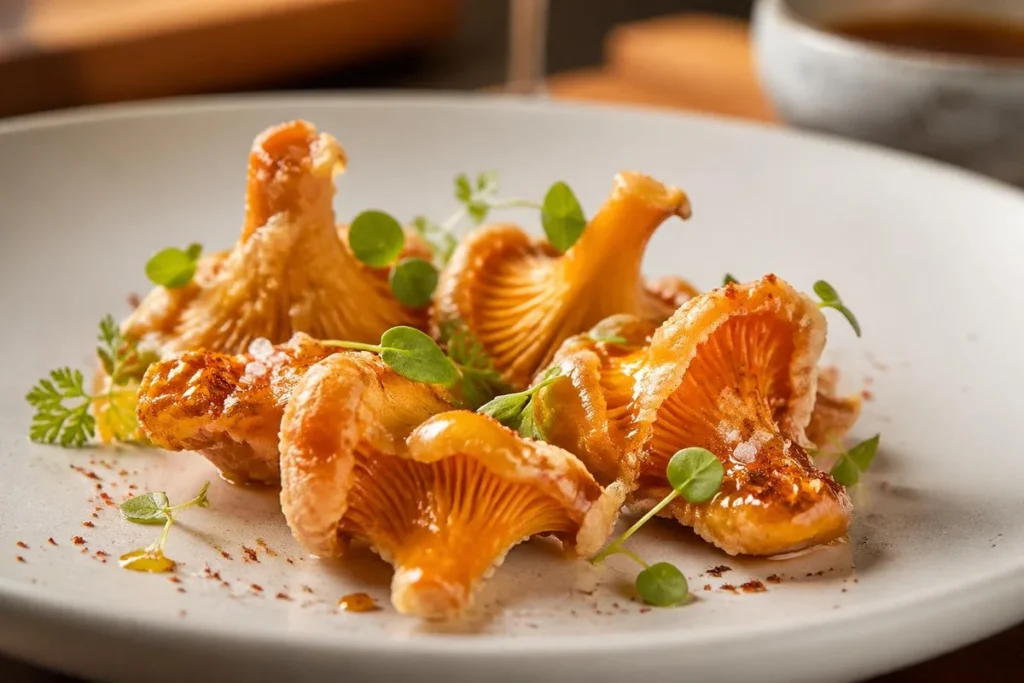
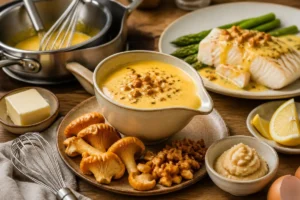
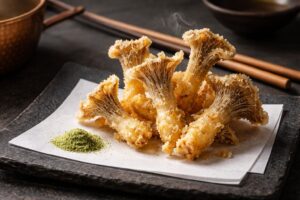
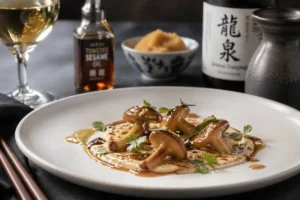
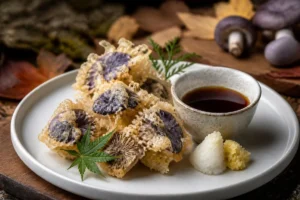
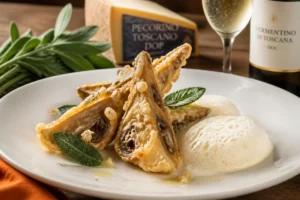
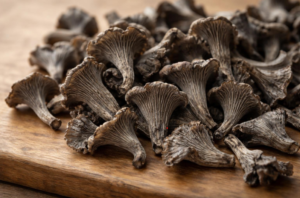
A radical synthesis of Japanese precision and forest foraging, utilizing the "Hydro-Thermal Shock" of tempura frying to create a crystalline structural barrier around the succulent parenchyma of the Golden Chanterelle.
Miso-Glazed Tempura Chanterelles
For our twenty-ninth technical formulation, we explore the physics of **thermal insulation**. Cantharellus cibarius (Golden Chanterelle) contains delicate aromatic ketones that evaporate at high temperatures. By utilizing a "Cryo-Batter" technique—extreme cold-to-hot shock—we create a porous, glass-like shell that flash-steams the mushroom in its own juices while protecting its apricot-like esters. At pure-umami.cc, we finish this technical marvel with a high-viscosity Miso glaze to bridge the gap between the fermented depths of the orient and the bright umami of the forest floor.
The Culinary Physics of This Dish
The engineering of this tempura relies on **Gluten Inhibition and Vaporization**. By using ice-cold sparkling water and low-protein flour, we prevent the formation of gluten networks, ensuring a "snap" rather than a "chew." Molecularly, when the batter-coated **Cantharellus cibarius** hits the 180°C oil, the water in the batter vaporizes instantly, creating micro-voids that result in the characteristic light texture. The Miso glaze, rich in melanoidins, provides a secondary "umami-shield" that prevents the mushroom's moisture from migrating into the crust, keeping it crisp for a longer duration.
Terroir Narrative
This formulation pays homage to the **Edo-style** tempura houses of Tokyo, reimagined within the context of the European forest. The terroir is reflected in the use of unrefined sesame oil for frying and the inclusion of white miso. This represents a bridge between the "shimaguni" (island nation) mentality and the vast, continental forests that yield our Boletus edulis and Amanita caesarea, proving that the most ancient Japanese techniques are perfectly suited for the most traditional European fungi.
Quick Info Bar
Oil Temp
Prep Time
Complexity
Region
180°C
15 mins
Grand Officier
Tokyo / Alps
Master Recipe (1:10 Rule)
Technical proportions for the Cryo-Batter:
300g Fresh **Cantharellus cibarius** (Cantharellus cibarius) – uniform medium size
100g Low-protein flour (Cake flour or Tempura flour)
150ml Ice-cold Sparkling Water (near 0°C)
1 Egg Yolk (cold)
2 tbsp White Miso (Shiro Miso)
1 tbsp Mirin + 1 tsp Rice Vinegar (for the glaze)
Neutral frying oil (Rice bran or Grapeseed)
The Technique
The Miso Glaze: Whisk the miso, mirin, and vinegar until smooth. Reduce slightly in a small pan until it reaches a "honey-like" viscosity.
The Cryo-Batter: Gently whisk the egg yolk into the ice-cold sparkling water. Sift in the flour. **DO NOT OVERMIX.** Lumps are essential for a variegated, crystalline texture.
The Dredge: Lightly dust the **Cantharellus cibarius** with dry flour. This acts as a molecular "primer" for the wet batter to adhere to.
The Flash-Fry: Dip the mushrooms in the batter and drop into 180°C oil. Fry for 90-120 seconds. They should be pale gold and extremely rigid.
The Glaze Application: Brush the hot tempura mushrooms with the Miso glaze immediately upon removal. Serve with a sprinkle of Togarashi or sea salt.
Shop Integration
The firm stipe of our **Cantharellus cibarius** is what prevents this tempura from becoming soggy. For a more intense experience, try this with our **Craterellus cinereus** (Grey Chanterelle), which takes on an incredible charred-miso profile. Our **Marasmius oreades** can be fried in small "clusters" (kakiage style) for an amazing nutty snack. Avoid using **Morchella conica** (Morel) in a wet batter; their hollow structure can trap hot oil, creating a safety hazard and an oily finish. For an elite presentation, serve with a side of seared **Boletus edulis** (Porcini).
The Umami Profile
This dish features **Fermented-Fungal Umami**. The free glutamates in the fermented Miso work in perfect synergy with the guanylates in the **Cantharellus cibarius**. The contrast between the salty, deep miso and the bright, peppery mushroom creates a "push-pull" effect on the palate that is highly addictive.
Sommelier’s Choice
A chilled **Junmai Ginjo Sake** or a **Dry Riesling**. The clean, rice-forward notes of a Ginjo sake harmonize with the miso, while its acidity cuts through the fried texture to highlight the mushroom's fruit esters.
The Etymological Chronicle
The term Tempura actually comes from the Latin *tempora*, introduced to Japan by Portuguese missionaries. In **French**, this would be *Chanterelles en Tempura*. In **German**, it is *Pfifferlinge im Tempura-Teig*. Regardless of the origin, the **Chanterelle** in a cryo-batter is the ultimate expression of modern fungal frying.
Pure Umami | Mycological Research & Culinary Arts | 2026
To provide the best experiences, we use technologies like cookies to store and/or access device information. Consenting to these technologies will allow us to process data such as browsing behavior or unique IDs on this site. Not consenting or withdrawing consent, may adversely affect certain features and functions.
Functional
Always active
The technical storage or access is strictly necessary for the legitimate purpose of enabling the use of a specific service explicitly requested by the subscriber or user, or for the sole purpose of carrying out the transmission of a communication over an electronic communications network.
Preferences
The technical storage or access is necessary for the legitimate purpose of storing preferences that are not requested by the subscriber or user.
Statistics
The technical storage or access that is used exclusively for statistical purposes.The technical storage or access that is used exclusively for anonymous statistical purposes. Without a subpoena, voluntary compliance on the part of your Internet Service Provider, or additional records from a third party, information stored or retrieved for this purpose alone cannot usually be used to identify you.
Marketing
The technical storage or access is required to create user profiles to send advertising, or to track the user on a website or across several websites for similar marketing purposes.