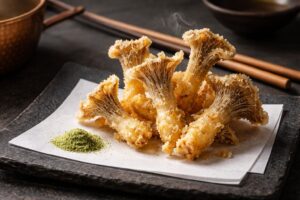
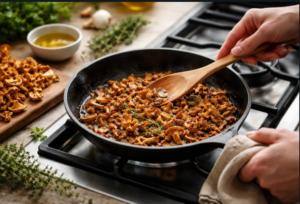
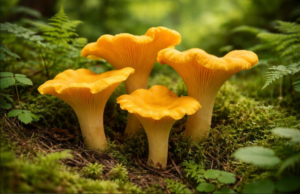
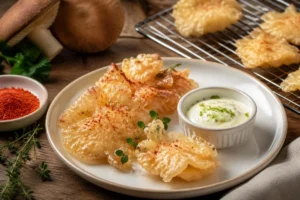
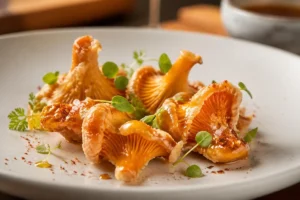
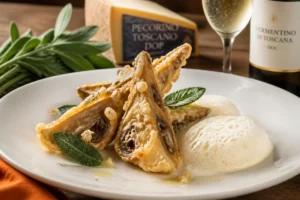
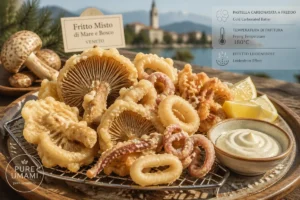
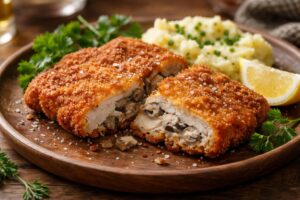
This technical execution explores the intersection of Japanese precision and European foraged ingredients. By utilizing the non-brittle, "greasy" gill structure of Russula cyanoxantha, we create a high-contrast tempura where the rapid dehydration of the ice-cold batter encapsulates the mushroom's flexible tissues. The result is a light, ethereal crunch that gives way to a succulent, forest-scented interior, elevated by a molecularly balanced soy-reduction dip.
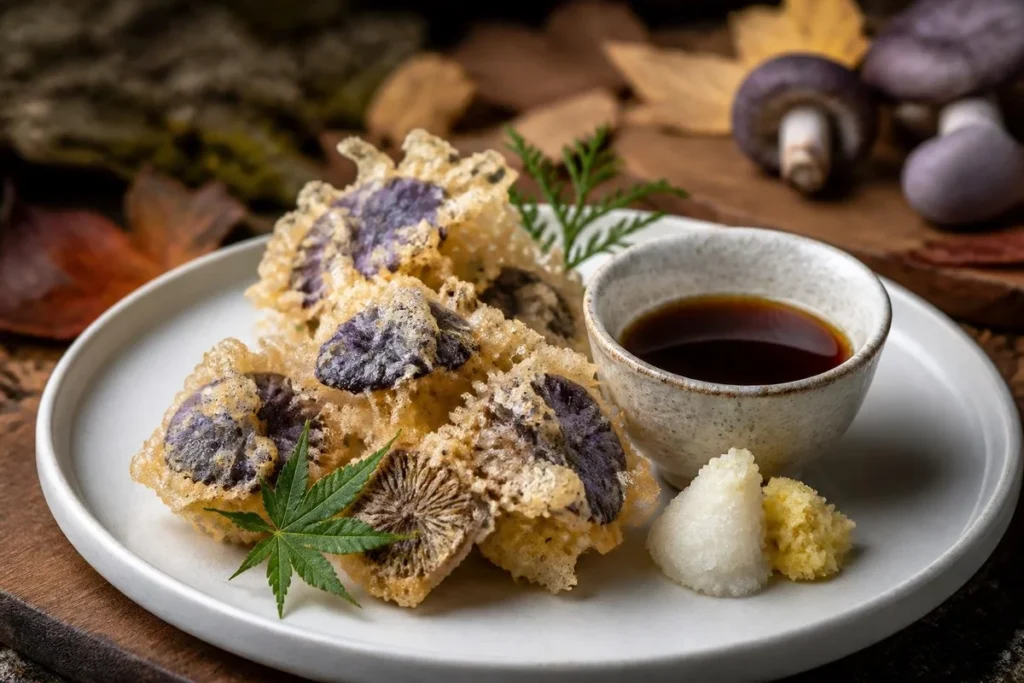
Tempura of Russula Cyanoxantha with Umami Soy
This technical execution explores the intersection of Japanese precision and European foraged ingredients. By utilizing the non-brittle, "greasy" gill structure of Russula cyanoxantha, we create a high-contrast tempura where the rapid dehydration of the ice-cold batter encapsulates the mushroom's flexible tissues. The result is a light, ethereal crunch that gives way to a succulent, forest-scented interior, elevated by a molecularly balanced soy-reduction dip.
The Culinary Physics of This Dish
The Russula cyanoxantha is scientifically ideal for tempura because its flexible gills prevent the steam from escaping too quickly, effectively "pressure-steaming" the mushroom inside its own batter shell. We utilize a **low-gluten flour** mixed with carbonated water at 2°C. The thermal shock of the cold batter meeting 180°C oil causes the carbon dioxide to expand rapidly, creating a micro-porous crust. This barrier prevents lipid saturation of the mushroom, ensuring that the Charcoal Burner's delicate 1-octen-3-ol aromatic compounds remain intact and concentrated.
Terroir Narrative
This dish represents the East-West Mycological Fusion. While tempura techniques are rooted in the culinary traditions of Japan, the foraged "Charbonnier" is a quintessentially European forest treasure. Traditionally found in the broadleaf forests of Central Europe, the Charcoal Burner's nutty finish and meat-like bite are reimagined here through a minimalist, technique-driven lens. It is a preparation that honors the mushroom's form, showcasing the iridescent violet-gray cap within a pale, golden-lace exterior.
Prep Time
Cook Time
Complexity
Calories
Region
25 Mins
5 Mins
Grand Officier
230 kcal
Fusion / European Forest
Master Recipe (1:10 Rule)
500 g Russula cyanoxantha (Whole small caps or thick halves)
150 g Tempura flour (or a 70/30 mix of wheat flour and cornstarch)
200 ml Ice-cold sparkling water (highly carbonated)
1 Egg yolk (chilled)
1 l Neutral oil (Rice bran or refined sunflower)
50 ml Aged Soy Sauce (Shoyu)
10 ml Mirin
5 g Grated Daikon radish & Ginger
The Technique
1. The Cold Extraction: Ensure all batter ingredients are kept at 2°C. Whisk the egg yolk and sparkling water lightly, then fold in the flour with chopsticks. Do not overmix; lumps are essential for the traditional "lace" texture.
2. Mycological Prep: Clean the Russula cyanoxantha with a dry brush. Dust lightly with cornstarch—this acts as a dry adhesive for the wet batter.
3. Thermal Management: Heat the oil to exactly 180°C. Maintaining this temperature is vital to prevent the mushrooms from absorbing oil.
4. The Dipping: Dip the caps into the batter, ensuring the gills are well-coated to trap the air pockets. Drop carefully into the oil.
5. The Flash Fry: Fry for 90–120 seconds. The batter should be pale gold and crisp, not brown. The flexible structure of the "Charbonnier" ensures it stays tender inside while the outside remains rigid.
6. Umami Soy Service: Combine the Shoyu and Mirin. Serve the hot tempura immediately with the soy dip, Daikon, and Ginger to provide an enzymatic and acidic counterpoint to the fried richness.
Shop Integration
The delicate crunch of tempura is an excellent way to experience our diverse shop offerings. Beyond the Charcoal Burner, try our Marasmius oreades (Marasmius oreades) for a sweeter, snack-like bite, or the iconic Boletus edulis (Boletus edulis) for a more robust earthy core. For visual splendor, the vibrant Cantharellus cibarius (Cantharellus cibarius) or Amanita caesarea (Amanita caesarea) create a stunning tempura assortment. For advanced umami profiles, explore the smoky Craterellus cornucopioides (Craterellus cinereus) or the unparalleled honeycomb texture of our Morchella (Morchella conica).
The Umami Profile
This dish creates a **Triple Umami Bridge**. The Glutamates in the Charcoal Burner are reinforced by the Inosinates in the aged soy sauce and the Guanylates developed during the high-heat frying of the mushroom's proteins. The result is a savory surge that is both immediate (from the crust) and sustained (from the mushroom core).
Sommelier’s Choice
Extra Dry Sake (Junmai): A clean, rice-forward sake with a dry finish. It acts as a palate cleanser for the oil while its subtle grain sweetness harmonizes with the mushroom's nutty hazelnut undertones.
THE ETYMOLOGICAL CHRONICLE
French:Russule charbonnière – Named for the coal-like iridescence of the cap, which shifts from blue to purple and slate.
Italian:Colombina maggiore – Referencing its status as the "Greater Dove," a name inspired by the soft, feather-like tones of its skin.
German:Frauentäubling – A poetic reference meaning "Lady's Little Dove," noting the mushroom's non-brittle, flexible nature.
Spanish:Carbonera – Associated with the soot and ash of the forest floor where its dark cap provides natural camouflage.
To provide the best experiences, we use technologies like cookies to store and/or access device information. Consenting to these technologies will allow us to process data such as browsing behavior or unique IDs on this site. Not consenting or withdrawing consent, may adversely affect certain features and functions.
Functional
Always active
The technical storage or access is strictly necessary for the legitimate purpose of enabling the use of a specific service explicitly requested by the subscriber or user, or for the sole purpose of carrying out the transmission of a communication over an electronic communications network.
Preferences
The technical storage or access is necessary for the legitimate purpose of storing preferences that are not requested by the subscriber or user.
Statistics
The technical storage or access that is used exclusively for statistical purposes.The technical storage or access that is used exclusively for anonymous statistical purposes. Without a subpoena, voluntary compliance on the part of your Internet Service Provider, or additional records from a third party, information stored or retrieved for this purpose alone cannot usually be used to identify you.
Marketing
The technical storage or access is required to create user profiles to send advertising, or to track the user on a website or across several websites for similar marketing purposes.