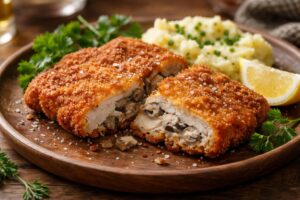
A technical study in Direct-Flame Carbonization and Capsaicin-Lipid Emulsification, utilizing the Parasol mushroom's resilient structure to absorb the smoke-profile of roasted vegetables, paired with a high-viscosity nut and pepper reduction.
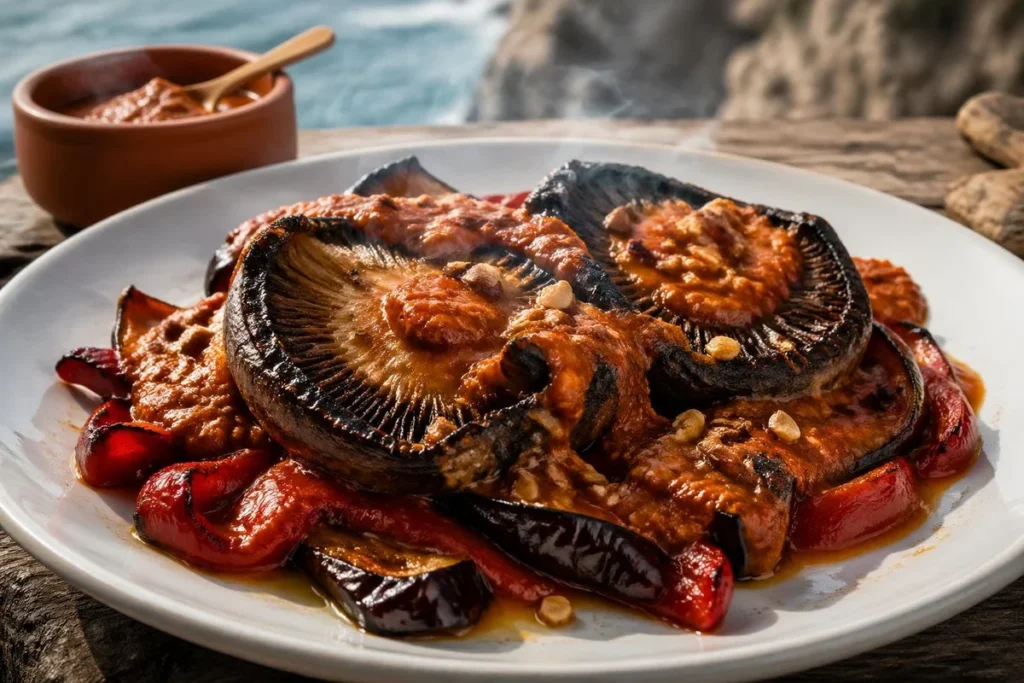
Catalan-style Parasol “Escalivada” with Romesco
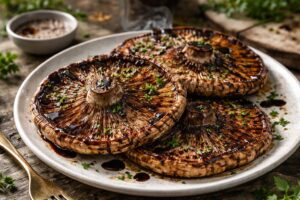
For our 103rd technical formulation, we analyze Pyrolytic Aromatic Infusion and Emulsion Stability. Macrolepiota procera (Parasol Mushroom), locally identified as Macrolepiota procera, possesses a gill architecture that acts as a highly efficient "smoke trap." At pure-umami.cc, we utilize the Catalan Escalivada technique. By roasting the mushrooms alongside peppers and eggplants directly over an open flame, we induce Surface Carbonization, creating a smoky, charred exterior that contrasts with the mushroom's succulent, almond-scented interior.
The Culinary Physics of This Dish
The engineering of this dish relies on Convection Charring and Lipid-Capsaicin Bonding. Molecularly, the high heat of the flame triggers the Maillard Reaction and caramelization on the **Macrolepiota procera** cap, while the smoke particles (phenols) are trapped within the gill matrix. The Romesco sauce provides the Textural Anchor. It is a Non-Newtonian Fluid created by emulsifying roasted garlic, almonds, hazelnuts, and ñora peppers in olive oil. The high concentration of nut oils and vegetable solids creates a high-viscosity coating that adheres to the charred mushroom, ensuring that every savory signal is delivered with maximum persistence.
Terroir Narrative
This formulation is a tribute to Catalonia (Catalunya) and the rugged Mediterranean coastline. We bridge the smoke-filled kitchens of the Priorat with the Balkan highland meadows. The terroir is expressed through the marriage of the forest's "wild" Macrolepiota procera and the vibrant, earth-driven depth of the Romesco. This follows the same technical rigor we apply to our Boletus edulis (Porcini) and Amanita caesarea (Caesar's mushroom), treating the open fire as a chemical catalyst for umami evolution.
2 Red Bell Peppers + 1 Eggplant (for the Escalivada base)
Romesco: 50g Almonds (toasted), 50g Hazelnuts (toasted), 1 head of Garlic (roasted), 2 Dried Ñora Peppers (soaked), 1 slice of fried bread, 100ml Extra Virgin Olive Oil, 30ml Sherry Vinegar.
Fleur de Sel and Smoked Paprika (Pimentón)
The Technique
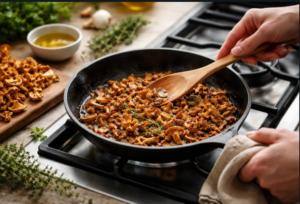
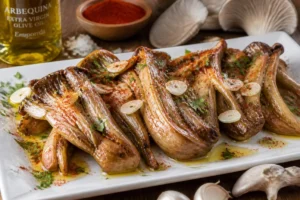
The Fire-Induced Char: Roast the peppers and eggplant over a gas flame or charcoal until the skins are black. Do the same with the **Macrolepiota procera** caps—they require only 2-3 minutes. This is the Pyrolytic Infusion Phase.
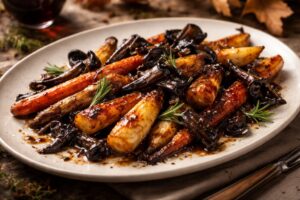
The Steam Peeling: Place the roasted vegetables in a bowl and cover with plastic wrap. The residual steam will loosen the skins. Once cooled, peel and slice into long ribbons.
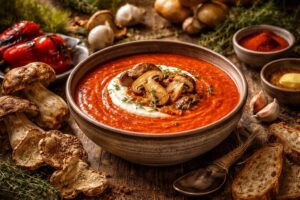
The Romesco Synthesis: In a mortar or blender, combine the toasted nuts, roasted garlic, soaked peppers, and bread. Slowly emulsify with olive oil and vinegar until thick and creamy. The Sherry vinegar acts as a Volatile Brightener.
The Assembly: Arrange the vegetable ribbons and charred mushroom wedges on a plate. Drizzle generously with the Romesco sauce.
Service: Serve at room temperature. The Flavor Equilibrium is best achieved when the smoke, acid, and nut fats are allowed to settle.
Shop Integration
The Macrolepiota procera provides the essential smoky mass, but its umami depth can be reinforced. We recommend adding a fine dust of our dried Boletus edulis (Porcini) to the Romesco for a meatier finish. If you seek a brighter peppery contrast, garnish with sautéed Cantharellus cibarius (Chanterelle). For a luxury upgrade, finish the plate with a few drops of Morchella conica (Morel) oil. If available, raw shavings of Amanita caesarea (Caesar's mushroom) with lemon provide a necessary mineral "reset" against the heavy roasted flavors. For an extra earthy baseline, our Craterellus cinereus (Grey Chanterelle) can be roasted alongside the Parasol for its smoky complexity.
The Umami Profile
This dish features **Smoked-Capsaicin Synergistic Umami**. The Macrolepiota procera provides the fungal guanylates, while the roasted peppers and garlic introduce glutamates. The Romesco's nut oils act as Lipid Resonators, carrying the smoky phenols and capsaicin across the palate. The result is a savory experience that is exceptionally deep, "fire-kissed," and long-lasting.
Sommelier’s Choice
A glass of **Priorat (Red)** or a chilled **Sherry (Amontillado)**. The high minerality and dark fruit of the Priorat match the charred intensity, while the oxidative nuttiness of the Amontillado is the technical requirement to harmonize with the Romesco and the almond notes of the Parasol mushroom.
The Etymological Chronicle
The term Escalivada is **Catalan**, from escalivar (to roast in ashes). In **French**, this would be Coulemelles à la Catalane. In **German**, it is Katalanisches Parasolpilz-Röstgemüse. In **Spanish**, it is Escalivada de Galamperna. Regardless of the language, the **Parasol mushroom** Escalivada remains the definitive standard for technical fire-based mycological engineering.
Pure Umami | Mycological Research & Culinary Arts | 2026
To provide the best experiences, we use technologies like cookies to store and/or access device information. Consenting to these technologies will allow us to process data such as browsing behavior or unique IDs on this site. Not consenting or withdrawing consent, may adversely affect certain features and functions.
Functional
Always active
The technical storage or access is strictly necessary for the legitimate purpose of enabling the use of a specific service explicitly requested by the subscriber or user, or for the sole purpose of carrying out the transmission of a communication over an electronic communications network.
Preferences
The technical storage or access is necessary for the legitimate purpose of storing preferences that are not requested by the subscriber or user.
Statistics
The technical storage or access that is used exclusively for statistical purposes.The technical storage or access that is used exclusively for anonymous statistical purposes. Without a subpoena, voluntary compliance on the part of your Internet Service Provider, or additional records from a third party, information stored or retrieved for this purpose alone cannot usually be used to identify you.
Marketing
The technical storage or access is required to create user profiles to send advertising, or to track the user on a website or across several websites for similar marketing purposes.