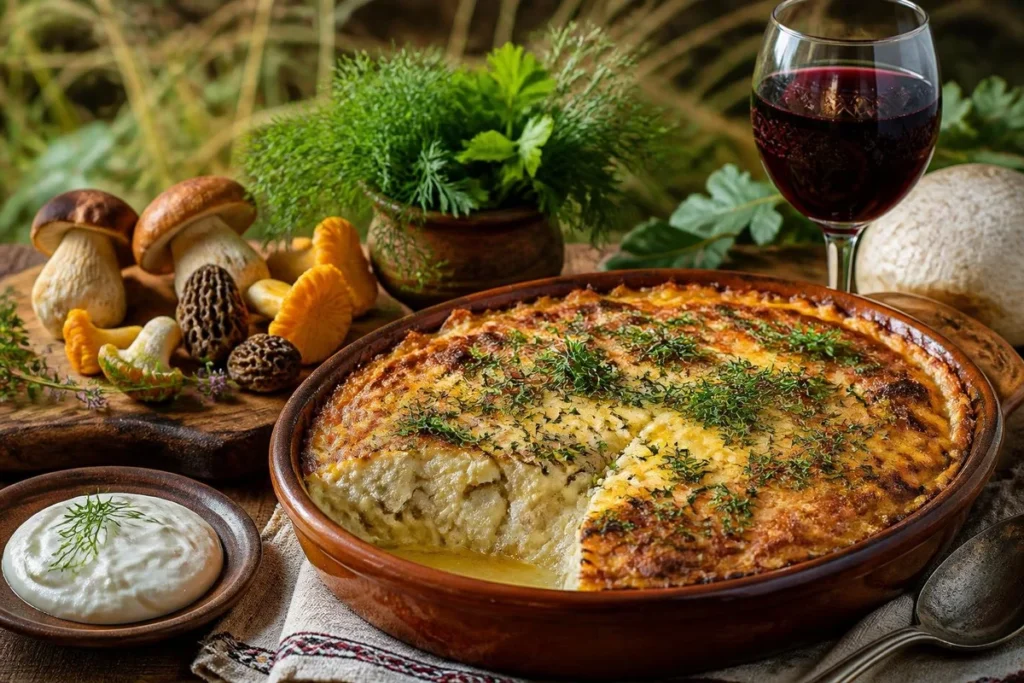
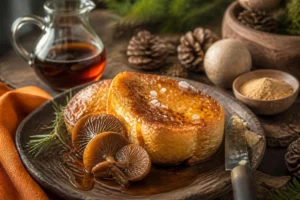
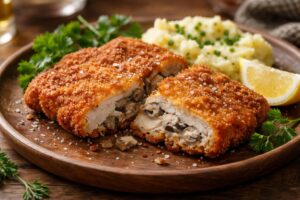
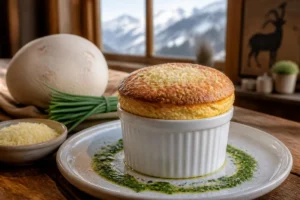
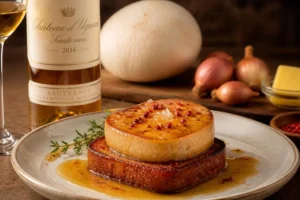
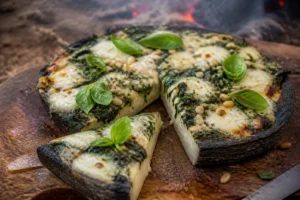
This technical execution explores the Lactic-Acid Protein Denaturation and Moisture-Retentive Baking of Calvatia gigantea. By utilizing the puffball's porous gleba as a structural absorbent for a kefir-based custard, we create a dish that balances the mushroom's airy histology with the tang and density of fermented dairy. The result is a savory, "cushion-like" casserole that mimics the soft, comforting texture of traditional Slavic Zapekanka, but with a purely mycological foundation.
Puffball Zapekanka with Forest Herbs and Kefir
This culinary protocol focuses on Intracellular Liquid Saturation and Protein Gelation. The Giant Puffball is essentially a biological scaffold of microscopic chambers. Through the technique of Lactic Infusion, we use kefir (fermented milk) to carry aromatics into these chambers. The natural acidity of the kefir initiates a subtle Structural Set within the mushroom's gleba, which, when combined with egg proteins and baked, transforms into a stable, savory custard that retains its volume and silkiness.
The Culinary Physics of This Dish
Calvatia gigantea behaves as a Multicellular Cushion. We employ Low-Heat Convection Consolidation. By baking the puffball cubes in a kefir-egg matrix at 170°C, we ensure that the moisture within the mushroom does not vaporize too rapidly. The kefir provides Lactic Volatiles that bridge the gap between the mushroom's neutral profile and the richness of the eggs. The addition of dill and wild thyme introduces Terpenic Aromatics that are "locked" into the custard as it sets, resulting in an intense release of forest scents upon consumption.
Terroir Narrative
Inspired by the rural kitchens of Bulgaria, Poland, and Ukraine, this dish reflects the soul of the Slavic forest interface. In these regions, where the Giant Puffball appears in the tall grasses bordering oak and birch forests, it is often treated with the same restorative reverence as cottage cheese or farm eggs. This recipe reflects the Cuisine of the Hinterland—taking a massive, foraged prize and baking it into a communal, nutrient-dense meal that celebrates the symbiotic relationship between fermented dairy and the wild harvest.
Prep Time
Bake Time
Complexity
Calories
Region
25 Mins
35 Mins
Grand Officier
280 kcal
Eastern Europe
Master Recipe (1:10 Rule)
600 g Giant Puffball (peeled, cut into 2cm cubes)
250 ml High-fat Kefir or Buttermilk
3 Large eggs (beaten)
100 g Kashkaval or aged white cheese (grated)
30 g Butter (melted)
Fresh Dill, Wild Thyme, and Parsley (finely chopped)
10 g Semolina (to dust the baking dish)
Sea Salt and White Pepper
The Technique
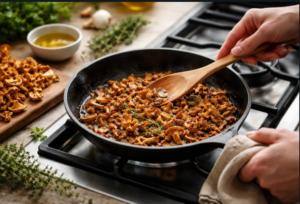
1. The Pre-Treatment: Sauté the puffball cubes briefly in butter for 3 minutes. This removes surface air and prepares the gleba for liquid absorption.
2. The Custard: Whisk together the kefir, eggs, melted butter, and the majority of the grated cheese. Fold in the fresh herbs. The mixture should be thick and vibrant green.
3. The Infusion: Add the sautéed puffball cubes to the custard. Let them sit for 10 minutes; they will act as a biological sponge, drawing the seasoned kefir into their core.
4. The Assembly: Butter a ceramic baking dish and dust with semolina. Pour the puffball-custard mixture in, leveling the top. Sprinkle the remaining cheese over the surface.
5. The Bake: Bake at 170°C for 30-35 minutes until the custard is set and the top is a pale golden brown. The Zapekanka should wobble slightly in the center but be firm to the touch.
6. Service: Allow to rest for 5 minutes before slicing. Serve with a dollop of cold sour cream. The contrast between the warm, herbal mushroom custard and the cold, tart cream is a hallmark of the Slavic palate.
Shop Integration
The creamy, herbal profile of this Zapekanka is a perfect partner for our shop's premium delicacies. You can increase the earthy depth by layering sautéed Boletus edulis (Boletus edulis) or Craterellus cornucopioides (Craterellus cinereus) between the puffball layers. For a floral top-note, garnish with the small caps of Marasmius oreades (Marasmius oreades) or ribbons of raw Amanita caesarea (Amanita caesarea). For a royal finish, serve alongside a glass of tea infused with Cantharellus cibarius (Cantharellus cibarius) aromatics. For an elite seasonal presentation, use our Morchella (Morchella conica) to create a dark, savory broth to pour over the Zapekanka at the table.
The Umami Profile
This dish demonstrates Lactic-Acid Umami Potentiation. The free glutamates in the Puffball are naturally subtle, but they are dramatically amplified by the lipids in the eggs and cheese. The lactic acids in the kefir act as a "flavor catalyst," increasing the solubility of savory compounds on the tongue. The result is a profound Kokumi sensation—a perceived thickness and longevity of flavor that persists long after the final bite.
Sommelier’s Choice
Mavrud (Bulgaria): A local red wine with high tannins and notes of wild berries and forest floor. Its robust character and natural acidity provide an excellent bridge between the rich, cheesy custard and the herbal, earthy notes of the puffball Zapekanka.
THE ETYMOLOGICAL CHRONICLE
Bulgarian:Пърхутка (Parhutka) – Referring to the "puff" of spores, used here in its pristine, young, culinary state for baking.
Russian:Дождевик (Dozhdevik) – "Rain-mushroom," referring to its appearance after heavy downpours in the Slavic meadows.
German:Riesenbovist – Highlighting the massive scale which ensures enough material for a large family-sized bake.
Spanish:Pedo de lobo gigante – A name used in the rustic Pyrenees, where the mushroom is often baked with goat's milk and wild herbs.
To provide the best experiences, we use technologies like cookies to store and/or access device information. Consenting to these technologies will allow us to process data such as browsing behavior or unique IDs on this site. Not consenting or withdrawing consent, may adversely affect certain features and functions.
Functional
Always active
The technical storage or access is strictly necessary for the legitimate purpose of enabling the use of a specific service explicitly requested by the subscriber or user, or for the sole purpose of carrying out the transmission of a communication over an electronic communications network.
Preferences
The technical storage or access is necessary for the legitimate purpose of storing preferences that are not requested by the subscriber or user.
Statistics
The technical storage or access that is used exclusively for statistical purposes.The technical storage or access that is used exclusively for anonymous statistical purposes. Without a subpoena, voluntary compliance on the part of your Internet Service Provider, or additional records from a third party, information stored or retrieved for this purpose alone cannot usually be used to identify you.
Marketing
The technical storage or access is required to create user profiles to send advertising, or to track the user on a website or across several websites for similar marketing purposes.