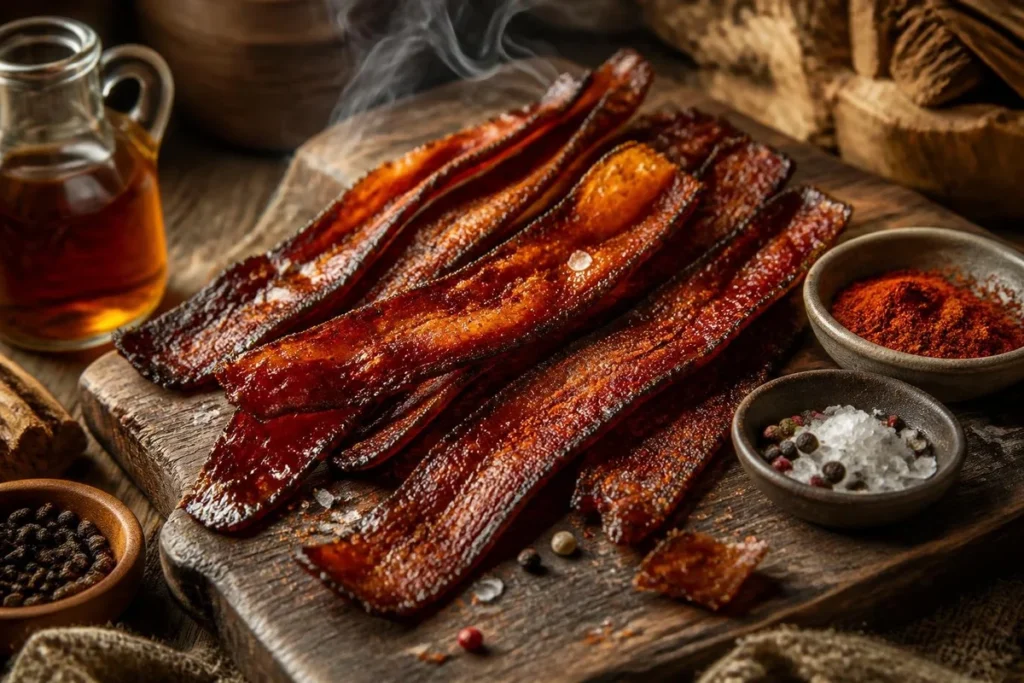
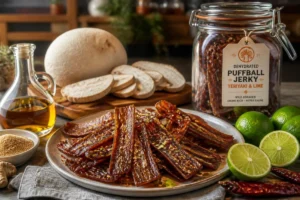
This technical execution explores the Cellular Compression and Phenolic Infusion of Calvatia gigantea. By subjecting the mushroom's porous gleba to a dual-stage process of osmotic dehydration and low-temperature convection, we collapse its airy matrix into a dense, leathery strip. This "mycological bacon" mimics the adipose-to-muscle ratio of traditional pork belly through the concentration of natural polysaccharides and the infusion of fat-soluble smoke volatiles.
Smoked Puffball Bacon Strips with Paprika
This culinary protocol focuses on Solute-Driven Matrix Collapse. The Giant Puffball is primarily composed of air-filled structural chambers. Through the technique of Osmotic Curing, we utilize salt and sugar to evacuate internal cellular water. As the mushroom dehydrates, the chambers collapse, creating a dense, elastic texture. When finished with a high-heat "crisping" phase, the concentrated sugars undergo the Maillard Reaction, producing a smoky, savory strip with a structural "snap" indistinguishable from cured pork.
The Culinary Physics of This Dish
Calvatia gigantea behaves as a Volatile Flavour Trap. We employ Lipid-Smoke Advection. By coating the dehydrated strips in a mixture of oil and smoked paprika (Pimentón), we introduce fat-soluble phenols that migrate into the compressed fibers. The paprika provides Capsaicinoid warmth and deep red pigments, while the smoking process (using beechwood or oak) introduces Guaiacol compounds, which the brain interprets as "meaty" and "cured."
Terroir Narrative
Inspired by the smokehouses of the Black Forest and the Carpathian Mountains, this dish adapts ancient preservation methods for the modern forager. In these regions, where the Giant Puffball (Riesenbovist) appears in massive quantities during the late summer, smoking was a primary method for extending the harvest. This recipe reflects the Räucherkammer philosophy—transforming a fleeting, soft fungus into a durable, umami-dense staple that captures the essence of wood-fire and winter survival.
Prep Time
Dehydration
Complexity
Calories
Region
20 Mins
4-6 Hours
Grand Officier
160 kcal
Central Europe
Master Recipe (1:10 Rule)
800 g Giant Puffball (peeled, sliced into 5mm thick "bacon" ribbons)
30 ml Soy sauce or Tamari (for amino-acid depth)
20 ml Maple syrup or honey (for caramelization)
10 g Smoked Paprika (Pimentón de la Vera)
5 g Liquid smoke (if not using a real smoker) or Beechwood chips
30 ml Neutral oil (high smoke point)
Black Pepper and Smoked Salt
The Technique
1. The Curing Bath: Whisk together the soy sauce, maple syrup, paprika, oil, and liquid smoke. This creates a Hypertonic Solution that will simultaneously flavor and dehydrate the mushroom.
2. Osmotic Infusion: Coat the puffball strips in the marinade. Let them sit for 30 minutes. The strips will become limp and significantly thinner as they release their internal water.
3. Thermal Dehydration: Arrange the strips on a wire rack or parchment-lined tray. Bake at 110°C (230°F) for 2-3 hours, or use a dehydrator at 65°C for 6 hours. The goal is to reach a "leathery" state where the strip is flexible but dry to the touch.
4. The Crisping Phase: Just before service, pan-fry the strips in a hot skillet with a teaspoon of oil. The residual sugars will rapidly caramelize. Fry for 30-45 seconds per side until the edges turn dark brown and crispy.
5. Resting: Place on a paper towel. As the strips cool, they will further harden, achieving the classic bacon "crunch."
6. Service: Use as a high-umami component in breakfasts, crumbled over salads, or as a structural garnish for creamy mushroom soups.
Shop Integration
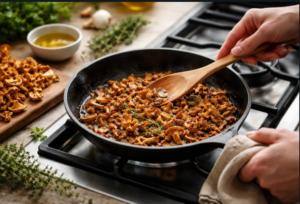
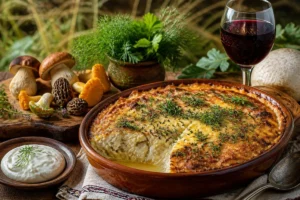
The intense, smoky profile of this "bacon" makes it an incredible flavor multiplier for our boutique species. You can crumble these strips over a risotto made with our Boletus edulis (Boletus edulis) to add a smoky top note. For a textural contrast, serve alongside sautéed Cantharellus cibarius (Cantharellus cibarius), whose apricot-like notes harmonize with the maple glaze. If looking for a royal breakfast, serve with poached eggs and fresh Amanita caesarea (Amanita caesarea). For an elite seasonal touch, use the bacon strips as a "wrap" for our grilled Morchella (Morchella conica), creating a forest-derived "pigs in blankets" delicacy.
The Umami Profile
This dish demonstrates Evaporative Umami Concentration. By removing 70% of the mushroom's water weight, we spike the density of guanylate and glutamate. The addition of soy sauce provides exogenous amino acids, while the smoke provides phenolic compounds. Together, they create a Synergistic Umami reaction that lingers on the palate, satisfying the biological craving for salt, fat, and smoke (Kokumi).
Sommelier’s Choice
Rauchbier (Bamberg Smoked Beer): A traditional German lager brewed with malt smoked over beechwood fires. Its intense, ham-like smokiness and crisp finish provide an identical aromatic bridge to the puffball bacon, creating a unified sensory experience.
THE ETYMOLOGICAL CHRONICLE
German:Riesenbovist – Used in German smokehouses where large forest specimens were historically preserved alongside meats.
Italian:Vescia gigante – Common in the Apennines for creating "meatless" protein sources for long winter months.
French:Vesse-de-loup géante – Highlighting the scale of the mushroom, allowing for "full-length" bacon strips from a single globe.
Spanish:Pedo de lobo gigante – A rustic name used in the mountainous North, where smoke-drying is a traditional method of mycological preservation.
To provide the best experiences, we use technologies like cookies to store and/or access device information. Consenting to these technologies will allow us to process data such as browsing behavior or unique IDs on this site. Not consenting or withdrawing consent, may adversely affect certain features and functions.
Functional
Always active
The technical storage or access is strictly necessary for the legitimate purpose of enabling the use of a specific service explicitly requested by the subscriber or user, or for the sole purpose of carrying out the transmission of a communication over an electronic communications network.
Preferences
The technical storage or access is necessary for the legitimate purpose of storing preferences that are not requested by the subscriber or user.
Statistics
The technical storage or access that is used exclusively for statistical purposes.The technical storage or access that is used exclusively for anonymous statistical purposes. Without a subpoena, voluntary compliance on the part of your Internet Service Provider, or additional records from a third party, information stored or retrieved for this purpose alone cannot usually be used to identify you.
Marketing
The technical storage or access is required to create user profiles to send advertising, or to track the user on a website or across several websites for similar marketing purposes.