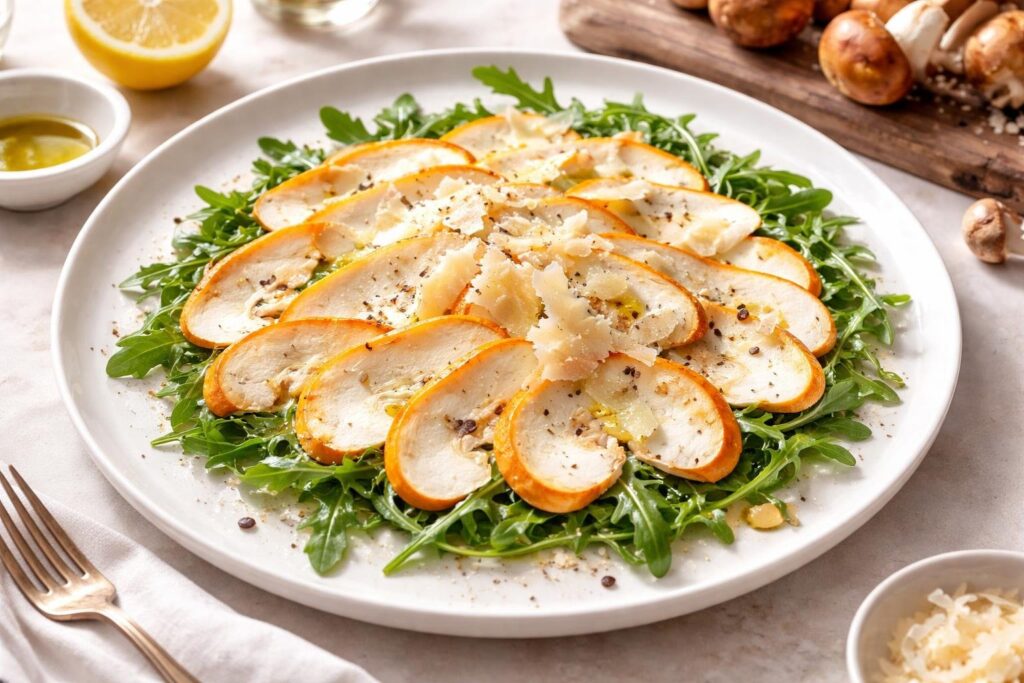
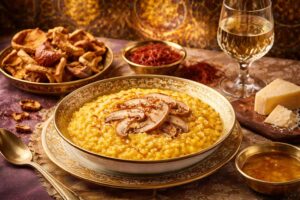
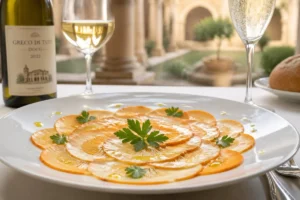
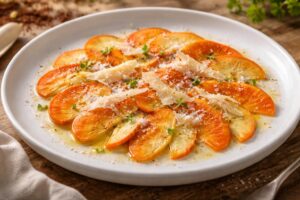
A luminous, high-precision masterpiece featuring the prestigious Amanita caesarea, served in its most honest, raw state to celebrate the mushroom once reserved for the tables of the Roman Emperors.
The Emperor’s Debut
Raw Slices of Amanita caesarea with Sorrento Lemon, Cold-Pressed Olive Oil, and 24-Month Parmigiano
The Historical Prelude
The Amanita caesarea, famously known as Caesar's Mushroom (or Boulka in the Balkans), is the most historically significant fungus in Western civilization. Historically, it was the only mushroom permitted to be served to the Roman Emperors. While the commoners gathered the field mushroom, the Boulka was considered the "Sun of the Forest," its orange cap and golden gills symbolizing the divine right of the Caesars.
In the sun-drenched regions of Italy and the Mediterranean Atlantic Fringes, this mushroom is traditionally eaten raw. Unlike most fungi, the Caesar's Mushroom possesses a crisp, hazelnut-like texture and a sweetness that is destroyed by excessive heat. This carpaccio represents the "Pure Umami" of the classical world—a dish that has remained unchanged since the banquets of Nero and Augustus.
The objective is Minimalist Interference. Because the Caesar's Mushroom is one of the few mushrooms safe and desirable to eat raw, our philosophy focuses on Acid-Lipid Balance. We use the citric acid of the lemon to slightly denature the mushroom proteins—effectively "cooking" them in cold acid—while the olive oil provides a lipid bridge that carries the mushroom's delicate hazelnut volatiles to the retro-nasal passage.
Terroir: The finest Boulka are found in the oak and chestnut forests of the Mediterranean and the Balkan Peninsula. The warm, dry soil of these regions produces specimens with a distinct buttery-nut finish.
Professional Protocol: We only use specimens in the "Ovoide" (egg) or newly opened "Umbrella" stage. In accordance with "Leave No Trace" ethics, we ensure the white volva (the base egg shell) is inspected to confirm the species and that mature specimens are left to drop spores for the next generation of Emperors.
Essential Equipment
Japanese Mandoline or Yanagiba Knife: For achieving paper-thin, translucent slices (1-2mm).
Chilled Ceramic Plate: To maintain the mushroom's crisp, structural integrity during service.
Microplane: For creating light, snow-like shards of Parmesan.
Master Recipe
Stage 1: The Imperial Slice
300g Fresh Caesar's Mushrooms (Boulka). Must be firm and pristine.
Clean the mushrooms with a soft brush; never use water. Trim the very base of the stem.
Using the mandoline, slice the entire mushroom (cap and stem) vertically to showcase the beautiful yellow-orange cross-section.
Stage 2: The Lipid Coating
Arrange the slices in a single layer on a chilled plate.
Drizzle immediately with 30ml of high-polyphenol Extra Virgin Olive Oil. This prevents oxidation and seals in the aroma.
Stage 3: The Acidic Spark
Just before serving, squeeze the juice of half a Sorrento Lemon over the slices.
Scatter 40g of shaved Parmigiano Reggiano (24-month) over the top.
Finish with a light dusting of cracked white pepper and Fleur de Sel. Serve within 2 minutes.
The Umami Secret: The 1:10 Slicing Synergy
The "Pure Umami" of this carpaccio is achieved through Surface Area Maximization. While we do not use dried mushrooms here, the 1:10 principle applies to the slicing: By slicing the mushroom 10 times thinner than a standard sauté wedge, you expose 10 times the amount of cellular guanylates to the palate. This creates an immediate savory impact that mimics the intensity of a concentrated mushroom stock, but in a fresh, cold format.
Pro Technique: The “Lemon-Timer”
To achieve a professional finish, never add the lemon juice more than 120 seconds before service. If left too long, the acid will turn the brilliant orange of the cap into a dull brown and soften the crisp texture. The lemon should be a "spark" that excites the mushroom, not a soak that pickles it.
The Art of Pairing
Sommelier's Choice: A Vermentino from Sardinia or a Greco di Tufo. The wine's saline minerality and citrus notes are structural mirrors to the raw mushroom and lemon.
Non-Alcoholic: Sparkling water with a slice of cucumber and a sprig of mint.
Ancestral Nutrition
Caesar's Mushrooms are an exceptional source of B-vitamins and Antioxidants. Historically, in the **Italian and Balkan** countryside, this mushroom was known as the "Forest Egg" due to its high protein density and life-giving nutrients, making it the perfect light meal for the heat of the late summer harvest.
Micro-FAQ
Q: Can I cook this mushroom? A: You can, but it is a culinary crime. Cooking the Boulka destroys its unique hazelnut volatiles and makes it rubbery. If you must, a 30-second flash-sear is the limit.
Q: How do I know it's a real Caesar's Mushroom? A: It must have an orange cap, yellow gills, and a yellow stem, sitting in a white "egg-shell" cup (volva). If the gills are white, DO NOT EAT IT; it may be a toxic Amanita.
To provide the best experiences, we use technologies like cookies to store and/or access device information. Consenting to these technologies will allow us to process data such as browsing behavior or unique IDs on this site. Not consenting or withdrawing consent, may adversely affect certain features and functions.
Functional
Always active
The technical storage or access is strictly necessary for the legitimate purpose of enabling the use of a specific service explicitly requested by the subscriber or user, or for the sole purpose of carrying out the transmission of a communication over an electronic communications network.
Preferences
The technical storage or access is necessary for the legitimate purpose of storing preferences that are not requested by the subscriber or user.
Statistics
The technical storage or access that is used exclusively for statistical purposes.The technical storage or access that is used exclusively for anonymous statistical purposes. Without a subpoena, voluntary compliance on the part of your Internet Service Provider, or additional records from a third party, information stored or retrieved for this purpose alone cannot usually be used to identify you.
Marketing
The technical storage or access is required to create user profiles to send advertising, or to track the user on a website or across several websites for similar marketing purposes.