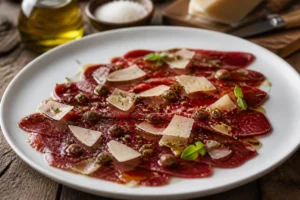
This technical execution focuses on the Organoleptic Simulation of Fegato alla Veneziana using Fistulina hepatica. By exploiting the mushroom's liver-like histology and its natural iron-rich aftertaste, we apply a rapid high-heat sauté technique to create a dish where the fungus mimics the texture and mineral depth of calf's liver, balanced by the high-fructose sweetness of slow-caramelized white onions.
Venetian Beefsteak Fungus Liver-Style with Onions
This culinary protocol explores the biomimetic potential of Fistulina hepatica within the framework of North-Italian Cucina Lagunare. The Beefsteak Fungus is unique in the mycological world for its "bleeding" juice and a texture that, when sliced thinly and seared, is virtually indistinguishable from high-grade calf's liver. We utilize a dual-stage cooking process to manage the mushroom's natural acidity while developing the deep savory crust required for a convincing liver substitute.
The Culinary Physics of This Dish
Fistulina hepatica possesses a vascular, almost spongy tissue that retains high levels of oxalic acid. We employ Alkaline-Acid Neutralization. By slow-cooking white onions until they reach full caramelization, we release concentrated sugars and alkaline compounds that buffer the mushroom's sharpness. During the high-heat sauté (sauter), the mushroom's surface sugars undergo rapid Maillard Browning, creating a "crust" that protects the tender, moist interior. The addition of a splash of vinegar or wine provides a final enzymatic lift that cuts through the rich lipids used in the pan.
Terroir Narrative
Inspired by the bacari of Venice, where Fegato alla Veneziana is a staple of the lagoon's culinary heritage, this dish bridges the gap between the butcher's stall and the oak groves of the Italian mainland. In the damp, forested areas surrounding the Venetian lagoon, the "Lingua di bue" has long been recognized as a "forest meat." This recipe reflects the Venetian mastery of balancing sweet and sour (agrodolce), transforming a wild fungus into a sophisticated centerpiece of Italian gastronomy.
Prep Time
Cook Time
Complexity
Calories
Region
20 Mins
25 Mins
Grand Officier
240 kcal
Veneto, Italy
Master Recipe (1:10 Rule)
500 g Fistulina hepatica (sliced into thin 5mm strips)
400 g White onions (sweet varieties like Tropea or Chioggia, thinly sliced)
40 g Unsalted butter (high fat)
30 ml Extra Virgin Olive Oil
15 ml Aged Balsamic Vinegar or dry white wine
10 g Flat-leaf parsley (finely chopped)
Sea Salt and Coarse Black Pepper
The Technique
1. The Onion Foundation: Heat olive oil and half the butter in a large skillet. Add the onions and cook over very low heat for at least 20 minutes. You want them to be jam-like and sweet, not browned. Remove and set aside.
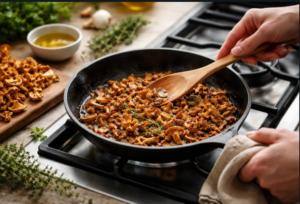
2. The Sear (The Mimicry): Clean the skillet and add the remaining butter and a touch of oil. Increase heat to high. Add the Fistulina hepatica strips in a single layer. Do not crowd the pan. Sauté for 2-3 minutes until the edges are crisp and the center remains pink and succulent.
3. The Deglazing: Return the onions to the pan. Add the balsamic vinegar or white wine. Scrape the pan (deglacer) to release the savory juices and mushroom "blood."
4. The Liaison: Toss the mixture gently for 60 seconds until the liquid has emulsified into a light, dark-red sauce coating the mushrooms and onions.
5. The Finishing: Season with salt and a generous amount of black pepper to emphasize the "liver" notes. Stir in the fresh parsley at the very last second.
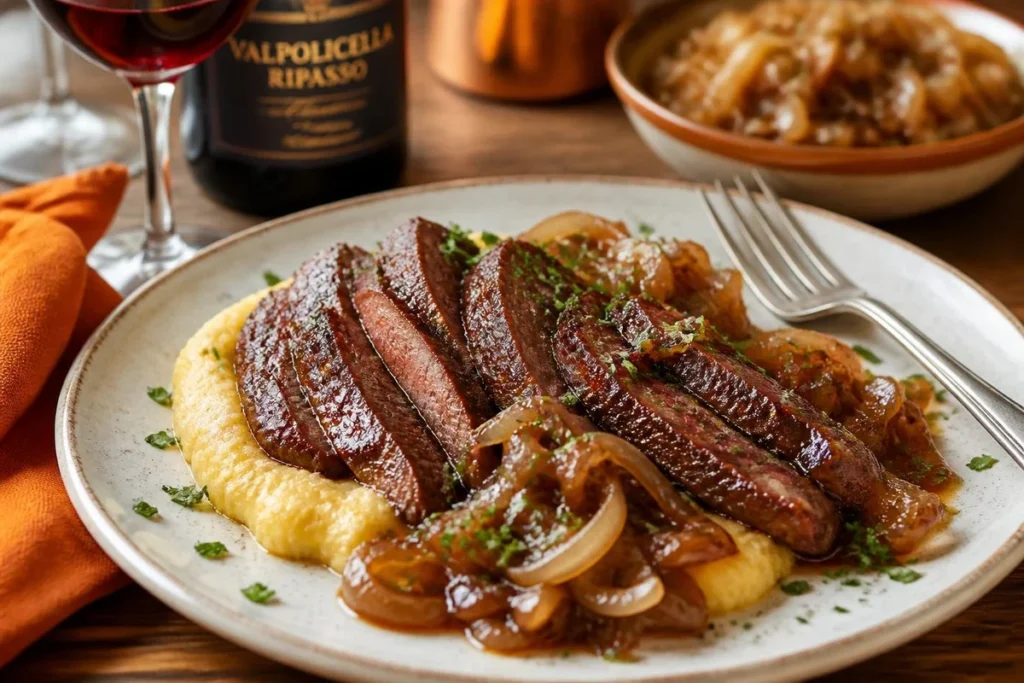
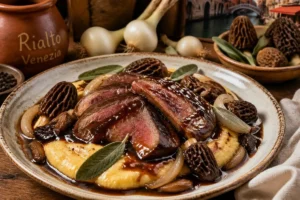
6. Service: Serve traditionally over a bed of creamy white polenta. The soft polenta provides the perfect neutral starch to absorb the mushroom's rich, tart juices.
Shop Integration
This liver-style preparation can be expanded into a true forest feast by adding other delicacies from our boutique. You can introduce a deeper, nuttier layer by adding sautéed Boletus edulis (Boletus edulis) or the concentrated earthiness of our Marasmius oreades (Marasmius oreades). For a visual pop and peppery finish, garnish with our Cantharellus cibarius (Cantharellus cibarius). If looking for a regal touch, slices of Amanita caesarea (Amanita caesarea) provide a noble, buttery counterpoint to the tartness of the Beefsteak Fungus. For a sophisticated smoky depth, consider incorporating Craterellus cornucopioides (Craterellus cinereus) or springtime Morchella (Morchella conica).
The Umami Profile
This dish demonstrates Dynamic Flavor Balancing. The free glutamates in the Beefsteak Fungus are elevated by the lipids in the butter and the sulfur compounds in the onions. The natural tannins in the mushroom provide a structure that mimics the mineral profile of calf's liver, resulting in an intense and long-lasting umami finish that satisfies the palate's biological "meat" requirements (kokumi).
Sommelier’s Choice
Valpolicella Ripasso: A structured yet fruity red wine from the Veneto. Its notes of cherry and spice, combined with its characteristic "ripasso" richness, match the intensity of the caramelized onions and the earthy, tart profile of the "liver" mushrooms.
THE ETYMOLOGICAL CHRONICLE
Italian:Lingua di bue – The standard Italian name, perfectly describing the mushroom's physical resemblance to a tongue.
French:Fistuline hépatique – Emphasizing the hepatic/liver-like qualities that make it a favorite for "meatless" French preparations.
German:Leberreischling – "Liver mushroom," the German common name that directly references its use as a liver substitute.
Spanish:Hígado de buey – "Ox liver," highlighting both the color and the mineral richness of the species.
To provide the best experiences, we use technologies like cookies to store and/or access device information. Consenting to these technologies will allow us to process data such as browsing behavior or unique IDs on this site. Not consenting or withdrawing consent, may adversely affect certain features and functions.
Functional
Always active
The technical storage or access is strictly necessary for the legitimate purpose of enabling the use of a specific service explicitly requested by the subscriber or user, or for the sole purpose of carrying out the transmission of a communication over an electronic communications network.
Preferences
The technical storage or access is necessary for the legitimate purpose of storing preferences that are not requested by the subscriber or user.
Statistics
The technical storage or access that is used exclusively for statistical purposes.The technical storage or access that is used exclusively for anonymous statistical purposes. Without a subpoena, voluntary compliance on the part of your Internet Service Provider, or additional records from a third party, information stored or retrieved for this purpose alone cannot usually be used to identify you.
Marketing
The technical storage or access is required to create user profiles to send advertising, or to track the user on a website or across several websites for similar marketing purposes.