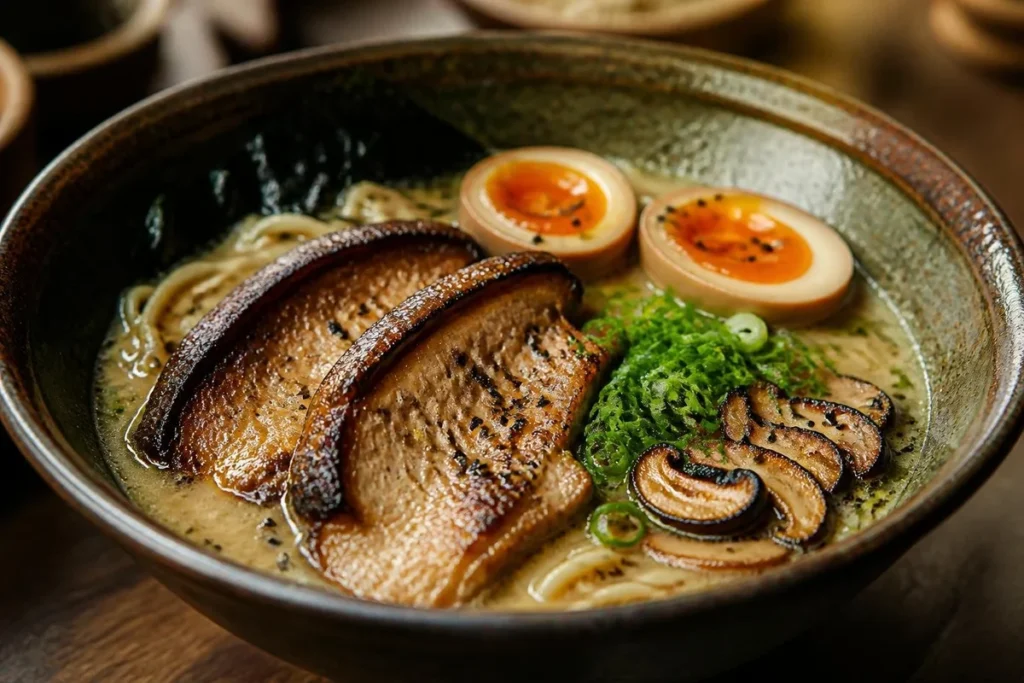
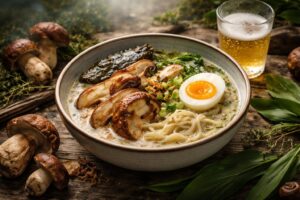
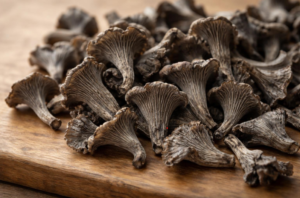
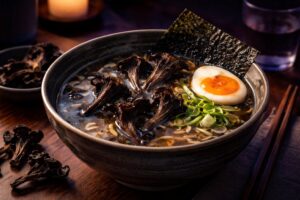
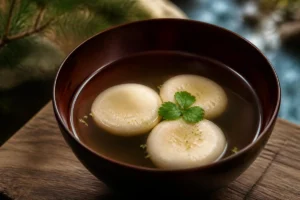
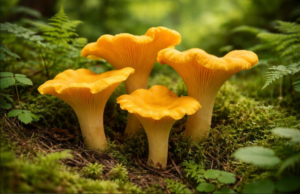
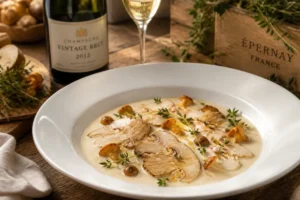
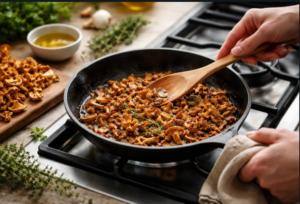
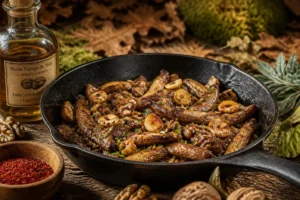
A fusion of Japanese precision and European foraged ingredients, featuring a deep, double-extracted Cerioporus broth, hand-pulled noodles, and charred "Wood Trout" slices.
Wood Trout Forest Ramen
The complexity of a world-class ramen lies in the depth of its dashi. In this modernist interpretation, the Cerioporus squamosus acts as both the primary aromatic donor for the broth and the centerpiece "chashu" substitute. By utilizing a double-extraction method—merging a long-simmered mushroom base with a quick, high-aromatic infusion—we capture the full spectrum of the Wood Trout's flavor, from deep forest earthiness to its fleeting, cucumber-like top notes. This dish represents the Grand Officier's ability to bridge Eastern technique with Western mycological treasures.
The Culinary Physics of This Dish
The core of this ramen is the emulsification of fungal lipids. Traditional ramen broths rely on animal fats to carry flavor; here, we utilize a Taro-base and toasted sesame oil to create a stable emulsion with the concentrated Cerioporus squamosus essence. During the "double-boil" process, we first extract the heavy glutamates from mature specimens, then finish the broth with thin ribbons of young mushrooms to preserve their delicate volatile esters. The alkaline noodles (containing kansui) provide a specific pH environment that enhances the perceived slipperiness and "snap" of the mushroom slices, creating a unified textural experience.
Terroir Narrative
This recipe imagines a meeting between the ancient oak forests of Europe and the ramen shops of Tokyo. Historically, Japanese cuisine has revered the Maitake and Shiitake, but the Cerioporus squamosus offers a unique, Western-terroir alternative with its substantial, meaty bite. By marinating the mushroom "chashu" in a blend of soy and mirin, we anchor the foraged ingredients in classical Japanese flavors. At Pure Umami, we see this Ramen as a global mycological dialogue, proving that the forest floor has no borders.
Prep Time
Cook Time
Complexity
Calories
Region
60 min
180 min
Grand Officier
540 kcal
Fusion / Global
Master Recipe (1:10 Rule)
500g Cerioporus squamosus (mature for broth, young for topping)
2L Pure spring water
100ml High-quality Shoyu (Soy Sauce)
2 Soft-boiled eggs (marinated in soy/mirin)
200g Fresh Ramen noodles
30ml Toasted Sesame Oil (Mayu)
20g Kombu (dried kelp)
Garnish: Scallions, Noriseed, and charred Wood Trout slices
The Technique
Prepare the Mushroom Dashi by simmering mature Cerioporus squamosus and kombu in water for 2 hours. Strain and combine with the shoyu tare. For the "chashu," sear thick, young mushroom slices in a hot pan until charred, then deglaze with a soy-mirin reduction. Cook the ramen noodles in alkaline water until al dente.
To assemble, place a portion of noodles in a deep bowl, pour over the boiling hot dashi, and arrange the charred mushroom slices, jammy eggs, and scallions on top. Finish with a drizzle of toasted sesame oil. The high heat of the broth will flash-cook the fresh scallions, releasing their sharp aromatics into the rich, earthy liquid, creating a synergistic aromatic explosion.
Shop Integration
To maximize the umami depth of your ramen broth, we recommend adding a few of our dried Marasmius oreades (Fairy Ring Mushrooms) during the dashi extraction. Their natural sweetness balances the salt of the soy perfectly. For a more intense forest profile, a dash of powdered Boletus edulis (Porcini) can be whisked into the tare to provide a grounding, savory base that supports the lighter Wood Trout notes.
The Umami Profile
This dish achieves **Triple-Action Umami**. The kombu provides glutamates, the Cerioporus squamosus provides 5′-guanylates, and the fermented soy sauce provides a complex range of amino acids. When these three sources meet, they trigger a "synergy effect" that makes the broth taste significantly more savory than the sum of its parts. This is the molecular secret behind the world's most addictive ramen bowls.
Sommelier’s Choice
A chilled **Junmai Ginjo Sake** is the ideal partner. Its clean, slightly fruity profile and rice-driven sweetness provide a refreshing counterpoint to the salt and deep umami of the ramen broth, while its smooth finish respects the delicate aromatics of the Wood Trout.
The Etymological Chronicle
Japanese:Mori no Masu-ramen – A poetic translation meaning "Ramen of the Forest Trout."
French:Ramen au Polypore – Focusing on the botanical classification within a modern fusion context.
German:Waldpilz-Ramen – A descriptive name for forest-mushroom-based ramen.
Spanish:Ramen de Madera – Referencing the "wood" origin of the mushroom in a trendy, urban setting.
Pure Umami | Mycological Research & Culinary Arts | 2026
To provide the best experiences, we use technologies like cookies to store and/or access device information. Consenting to these technologies will allow us to process data such as browsing behavior or unique IDs on this site. Not consenting or withdrawing consent, may adversely affect certain features and functions.
Functional
Always active
The technical storage or access is strictly necessary for the legitimate purpose of enabling the use of a specific service explicitly requested by the subscriber or user, or for the sole purpose of carrying out the transmission of a communication over an electronic communications network.
Preferences
The technical storage or access is necessary for the legitimate purpose of storing preferences that are not requested by the subscriber or user.
Statistics
The technical storage or access that is used exclusively for statistical purposes.The technical storage or access that is used exclusively for anonymous statistical purposes. Without a subpoena, voluntary compliance on the part of your Internet Service Provider, or additional records from a third party, information stored or retrieved for this purpose alone cannot usually be used to identify you.
Marketing
The technical storage or access is required to create user profiles to send advertising, or to track the user on a website or across several websites for similar marketing purposes.