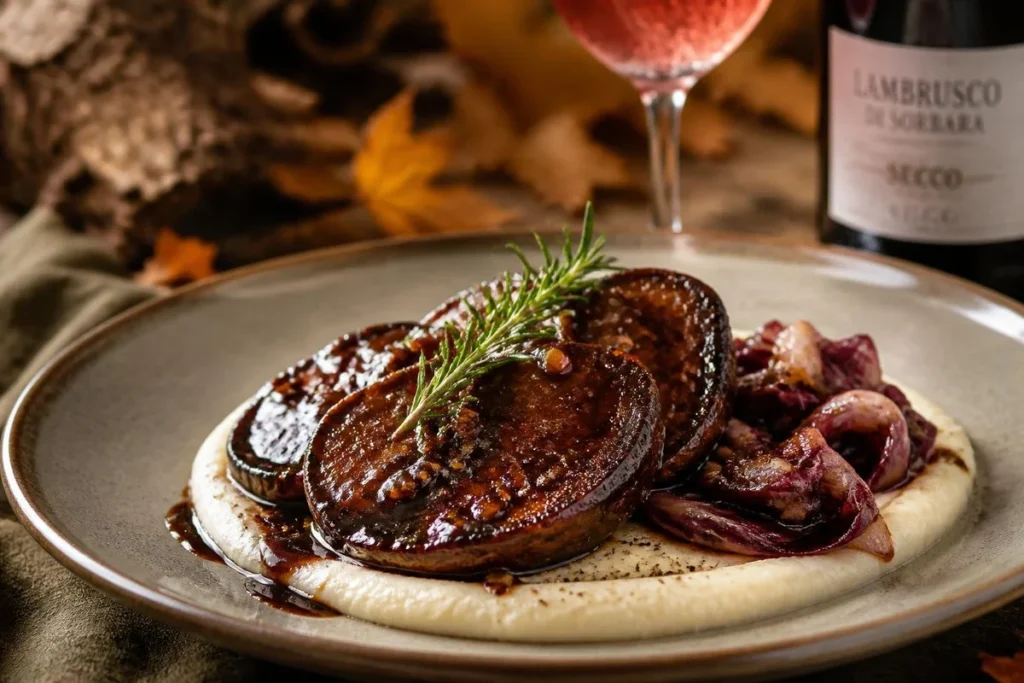
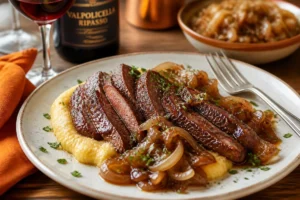
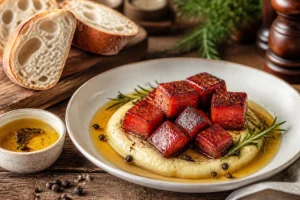
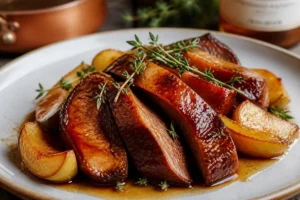
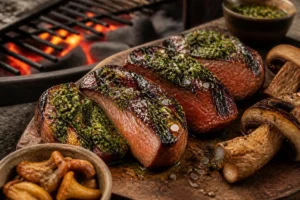
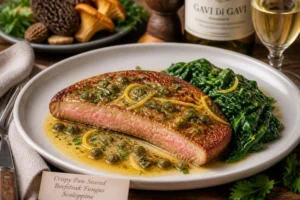
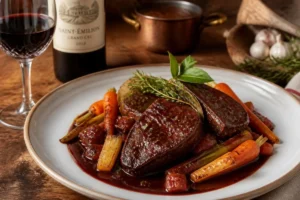
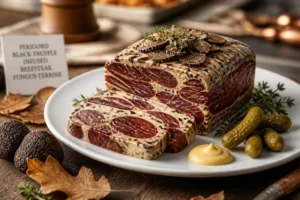
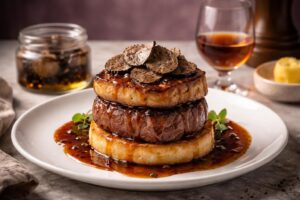
This technical execution explores the Hygroscopic Sugar Infusion of Fistulina hepatica using the complex saccharides of Traditional Balsamic Vinegar. By utilizing the mushroom's vascular porosity, we create a thermal environment where the natural oxalic acidity of the fungus is neutralized by the deep, woody sweetness of the Modena reduction, resulting in a lacquered "medallion" with the texture of a glazed filet mignon.
Balsamic Glazed Beefsteak Fungus from Modena
This culinary protocol focuses on Saccharide-Acid Inversion. The Beefsteak Fungus is naturally high in tannins and tart organic acids. Through the application of Aceto Balsamico di Modena, we utilize the high sugar density and low pH of the vinegar to penetrate the mushroom's fibrous "meat." During the reduction process, the mushroom's internal water is displaced by the viscous balsamic, creating a glossy, encapsulated glaze that transforms the foraged fungus into a sophisticated protein surrogate.
The Culinary Physics of This Dish
Fistulina hepatica possesses a poroid histological structure that facilitates Capillary Wick Absorption. We employ a two-stage thermal pulse. First, a high-heat sear creates a Maillard crust, sealing the internal juices. Second, a low-heat reduction allows the balsamic vinegar to thicken into a syrup (nappe). The vinegar's acetic acid works to further tenderize the mushroom's cross-linked fibers, while the wood-aged volatiles (oak, cherry, and juniper from the barrels) bridge the gap between the mushroom's forest aromatics and the culinary plate.
Terroir Narrative
Inspired by the "Food Valley" of Modena in the Emilia-Romagna region, this dish celebrates the intersection of artisan aging and forest foraging. In the ancient woodlands surrounding the Apennine foothills, the Beefsteak Fungus is a prized autumn treasure. This recipe pays homage to the Modenese tradition of using Aceto Balsamico to elevate simple proteins—in this case, replacing the classic beef medallion with a mycological "steak" that mirrors the region's passion for deep, complex umami.
Prep Time
Cook Time
Complexity
Calories
Region
15 Mins
20 Mins
Grand Officier
210 kcal
Emilia-Romagna, Italy
Master Recipe (1:10 Rule)
500 g Fistulina hepatica (sliced into 2cm thick rounds/medallions)
60 ml Aceto Balsamico di Modena (IGP or Traditional)
40 g Cold cultured butter (to emulsify the glaze)
15 ml Extra Virgin Olive Oil
1 Small shallot (finely minced)
1 Sprig of fresh rosemary
Sea Salt and Coarse Black Pepper
The Technique
1. The Primary Sear: Heat the olive oil in a stainless steel skillet until shimmering. Season the Fistulina hepatica medallions with salt. Sear for 3 minutes per side until they develop a dark, caramelized exterior. Remove and keep warm.
2. The Aromatic Base: In the same pan, add the minced shallot and the rosemary sprig. Sauté until the shallot is translucent, utilizing the remaining mushroom juices.
3. The Glazing: Pour the balsamic vinegar into the pan. Bring to a simmer and reduce by half until the liquid becomes viscous and coats the back of a spoon.
4. The Reintroduction: Return the medallions to the pan. Baste them continuously with the reducing balsamic for 2-3 minutes. The mushroom will absorb the vinegar, turning almost black and glossy.
5. The Liaison: Turn off the heat and whisk in the cold butter. This will create a velvety, stable emulsion that tempers the sharpness of the vinegar and adds a luxurious mouthfeel.
6. Service: Serve over a bed of parsnip purée or alongside sautéed bitter greens (like radicchio). The bitterness of the greens provides a perfect structural counter-note to the sweet, glazed mushroom.
Shop Integration
This glaze technique is an excellent foundation for pairing with other items from our boutique. You can introduce a different textural dimension by serving with whole roasted Boletus edulis (Boletus edulis) or crispy-fried Cantharellus cibarius (Cantharellus cibarius). For a royal display, garnish with shaved Amanita caesarea (Amanita caesarea). If looking for an intense earthy boost, a few drops of Craterellus cornucopioides (Craterellus cinereus) oil in the purée complements the balsamic depth, while Morchella (Morchella conica) could be sautéed and used as a porous garnish to hold the extra glaze.
The Umami Profile
This dish demonstrates Agrodolce Umami Amplification. The free glutamates in the Beefsteak Fungus are concentrated by the evaporation of moisture, while the polyphenols and complex sugars in the balsamic vinegar act as flavor catalysts. The addition of butter provides lipids that extend the savory signals across the tongue, resulting in an intense Kokumi (mouthfulness) that mimics the profile of aged, high-quality beef.
Sommelier’s Choice
Lambrusco di Sorbara (Secco): A dry, sparkling red from Modena. Its high acidity and vibrant bubbles cleanse the palate of the rich balsamic glaze, while its notes of wild strawberry and violet provide a beautiful floral contrast to the earthy mushroom.
THE ETYMOLOGICAL CHRONICLE
Italian:Lingua di bue – "Ox tongue," identifying the shape and density that allows for steak-style preparations.
French:Fistuline hépatique – Highlighting the "liver-like" color and mineral richness prized in continental gastronomy.
Spanish:Hígado de buey – In Spain, this refers to the "ox liver" appearance, especially when the mushroom is young and "bleeding."
German:Leberreischling – "Liver mushroom," the German common name that emphasizes its use as a meat analogue in traditional cooking.
To provide the best experiences, we use technologies like cookies to store and/or access device information. Consenting to these technologies will allow us to process data such as browsing behavior or unique IDs on this site. Not consenting or withdrawing consent, may adversely affect certain features and functions.
Functional
Always active
The technical storage or access is strictly necessary for the legitimate purpose of enabling the use of a specific service explicitly requested by the subscriber or user, or for the sole purpose of carrying out the transmission of a communication over an electronic communications network.
Preferences
The technical storage or access is necessary for the legitimate purpose of storing preferences that are not requested by the subscriber or user.
Statistics
The technical storage or access that is used exclusively for statistical purposes.The technical storage or access that is used exclusively for anonymous statistical purposes. Without a subpoena, voluntary compliance on the part of your Internet Service Provider, or additional records from a third party, information stored or retrieved for this purpose alone cannot usually be used to identify you.
Marketing
The technical storage or access is required to create user profiles to send advertising, or to track the user on a website or across several websites for similar marketing purposes.