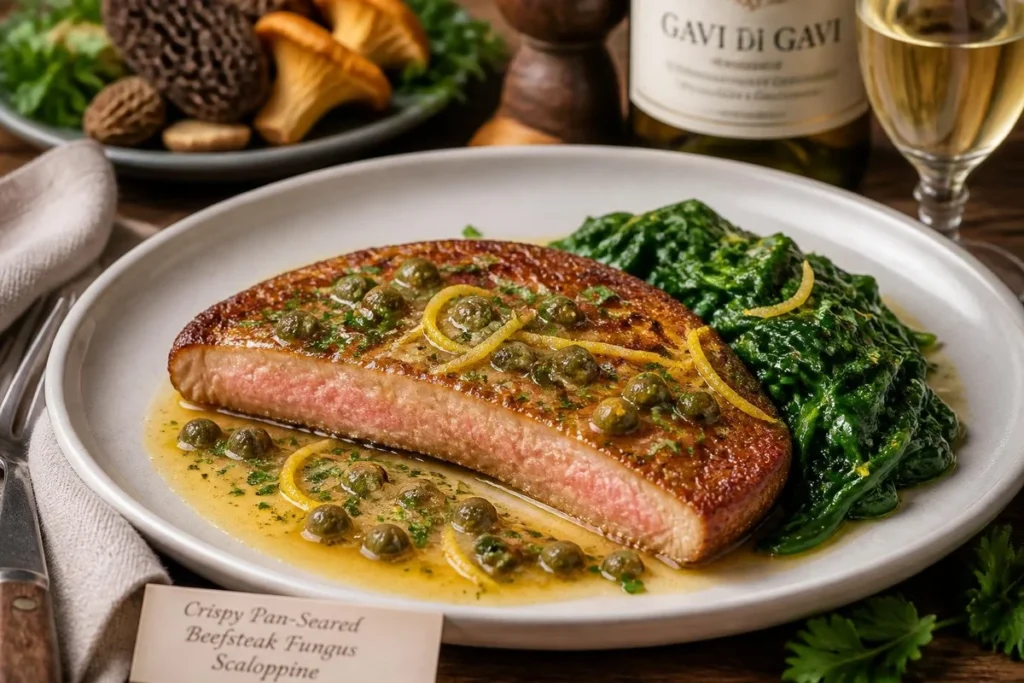
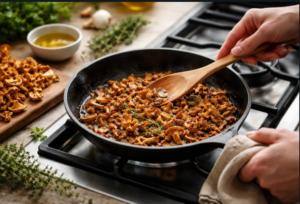
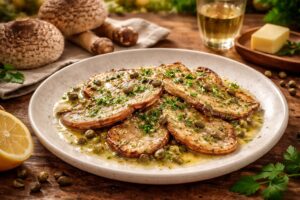
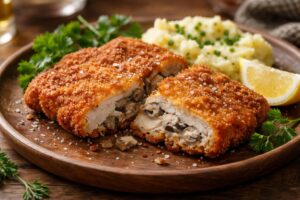
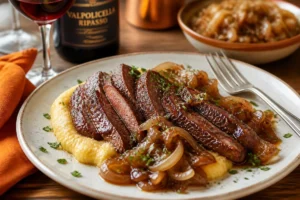
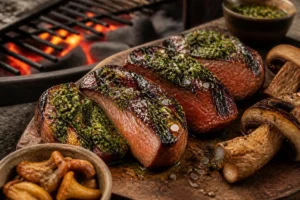
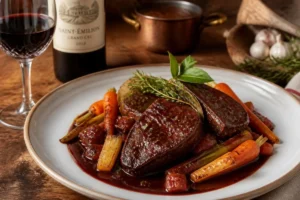
This technical execution explores the Hygroscopic Moisture Management of Fistulina hepatica. By applying a light dredging of flour and a rapid high-heat sear, we create a crisp, golden barrier that traps the mushroom's internal "blood" (red juice). This contrast between the crust's crunch and the succulent, slightly tart interior mimics the classic Italian Scaloppine, transforming the fibrous mushroom into a refined, meat-like delicacy.
Crispy Pan-Seared Beefsteak Fungus Scaloppine
This culinary protocol focuses on Surface Dehydration and Maillard Encapsulation. The Beefsteak Fungus is unique for its high moisture content and acidic juice. Through the technique of Scaloppine, we utilize a sacrificial starch layer (flour) to absorb surface moisture instantly upon contact with hot lipids. This allows for a rapid Maillard reaction, creating a savory crust that protects the mushroom's volatile organic acids and prevents the fibrous tissue from becoming rubbery through over-evaporation.
The Culinary Physics of This Dish
Fistulina hepatica possesses a structural matrix that behaves similarly to lean veal. We employ High-Heat Flash Searing. The mushroom's natural tannins react with the amino acids in the flour during searing to produce a deep, "beefy" flavor profile. Because the mushroom is naturally tart (oxalic acid), it requires no heavy marination; the heat concentrates these acids into a bright, citrus-like finish within the meat. The final deglazing with wine and lemon juice creates a Transient Emulsion that binds the rendered mushroom juices with the cooking fats.
Terroir Narrative
Inspired by the refined kitchens of Milan and Lombardy, this dish adapts the traditional Scaloppine al Limone for the mycological enthusiast. In the oak-rich foothills of the Italian Alps, the "Lingua di bue" has long been prized for its ability to mimic the tender texture of milk-fed veal. This recipe reflects the Italian mastery of semplicità—using high-quality foraged ingredients and precise technique to create a dish that is both rustic in origin and aristocratic in execution.
Prep Time
Cook Time
Complexity
Calories
Region
15 Mins
10 Mins
Grand Officier
280 kcal
Lombardy, Italy
Master Recipe (1:10 Rule)
500 g Fistulina hepatica (sliced into 1cm thick "scaloppine")
50 g Type "00" flour (for dredging)
40 g Clarified butter (Ghee) for high-smoke point searing
50 ml Dry white wine (Pinot Grigio or Gavi)
20 g Non-pareil capers (rinsed)
1 Organic lemon (juice and zest)
10 g Fresh parsley (finely chopped)
Sea Salt and White Pepper
The Technique
1. Tenderizing: Lightly pound the mushroom slices between two sheets of parchment paper. This breaks the densest fibers without rupturing the cell walls, ensuring a tender "veal-like" bite.
2. Dredging: Season the flour with white pepper. Pat the mushrooms dry and coat them lightly in the flour. Shake off all excess; a thick coating will lead to a soggy result.
3. The Sear: Heat the clarified butter in a stainless steel pan until shimmering. Sauté the mushroom slices for 2 minutes per side. They should be golden-brown and crisp on the outside while remaining pink and juicy in the middle.
4. The Sauce (Piccata Style): Remove the mushrooms to a warm plate. Deglaze the pan with the white wine, scraping up the flavorful sucs. Add the capers and lemon juice.
5. Emulsification: Swirl in a final teaspoon of cold butter to thicken the sauce and give it a glossy finish. Add the parsley and lemon zest.
6. Service: Pour the bright, acidic sauce over the scaloppine. Serve immediately with a side of sautéed spinach or light buttered noodles to provide a neutral base for the mushroom's tart intensity.
Shop Integration
The clean, pan-seared profile of these scaloppine can be further complexified by pairing them with other forest gems. Consider a side of sautéed Cantharellus cibarius (Cantharellus cibarius) for a peppery contrast, or use our Marasmius oreades (Marasmius oreades) to add a sweet, nutty dimension to the lemon-butter sauce. For an aristocratic display, garnish with thin ribbons of raw Amanita caesarea (Amanita caesarea). If you prefer a woodier foundation, serve alongside roasted Boletus edulis (Boletus edulis) or use rehydrated Morchella (Morchella conica) to absorb the lemon-caper reduction.
The Umami Profile
This dish demonstrates Acid-Linked Umami Potentiation. The free glutamates in the Beefsteak Fungus are naturally high, but the addition of citric acid from the lemon and the sodium from the capers acts as a chemical "brightener," making the savory signals more vibrant. The starch crust provides the necessary Maillard pyrazines, giving the brain the characteristic "cooked meat" olfactory cue (kokumi).
Sommelier’s Choice
Gavi di Gavi (Cortese): A crisp, flinty white wine from Piedmont. Its high acidity and notes of green apple and citrus peel are the perfect structural match for the lemon-caper sauce and the tart, meaty character of the Fistulina hepatica.
THE ETYMOLOGICAL CHRONICLE
Italian:Lingua di bue – Describing the tongue-like shape, often used for scaloppine-style preparations in Northern Italy.
French:Fistuline hépatique – Highlighting its similarity to liver, which is traditionally prepared with similar acidic sauces in France.
German:Ochsenzunge – "Ox tongue," referring to the density and substantial "bite" of the mushroom.
Spanish:Hígado de buey – "Ox liver," a name reflecting the dark red color and mineral richness of the raw fungus.
To provide the best experiences, we use technologies like cookies to store and/or access device information. Consenting to these technologies will allow us to process data such as browsing behavior or unique IDs on this site. Not consenting or withdrawing consent, may adversely affect certain features and functions.
Functional
Always active
The technical storage or access is strictly necessary for the legitimate purpose of enabling the use of a specific service explicitly requested by the subscriber or user, or for the sole purpose of carrying out the transmission of a communication over an electronic communications network.
Preferences
The technical storage or access is necessary for the legitimate purpose of storing preferences that are not requested by the subscriber or user.
Statistics
The technical storage or access that is used exclusively for statistical purposes.The technical storage or access that is used exclusively for anonymous statistical purposes. Without a subpoena, voluntary compliance on the part of your Internet Service Provider, or additional records from a third party, information stored or retrieved for this purpose alone cannot usually be used to identify you.
Marketing
The technical storage or access is required to create user profiles to send advertising, or to track the user on a website or across several websites for similar marketing purposes.