A technical examination of collagenous-lipid saturation and the stabilization of fungal umami within a high-viscosity, bovine-protein reduction.
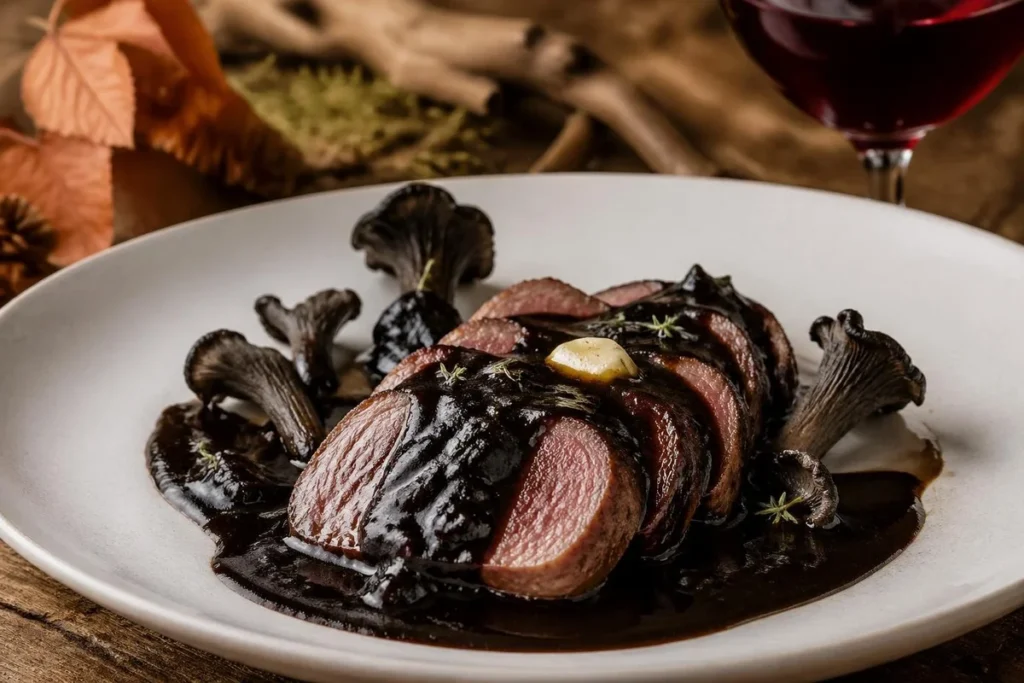
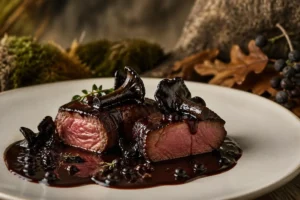
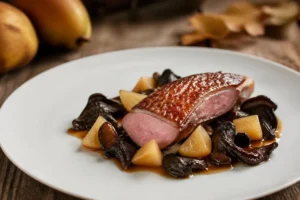
Beef Tongue with Black Trumpet Demi-Glace
In the discipline of nose-to-tail gastronomy, Beef Tongue is the ultimate canvas for texture-flavor integration. Pairing it with Black Trumpets is a technical exercise in "Black Umami" saturation. While the tongue provides an unparalleled, melt-in-the-mouth collagenous structure, the Black Trumpet offers the necessary oxidative tannins to balance the meat's high fat content. This preparation focuses on a long-duration braise where the fungal aromatics become part of the meat's structural moisture.
The Culinary Physics of This Dish
The core scientific principle is Gelatin-Polysaccharide Emulsification. Beef tongue is rich in connective tissue that, when simmered, transforms into a dense marine-like gelatin. Black Trumpets contain high levels of guanylate and pigments that are highly soluble in water-based reductions. During the reduction of the braising liquid into a demi-glace, these fungal pigments and nucleotides bond with the gelatin molecules, creating a stable, obsidian-colored lacquer that is significantly more savory than a standard meat reduction.
Furthermore, the Maillard reaction products from the final pan-searing of the tongue slices react with the smoky volatiles of the *Craterellus*. The mushroom's thin, funnel-like walls act as a capillary system, pulling the dark, viscous sauce into the mushroom's tissue, ensuring the garnish and the sauce act as a single, high-intensity flavor delivery unit.
Terroir Narrative
The rolling pastures and deep forests of Central Europe are the ancestral home of this pairing. Historically, beef tongue was a celebratory meal for the harvest season, coinciding with the peak of the Black Trumpet flush in the beech forests. This dish represents the "L'Essence de la Terre" (The Essence of the Earth)—a culinary dialogue between the slow, herb-grazing life of the cattle and the hidden, subterranean life of the forest fungi. It is a celebration of "Heavy Autumn," where flavors are concentrated, rich, and deeply traditional.
Prep Time
Cook Time
Complexity
Calories
Region
45 min
3-4 hours
Grand Officier
440 kcal
Central Europe
Master Recipe (The 1:10 Sauce Rule)
Following the 1:10 rule of professional glazing, the volume of the finished Black Trumpet demi-glace should be 1/10th of the weight of the meat slices to provide a definitive coating without overwhelming the protein's silken texture.
1 Beef Tongue (approx. 1.2kg, cleaned)
200 g Fresh Black Trumpets (kept whole)
1 L Brown Beef Stock
250 ml Red Wine (full-bodied)
2 Mirepoix vegetables (Carrot, Onion, Celery)
50 g Butter (for finishing)
To taste Salt and Black Peppercorns
The Technique
The Braise: Simmer the tongue with the mirepoix and half the wine in the beef stock for 3 hours until tender. Peel the skin while hot and let the meat cool in its own liquid. This ensures maximum juiciness.
The Reduction: Strain the braising liquid and reduce it by 80% with the remaining wine. This concentrates the gelatin and aromatics into a Black Gold consistency.
The Fungal Infusion: Add the Black Trumpets to the reduction in the final 5 minutes. The mushrooms will release their intense pigments, turning the sauce into a deep obsidian.
The Sear: Slice the cold tongue into 1cm medallions and sear them in a hot pan with a little butter to achieve a Maillard crust.
The Glaze: Pour the Black Trumpet demi-glace over the seared slices. Whisk in a cold knob of butter to create a high-gloss, technical finish.
"The tongue is the most patient muscle, and the Trumpet is the most patient fungus. Together, they require time to reveal their collective soul." – Executive Chef, Vienna
The Umami Profile
The umami profile of Craterellus is significantly amplified by the hydrolyzed bovine collagen. This interaction creates a "viscous-savory" profile that is a hallmark of European high-cuisine technical excellence. Pure Umami offers the finest wild-harvested specimens for your technical butchery projects.
Experience the precision of the forest with our Connoisseur-Grade Black Trumpets, selected for their aromatic clarity and structural resilience.
Sommelier’s Choice
A wine with high tannins and "leather" secondary notes is essential to match the intensity of the sauce. A Barolo or a Châteauneuf-du-Pape offers the necessary structure. For a white alternative, choose an Oxidative Rioja Blanco; its nutty, woody finish resonates perfectly with the smoky Morels and the rich tongue fat.
The Etymological Chronicle
In the culinary tradition, the tongue was known as pauvre homme (poor man's steak) but treated with royal care. Historically, Black Trumpets were the "truffle of the poor." This dish represents the meeting of these two "noble-poor" ingredients—a technical and seasonal fusion that has defined luxury for generations.
To provide the best experiences, we use technologies like cookies to store and/or access device information. Consenting to these technologies will allow us to process data such as browsing behavior or unique IDs on this site. Not consenting or withdrawing consent, may adversely affect certain features and functions.
Functional
Always active
The technical storage or access is strictly necessary for the legitimate purpose of enabling the use of a specific service explicitly requested by the subscriber or user, or for the sole purpose of carrying out the transmission of a communication over an electronic communications network.
Preferences
The technical storage or access is necessary for the legitimate purpose of storing preferences that are not requested by the subscriber or user.
Statistics
The technical storage or access that is used exclusively for statistical purposes.The technical storage or access that is used exclusively for anonymous statistical purposes. Without a subpoena, voluntary compliance on the part of your Internet Service Provider, or additional records from a third party, information stored or retrieved for this purpose alone cannot usually be used to identify you.
Marketing
The technical storage or access is required to create user profiles to send advertising, or to track the user on a website or across several websites for similar marketing purposes.