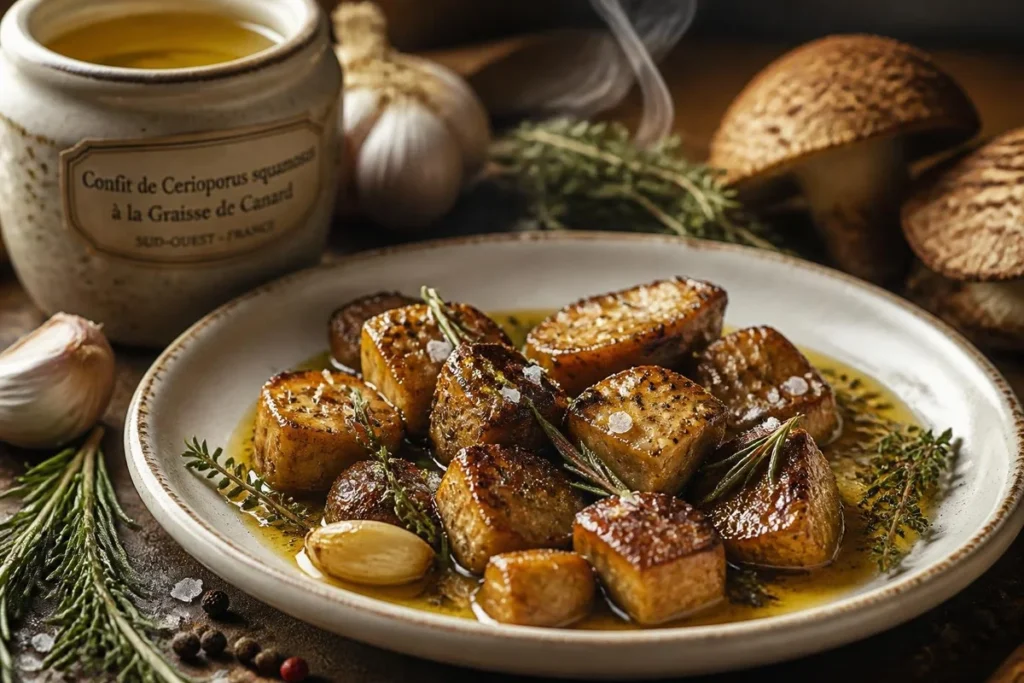
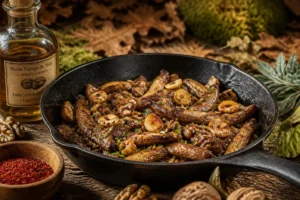
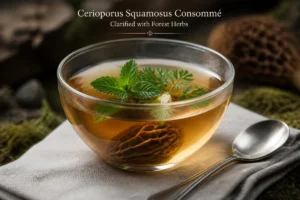
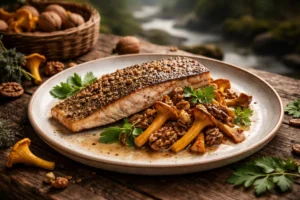
A luxurious French preservation technique that transforms the Wood Trout into a tender, buttery delicacy, slowly cooked in rendered duck fat and seasoned with rosemary smoked salt.
Cerioporus Squamosus Confit in Duck Fat
The confit method is one of the most revered pillars of French culinary heritage, traditionally reserved for noble meats of the Gascony region. When applied to Cerioporus squamosus, this technique serves a dual purpose: it fully tenderizes the mushroom's dense cellular matrix and replaces its aqueous cucumber notes with the rich, savory lipids of rendered duck fat. By poaching the "Wood Trout" at sub-boiling temperatures, we achieve a texture that is remarkably reminiscent of slow-cooked abalone or foie gras, creating a preservation-style dish that defines the Grand Officier approach to mycological arts.
The Culinary Physics of This Dish
The molecular transformation during a lipid-confit involves the total displacement of intracellular water with stable fats. Because Cerioporus squamosus has a porous underside, it acts as a biological sponge. At a constant temperature of 85°C, the mushroom's moisture slowly evaporates without causing the protein fibers to tighten (a process known as thermal contraction). As the water leaves, the duck fat—enriched with fat-soluble volatile compounds from rosemary and garlic—infiltrates the tissue. This results in a hydrophobic infusion, making the mushroom incredibly shelf-stable and creating a luxurious, melt-in-the-mouth consistency.
Terroir Narrative
This dish is a tribute to the rustic elegance of Southwest France (Sud-Ouest), where duck fat is the primary medium of the kitchen. Historically, foragers in the forests of Aquitaine would harvest Dryad's Saddle from fallen oak trees and preserve them in stone jars filled with fat to survive the winter months. At Pure Umami, we elevate this peasant tradition by utilizing molecular smoking techniques for the salt, bridging the gap between historical survivalism and modern-day molecular gastronomy.
Prep Time
Cook Time
Complexity
Calories
Region
20 min
120 min
Grand Officier
450 kcal
Gascony, FR
Master Recipe (1:10 Rule)
500g Young Cerioporus squamosus, cut into 2cm cubes
600ml Rendered Duck Fat (Graisse de Canard)
4 cloves Garlic, peeled and bruised
3 sprigs Fresh Rosemary
2 sprigs Thyme
15g Rosemary Smoked Sea Salt (for finishing)
2g Black Peppercorns, crushed
The Technique
Gently melt the duck fat in a heavy-bottomed pot (or cocotte) until it reaches exactly 85°C. Submerge the Cerioporus squamosus cubes, ensuring they are completely covered by the lipid. Add the garlic, rosemary, thyme, and peppercorns. Maintain the heat consistently for 2 hours; the mushrooms should not "fry" or bubble aggressively, but rather undergo a slow Poaching in the fat.
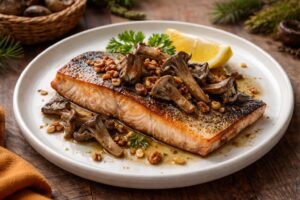
Once the mushrooms are translucent and tender, remove the pot from the heat and allow them to cool within the fat. This Cooling Infusion allows the flavors to settle. For service, remove the mushrooms from the fat and sear them briefly in a hot pan for 60 seconds to create a crisp exterior. Finish with a generous dusting of rosemary smoked salt to provide a molecular aromatic lift.
Shop Integration
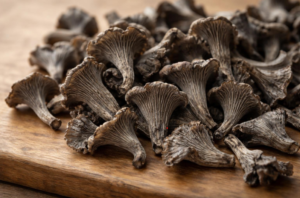
To add a layer of complexity to the confit, consider infusing the duck fat with a small amount of our Boletus edulis (Porcini) oil. Serving the confit alongside sautéed Craterellus cinereus (Black Trumpet mushrooms) provides a stunning visual contrast and a deep, autumnal flavor profile that complements the richness of the duck fat perfectly.
The Umami Profile
The umami in this dish is amplified through lipid-solubilization. Many of the flavor compounds in Cerioporus squamosus are fat-soluble, meaning they become more perceptible to the tongue when carried by a high-quality fat like duck grease. The addition of smoked salt triggers the trigeminal nerve, which enhances the overall perception of saltiness and savoriness, leading to an intensified umami experience that lingers on the palate.
Sommelier’s Choice
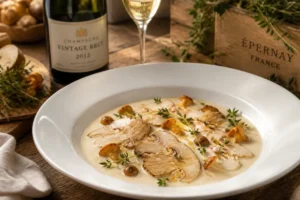
A bold Cahors (Malbec) from the Southwest of France is the essential pairing. Its high tannins and dark, "black" fruit character are robust enough to stand up to the richness of the duck fat, while its earthy undertones mirror the forest notes of the confit wood trout.
The Etymological Chronicle
French:Confit de Polypore – Derived from "confire," meaning to preserve, a staple of Occitan cuisine.
Italian:Fungo in Confit – Adopting the French terminology for high-end "sott'olio" (under oil) preparations.
German:In Entenfett gegarter Schuppenporling – A precise description of the "scaly porling cooked in duck fat."
Spanish:Confitado de Silla de Dríada – Poetically referencing the "Saddle of the Dryad" preserved in noble fats.
Pure Umami | Mycological Research & Culinary Arts | 2026
To provide the best experiences, we use technologies like cookies to store and/or access device information. Consenting to these technologies will allow us to process data such as browsing behavior or unique IDs on this site. Not consenting or withdrawing consent, may adversely affect certain features and functions.
Functional
Always active
The technical storage or access is strictly necessary for the legitimate purpose of enabling the use of a specific service explicitly requested by the subscriber or user, or for the sole purpose of carrying out the transmission of a communication over an electronic communications network.
Preferences
The technical storage or access is necessary for the legitimate purpose of storing preferences that are not requested by the subscriber or user.
Statistics
The technical storage or access that is used exclusively for statistical purposes.The technical storage or access that is used exclusively for anonymous statistical purposes. Without a subpoena, voluntary compliance on the part of your Internet Service Provider, or additional records from a third party, information stored or retrieved for this purpose alone cannot usually be used to identify you.
Marketing
The technical storage or access is required to create user profiles to send advertising, or to track the user on a website or across several websites for similar marketing purposes.