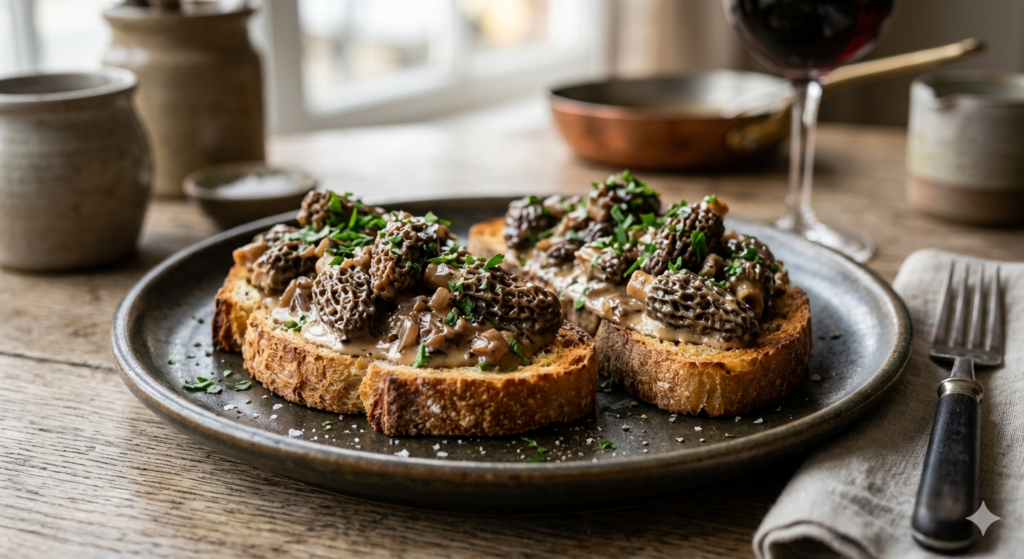
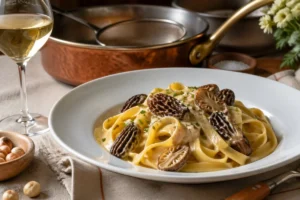
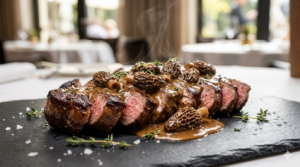
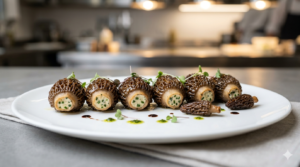
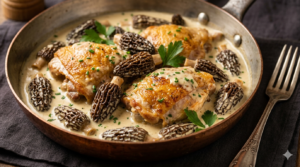
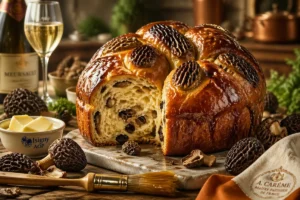
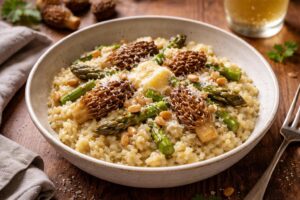
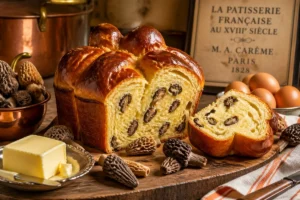
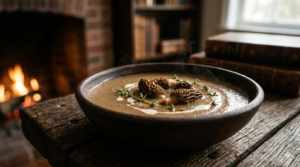
A sophisticated seasonal delicacy featuring the honeycomb-textured Morchella and the noble fortified wine of Madeira.
The Vernal Sovereign
Sautéed Morels in a Silken Madeira Reduction over Brioche
The Historical Prelude
The Morchella, or Morel, is the heralded messenger of spring in the European culinary calendar. Unlike the subterranean truffle, the Morel's fleeting appearance after the first spring rains made it a symbol of rebirth in the royal courts of the French Alps. Its distinctive honeycomb structure was once thought by medieval herbalists to be a gift from the gods, appearing where lightning had struck the earth.
By the 19th century, the great Antonin Carême, the "King of Chefs and Chef of Kings," began pairing these hollow treasures with fortified wines. Madeira, a wine that evolved through the heat of long sea voyages from the Atlantic islands to the courts of Europe, provided the perfect oxidative depth to match the Morel's smoky, nut-like profile. This specific preparation—Morels on Toast—became a staple at the Hôtel Ritz in Paris, served as a light but indulgent breakfast for the traveling aristocracy of the Belle Époque.
The Morel is a "vessel mushroom." Its unique internal cavity and external pits are designed by nature to hold sauce. Our philosophy focuses on the Reduction-Emulsion technique: transforming a sharp, fortified wine and heavy cream into a lacquer that coats the mushroom without overwhelming its delicate, earthy fiber.
Sensory & Foraging Profile
Nomenclature:Morchella esculenta (Yellow Morel) or Morchella elata (Black Morel).
Terroir: The finest Morels for this dish are found in the Atlantic Fringes and the Black Forest, often appearing near ash trees or in old apple orchards. The soil must be rich in calcium and wood-ash minerals to produce the deep, savory "forest floor" aroma.
Professional Protocol: Morels must never be eaten raw. They contain thermolabile toxins that are only neutralized through proper heat application. Professional foragers utilize a "Shake and Harvest" method to release spores from the honeycomb pits before placing the mushroom into a mesh basket.
Essential Equipment
Stainless Steel Sauté Pan: For precise control over the cream reduction.
Soft Pastry Brush: To clean the intricate honeycomb pits of the Morels.
Cast Iron Toaster or Grill: For achieving a "mottled" char on the brioche.
Clean the fresh mushrooms carefully. Slice larger Morels in half lengthwise to inspect the hollow interior for forest debris.
If using dried, the 1:10 ratio provides a significantly more intense flavor; reserve the filtered soaking liquid as a "Morel Jus."
Stage 2: The Aromatic Sauté
Heat 30g of clarified butter. Add 1 finely diced shallot and the 300g Fresh Morels (or 30g rehydrated equivalent).
Sauté for 6-8 minutes. The Morels must be thoroughly cooked until they release their moisture and begin to slightly "squeak" in the pan.
Stage 3: The Madeira Deglaze
Pour in 60ml of Madeira Wine (Sercial or Verdelho). Scrape the bottom of the pan to release the fond.
Reduce the wine by half, then add 150ml of high-fat double cream (Crème Fleurette).
Simmer until the sauce thickens to a nappe consistency (coats the back of a spoon). Season with a pinch of sea salt and white pepper.
The Umami Secret: Maillard & Nucleotide Synergy
Morels are outliers in the fungi world; they contain a high concentration of specific amino acids that, when combined with the Maillard reaction on the toasted brioche, create a "savory-sweet" bridge. The Madeira wine provides the acidity needed to "unlock" the glutamates bound in the mushroom's cell walls, resulting in a prolonged umami finish.
Pro Technique: The “Double Extraction”
For a true "Chef's Secret," if using rehydrated Morels (30g), reduce the soaking liquid separately until it becomes a thick syrup (a glace de champignons). Whisk this syrup into the cream at the final stage. This provides a dark, mahogany depth that fresh Morels alone cannot achieve.
The Art of Pairing
Sommelier's Choice: An oxidative Savagnin from the Jura or a dry Sherry (Amontillado). These wines mimic the nutty characteristics of the Morel.
Non-Alcoholic: A warm decoction of roasted chicory and dandelion root, which offers a sophisticated bitter contrast to the rich cream.
Ancestral Nutrition
Morels are historically prized for their high Iron and Copper content. In the folk medicine of the Pyrenees, they were consumed to "awaken the blood" after the dormant winter months. They also contain significant amounts of Vitamin D, rare for a non-animal food source.
Micro-FAQ
Q: Why is the 1:10 ratio so important for Morels? A: Morels are 90% water. When dried, their flavor compounds—particularly the smoky notes—become incredibly dense. 30g of dried Morels carries the aromatic weight of 300g of fresh ones.
Q: Can I use Port instead of Madeira? A: Port is often too sweet. Madeira's unique "maderized" (oxidized) profile is essential for balancing the earthiness of the fungi.
To provide the best experiences, we use technologies like cookies to store and/or access device information. Consenting to these technologies will allow us to process data such as browsing behavior or unique IDs on this site. Not consenting or withdrawing consent, may adversely affect certain features and functions.
Functional
Always active
The technical storage or access is strictly necessary for the legitimate purpose of enabling the use of a specific service explicitly requested by the subscriber or user, or for the sole purpose of carrying out the transmission of a communication over an electronic communications network.
Preferences
The technical storage or access is necessary for the legitimate purpose of storing preferences that are not requested by the subscriber or user.
Statistics
The technical storage or access that is used exclusively for statistical purposes.The technical storage or access that is used exclusively for anonymous statistical purposes. Without a subpoena, voluntary compliance on the part of your Internet Service Provider, or additional records from a third party, information stored or retrieved for this purpose alone cannot usually be used to identify you.
Marketing
The technical storage or access is required to create user profiles to send advertising, or to track the user on a website or across several websites for similar marketing purposes.