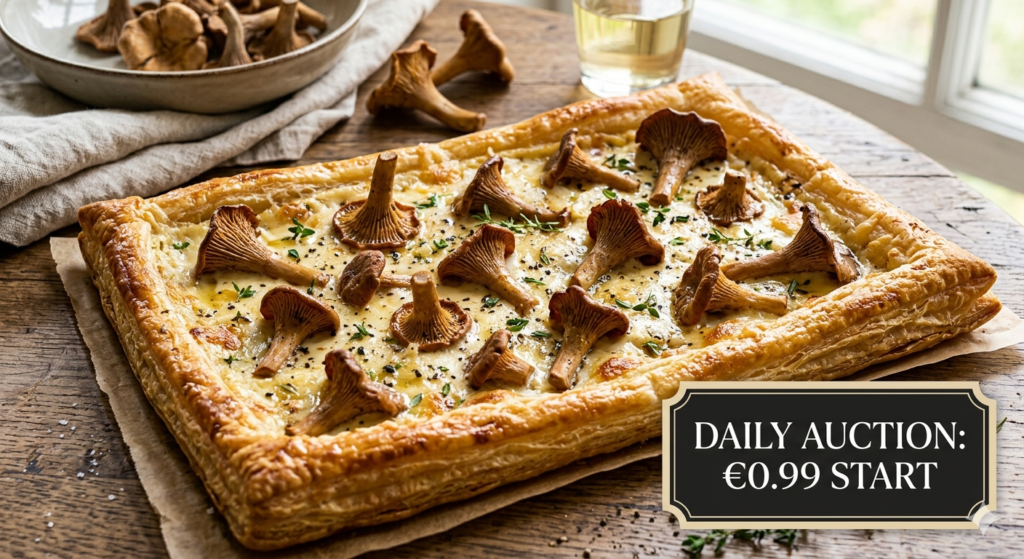
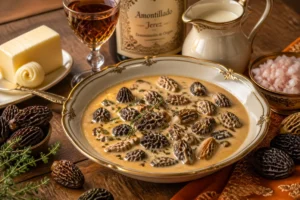
An exquisite savory tart featuring the peppery depth of Cantharellus cinereus and the mellow sweetness of slow-roasted garlic.
The Shadow Chanterelle Tart
A Melodic Blend of Wild Cantharellus and Caramelized Allium
The Historical Prelude
The Cantharellus cinereus, or Grey Chanterelle, has long lived in the shadow of its golden cousin, yet it has always been the preferred choice of the Dauphiné aristocracy for its superior aromatic complexity. Often confused with the "Trumpet of the Dead," the Grey Chanterelle was a prized ingredient in the 17th-century kitchens of Louis XIV. The Sun King's gardeners at Versailles were known to cultivate a deep respect for the wild "ash-colored" fungi that appeared in the palace's hunting grounds.
The savory tart—or flamiche—evolved from the monastic traditions of Northern France and the Black Forest. It was the legendary chef Marie-Antoine Carême who refined the crust into the buttery, short-crust Pâte Brisée we recognize today. By pairing the subtle smoke of the Grey Chanterelle with garlic roasted until it reached a jam-like consistency, French chefs created a dish that balanced the "earth" with "sunlight," a staple of autumn feasts in the French Alps.
This recipe is a study in "Aromatic Layering." The Grey Chanterelle possesses a delicate apricot-note masked by a damp-earth musk. To unlock this, we use the Roasted Garlic Emulsion as a base. The tart is not merely a carrier; the crust must be "short" and crumbly to contrast with the succulent, slightly elastic texture of the wild chanterelles.
Sensory & Foraging Profile
Nomenclature:Cantharellus cinereus (Grey Chanterelle) and Allium sativum (Hardneck Garlic).
Terroir: The Grey Chanterelle thrives in the Atlantic Fringes and the limestone soils of the Pyrenees. It is almost always found under deciduous trees, specifically ancient Beech and Oak. The soil's mineral composition gives this specific variety a metallic, peppery finish that is absent in golden varieties.
Professional Protocol: Unlike other fungi, Grey Chanterelles often grow in tight clusters. Foragers must use specialized "Fine-Tip" shears to harvest individual caps, ensuring the delicate moss and root systems are not torn, allowing for multiple "flushes" throughout the season.
Essential Equipment
Perforated Tart Ring: For ensuring a perfectly crisp bottom crust and "air-flow" during baking.
Marble Rolling Pin: To keep the butter in the pastry at a sub-ambient temperature.
Vitamix or High-Speed Blender: To achieve a molecularly smooth garlic-cream emulsion.
Master Recipe
Stage 1: The Pâte Brisée (The Foundation)
250g Type 00 Flour, 125g Cold AOP Charentes-Poitou Butter, 1 egg yolk, and a pinch of sel de Guérande.
Work the dough minimally. Chill for 2 hours before blind-baking at 180°C for 15 minutes.
2 whole heads of Garlic, roasted in foil with thyme and olive oil until soft.
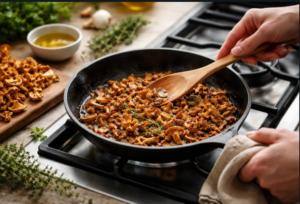
Sauté the 400g Fresh Chanterelles (or 40g rehydrated equivalent) in a dry pan first to release their "vegetal water," then finish with a touch of cultured butter.
Stage 3: The Assembly & Final Bake
Spread the roasted garlic paste over the bottom of the tart shell.
Whisk 200ml of Crème Fraîche with 2 eggs and a whisper of nutmeg. Fold in the sautéed Grey Chanterelles.
Pour into the shell and bake at 170°C for 25 minutes until the custard is set but still possesses a slight "jiggle" (the tremblant stage).
The Umami Secret: Sulfur & Glutamate Bonding
Grey Chanterelles are rich in sulfur-containing compounds which are biologically enhanced by the organosulfur molecules in the roasted garlic. This bonding creates a Hyper-Umami effect. By using the 1:10 ratio (40g dried for 400g fresh), you introduce a concentrated "mushroom flour" effect if you pulverize a small portion of the dried mushrooms into the tart crust itself.
Pro Technique: The “Dry-Searing” Method
Chanterelles are sponges. To prevent a "soggy" tart, always dry-sear the mushrooms in a hot pan without oil or butter for the first 2 minutes. This collapses the cellular structure and evaporates the excess moisture, ensuring the mushrooms "fry" in the tart's custard rather than "stew."
The Art of Pairing
Sommelier's Choice: A Chenin Blanc from the Loire Valley (Savennières). The wine's high acidity and "wet wool" or honeyed notes provide a stark, beautiful contrast to the peppery chanterelles.
Non-Alcoholic: A chilled infusion of Verjus and sparkling water, garnished with a bruised sprig of thyme.
Ancestral Nutrition
Grey Chanterelles are a significant source of Vitamin B12 and Fiber. Historically, they were known as the "Forest Liver" due to their high iron content, frequently served to mountain laborers in the Dolomites to combat fatigue.
Micro-FAQ
Q: Why use the 1:10 ratio for Grey Chanterelles? A: Grey Chanterelles lose exactly 90% of their mass during the dehydration process. To achieve the same "bite" and flavor density, 40g of dried is the mandatory substitute for 400g of fresh.
Q: Can I use pre-peeled garlic? A: Absolutely not. To achieve the "Pure Umami" depth, garlic must be roasted in its own skin (in papilloté) to steam in its own essential oils.
To provide the best experiences, we use technologies like cookies to store and/or access device information. Consenting to these technologies will allow us to process data such as browsing behavior or unique IDs on this site. Not consenting or withdrawing consent, may adversely affect certain features and functions.
Functional
Always active
The technical storage or access is strictly necessary for the legitimate purpose of enabling the use of a specific service explicitly requested by the subscriber or user, or for the sole purpose of carrying out the transmission of a communication over an electronic communications network.
Preferences
The technical storage or access is necessary for the legitimate purpose of storing preferences that are not requested by the subscriber or user.
Statistics
The technical storage or access that is used exclusively for statistical purposes.The technical storage or access that is used exclusively for anonymous statistical purposes. Without a subpoena, voluntary compliance on the part of your Internet Service Provider, or additional records from a third party, information stored or retrieved for this purpose alone cannot usually be used to identify you.
Marketing
The technical storage or access is required to create user profiles to send advertising, or to track the user on a website or across several websites for similar marketing purposes.