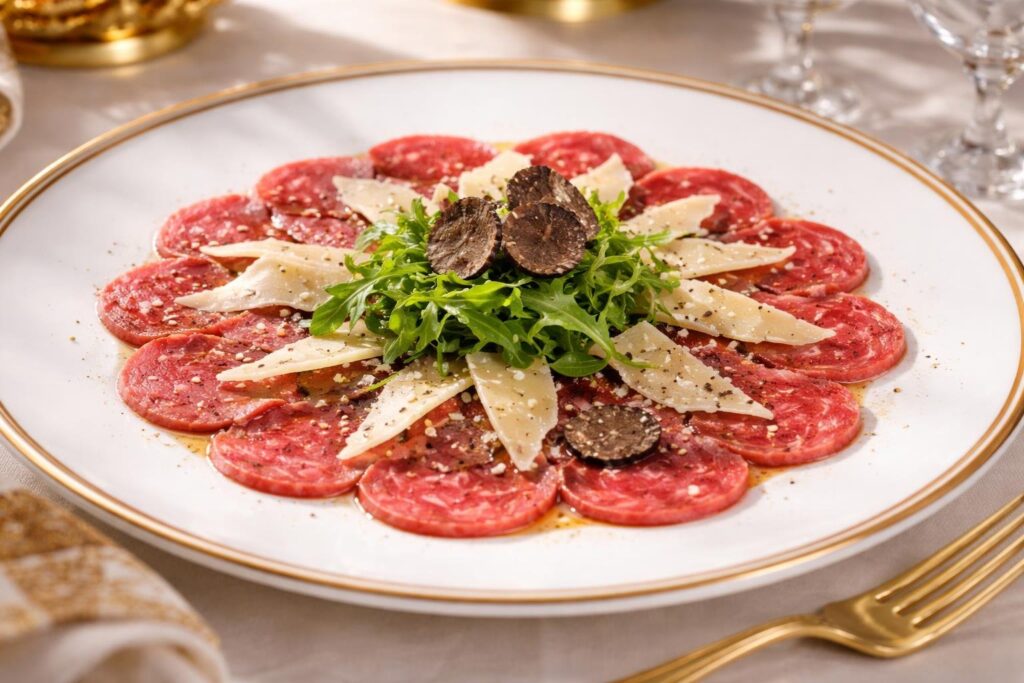
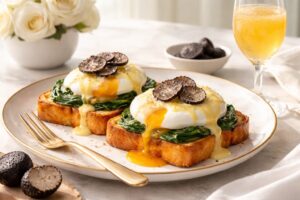
A prestigious high-precision masterpiece featuring the musky Tuber aestivum and prime aged beef in a silken lipid emulsion inspired by the opulence of the Sun King's court at Versailles.
The King’s Favorite
Dry-Aged Beef Fillet with Shaved Tuber Aestivum, Cold-Pressed Olive Oil, and Fleur de Sel
The Historical Prelude
The King's Favorite is a culinary tribute to the legendary appetite of Louis XIV and the dawn of Haute Cuisine at Versailles. Historically, the Tuber aestivum, or Black Summer Truffle, was the "Sun King's Diamond." While the winter truffle was rare and elusive, the Summer Truffle thrived in the sun-drenched soils of the Atlantic Fringes and the French Jura, appearing just as the court moved to its summer residences.
Louis XIV famously obsessed over the purity of ingredients. In the 17th-century Royal Kitchens, the transition from heavy medieval spices to the "natural essence" of the product began. The Summer Truffle, with its delicate aroma of toasted hazelnuts and damp earth, was the perfect partner for raw, prime beef. Historically, this dish represents the birth of the Carpaccio aesthetic—long before it bore an Italian name—where the beef's mineral depth was elevated by the truffle's musky volatiles.
This dish represents the "Versailles" school of Cold Gastronomy. It is a study in raw intensity and lipid-bonding. Historically, it was served at the Petit Couvert, where the King dined in view of his courtiers. The preparation required a master carver to slice the beef paper-thin, mirroring the delicate shavings of the truffle. It is a dish that demands an elite understanding of Aromatic Infusion—a "King's Favorite" that captures the olfactory essence of a French summer forest, refined through the technical excellence of the Bourbon and Modern French traditions.
Latin Nomenclature:Tuber aestivum (Black Summer Truffle).
Terroir: The most prestigious Summer Truffles are harvested from the chalky, well-drained soils of Provence and the Pyrenees. These regions produce truffles with a pale, hazelnut-colored interior and a subtle, sweet aroma of yeast and malt.
Leave No Trace Protocol: In accordance with French Truffle Ethics, we utilize trained lagotto romagnolo dogs to locate only the fully ripe specimens. We never "rake" the soil; each truffle is surgically extracted, and the earth is immediately replaced to protect the delicate mycelial network. This ensures the brûlée (the scorched-earth appearance around truffle trees) remains healthy for future summer cycles.
Essential Equipment
Professional Truffle Shaver: To achieve the 0.5mm "Petal" shavings required for the Tuber aestivum.
Surgical-Grade Slicing Knife: For the translucent, "paper-thin" sheets of aged beef.
Chilled Marble Platter: To maintain the thermal integrity of the raw lipids during service.
Master Recipe
Stage 1: The Imperial Prep
Select 300g of center-cut Beef Fillet (dry-aged for 28 days). Wrap tightly in film and freeze for 30 minutes to firm up for slicing.
Select 30g fresh Summer Truffle (the 1:10 equivalent of 300g fresh mushrooms). Clean with a soft brush and a whisper of cold water. Pat dry immediately.
Stage 2: The Slicing Ritual
Using the surgical knife, slice the beef into translucent sheets. Arrange them on the chilled platter so they barely overlap, like the scales of a mythical beast.
Brush the beef lightly with 20ml of Cold-Pressed Olive Oil.
Stage 3: The Sun King Finish
Adjust the truffle shaver to its finest setting. Shave the 30g of Summer Truffle directly over the beef.
The heat from the beef and the room will begin to "bloom" the truffle's volatiles.
Finish with a scattered dusting of Fleur de Sel and a few cracks of white pepper. Serve immediately with a side of toasted brioche.
The Umami Secret: The 1:10 Lipid-Hazelnut Bridge
The "Pure Umami" of the King's Favorite is achieved through Lipid-Volatile Infusion. Summer Truffles contain bis(methylthio)methane, which provides the musky, earthy scent. By utilizing the 1:10 rule (30g truffle to 300g beef equivalent), you create a high-density aromatic field. The fats in the aged beef act as a "flavor cage," trapping the truffle's hazelnut-scented volatiles. This results in a savory frequency where the beef's inosinates are magnified by the truffle's earthy aromatics, creating a lingering "Imperial" finish.
Pro Technique: The “Thermal Bloom”
To achieve a 3-star Michelin finish, never serve the carpaccio straight from the refrigerator. Allow the sliced beef to sit at room temperature for exactly 4 minutes before shaving the truffle. This "Thermal Bloom" ensures the beef's lipids are soft enough to immediately absorb the truffle's volatiles upon contact, turning the meat into a molecular sponge for the Tuber aestivum essence.
The Art of Pairing
Sommelier's Choice: A Vintage Champagne or a structured Chardonnay from the Côte de Beaune. The wine's brioche notes and acidity provide a structural mirror to the nutty truffle.
Non-Alcoholic: A sparkling White Grape juice with a splash of tonic.
Substitutions & Variations
Luxury Alternative: Finish with a few drops of Hazelnut Oil to amplify the truffle's natural profile.
Alpine Variant: Use Pecorino Romano shavings instead of Fleur de Sel for a more piquant, salty depth.
Storage & Reheating
This dish must be consumed within 10 minutes of preparation. Raw beef and fresh truffles lose their "Royal" integrity rapidly. Never reheat, as the beef will cook and the truffle's delicate volatiles will be permanently destroyed.
Ancestral Nutrition
Summer Truffles are a premier source of Phenolic Acids and Antioxidants. Historically, at Versailles, this combination was served to the Sun King to ensure metabolic vitality and provide a "nutritional shield" for his rigorous schedule of courtly duties and outdoor pursuits.
Micro-FAQ
Q: Why is the Summer Truffle less intense than the Winter Truffle? A: Its volatiles are more delicate, leaning toward hazelnut and yeast rather than the pungent garlic and musk of the winter variety. It is designed for lighter summer fare.
Q: Can I use truffle oil? A: For a professional result, only fresh Tuber aestivum provides the correct structural aromatic profile. Oil often tastes synthetic and masks the aged beef.
Q: Is the 1:10 rule mandatory? A: Yes. 30g of fresh truffle for 300g of beef ensures the "King's Favorite" aromatic density is achieved without overwhelming the palate.
To provide the best experiences, we use technologies like cookies to store and/or access device information. Consenting to these technologies will allow us to process data such as browsing behavior or unique IDs on this site. Not consenting or withdrawing consent, may adversely affect certain features and functions.
Functional
Always active
The technical storage or access is strictly necessary for the legitimate purpose of enabling the use of a specific service explicitly requested by the subscriber or user, or for the sole purpose of carrying out the transmission of a communication over an electronic communications network.
Preferences
The technical storage or access is necessary for the legitimate purpose of storing preferences that are not requested by the subscriber or user.
Statistics
The technical storage or access that is used exclusively for statistical purposes.The technical storage or access that is used exclusively for anonymous statistical purposes. Without a subpoena, voluntary compliance on the part of your Internet Service Provider, or additional records from a third party, information stored or retrieved for this purpose alone cannot usually be used to identify you.
Marketing
The technical storage or access is required to create user profiles to send advertising, or to track the user on a website or across several websites for similar marketing purposes.