An advanced technical study in "Protein-Substrate Hybridization," utilizing the flexible, porous cap of the Parasol mushroom to act as a structural foundation for salt-cured lipids and volatile herb esters, secured through thermal compression.
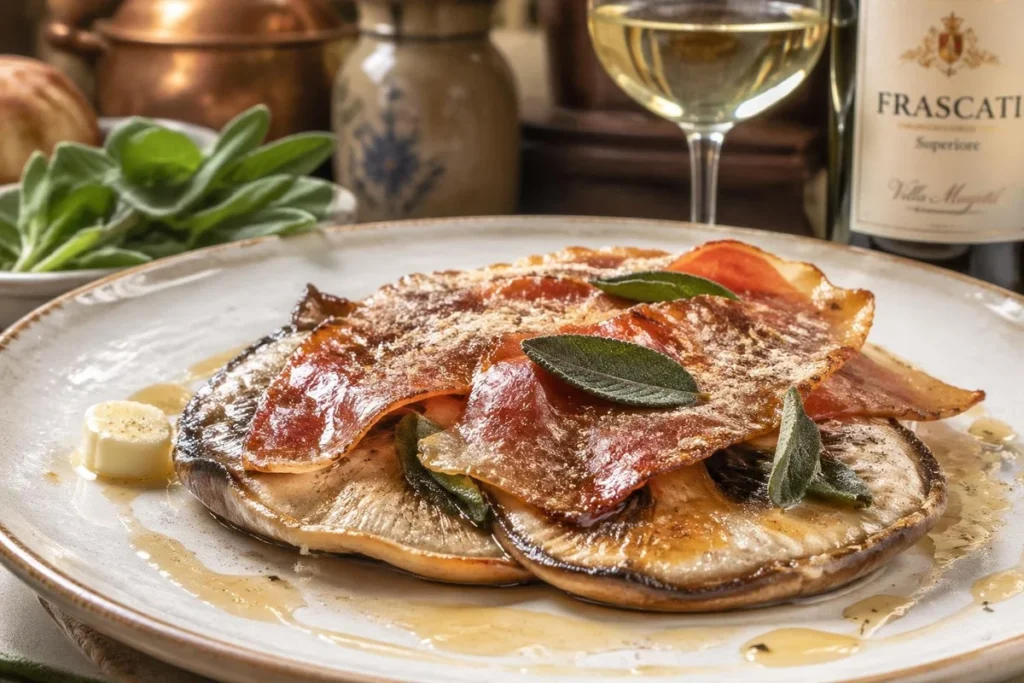
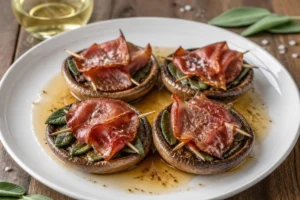
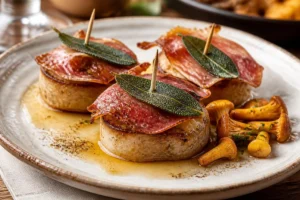
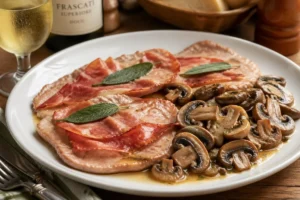
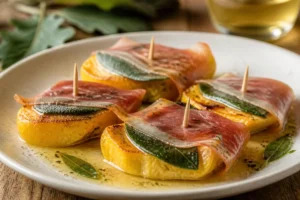
Macrolepiota procera “Saltimbocca” with Crispy Sage and Prosciutto
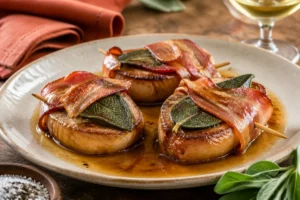
For our seventieth technical formulation, we analyze the Laminar Adhesion of the Roman kitchen. Macrolepiota procera (Parasol Mushroom), known as Macrolepiota procera, possesses a large, flexible cap that serves as a perfect botanical alternative to traditional veal escalopes. At pure-umami.cc, we utilize the mushroom's gills as a biological "velcro." By pressing thin slices of Prosciutto di Parma onto the gill surface, we create a fused protein-fungal unit that, when seared, translates into a singular, complex texture where the salt-cured fat bastes the mushroom from within.
The Culinary Physics of This Dish
The engineering of this Saltimbocca relies on Lipid Migration and Starch Gelatinization. Molecularly, as the prosciutto reaches 60°C, its intramuscular fats begin to render, flowing directly into the Macrolepiota procera's porous matrix. A light dusting of flour on the prosciutto side creates a protective starch barrier that facilitates a rapid Maillard reaction, locking the sage leaf's volatile oils (cineole and thujone) between the meat and the mushroom. This creates an internal "steam chamber" that tenderizes the mushroom while the exterior achieves a high-frequency crispness.
Terroir Narrative
This formulation is a tribute to the Lazio region of Italy, the birthplace of Saltimbocca alla Romana. We bridge the sophisticated salinity of the Mediterranean coast with the wild, earthy abundance of the Balkans. The terroir is expressed through the choice of aged prosciutto and fresh, resinous sage, which cuts through the deep nuttiness of the Macrolepiota procera. This follows the same technical rigor we apply to our Amanita caesarea (Caesar's mushroom) and Boletus edulis (Porcini), treating the mushroom as a structural canvas for classical European flavor profiles.
Quick Info Bar
Prep Time
Cook Time
Complexity
Region
15 mins
6 mins
Grand Officier
Rome, IT
Master Recipe (1:10 Rule)
4 Medium Macrolepiota procera caps (Macrolepiota procera) – cleaned
4 Slices of Prosciutto di Parma (sliced paper-thin)
8 Fresh Sage leaves
30g Flour (for dusting)
40g Unsalted Butter + 10ml Olive Oil
50ml Dry White Wine (Frascati or Pinot Grigio)
Fleur de Sel and Black Pepper (use salt sparingly)
Toothpicks (for mechanical stabilization)
The Technique
The Fungal Alignment: Place the **Macrolepiota procera** caps gill-side up. Arrange two sage leaves in the center of each cap. Lay a slice of prosciutto over the sage, pressing it firmly into the gills.
The Mechanical Bond: Use a toothpick to "stitch" the prosciutto and sage to the mushroom cap. This prevents the layers from curling away during thermal contraction.
The Starch Barrier: Dust *only* the prosciutto side of the assembly with a thin layer of flour. Shake off any excess—this layer must be microscopic to ensure a clean crisp.
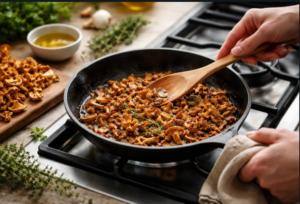
The High-Intensity Sauté: Melt butter and oil in a pan until foaming. Place the mushrooms in the pan, prosciutto-side down. Sauté for 2-3 minutes until the ham is crispy and gold. Turn carefully and cook the mushroom-skin side for 1-2 minutes.
The Wine Emulsion: Remove the mushrooms. Deglaze the pan with the white wine, scraping up the Maillard bits. Reduce by half and swirl in a tiny knob of cold butter to create a glossy sauce. Pour over the Saltimbocca and serve immediately.
Shop Integration
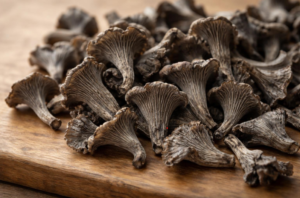
The Macrolepiota procera provides the ideal structural base, but its flavor can be reinforced. We recommend adding a fine dust of our dried Boletus edulis (Porcini) to the flour for an earthy boost. If you seek a brighter peppery contrast, garnish with sautéed Cantharellus cibarius (Chanterelle). For a luxury upgrade, finish the wine sauce with a few drops of Morchella conica (Morel) oil. If available, a side of raw Amanita caesarea (Caesar's mushroom) with lemon will provide a necessary mineral contrast. For a visual and smoky depth, our Craterellus cinereus (Grey Chanterelle) can be sautéed and served as a bed for the Saltimbocca. Our Marasmius oreades (Fairy Ring) can also be used if chopped and added to the deglazing sauce for an almond-aroma lift.
The Umami Profile
This dish features **Synergistic Umami Bonding**. The Macrolepiota procera provides the necessary fungal guanylates, while the cured prosciutto provides a high concentration of inosinates and glutamates. When combined, these molecules trigger a much more intense savory signal than they would individually. The sage provides a terpene-rich "spike" that cuts through the lipid density, resulting in a balanced, high-resolution palate profile.
Sommelier’s Choice
A crisp, dry **Frascati Superiore** or a **Vermentino**. The high acidity and saline minerality of these Italian whites are the technical requirement to balance the salt-cured prosciutto and the earthy, buttery depth of the Macrolepiota procera.
The Etymological Chronicle
The term Saltimbocca is **Italian**, meaning "jumps in the mouth." In **French**, this would be Coulemelles façon Saltimbocca. In **German**, it is Parasolpilz-Saltimbocca. In **Spanish**, it is Galamperna al Estilo Saltimbocca. Regardless of the language, the **Parasol** mushroom Saltimbocca remains the definitive standard for technical Roman-mycological fusion.
Pure Umami | Mycological Research & Culinary Arts | 2026
To provide the best experiences, we use technologies like cookies to store and/or access device information. Consenting to these technologies will allow us to process data such as browsing behavior or unique IDs on this site. Not consenting or withdrawing consent, may adversely affect certain features and functions.
Functional
Always active
The technical storage or access is strictly necessary for the legitimate purpose of enabling the use of a specific service explicitly requested by the subscriber or user, or for the sole purpose of carrying out the transmission of a communication over an electronic communications network.
Preferences
The technical storage or access is necessary for the legitimate purpose of storing preferences that are not requested by the subscriber or user.
Statistics
The technical storage or access that is used exclusively for statistical purposes.The technical storage or access that is used exclusively for anonymous statistical purposes. Without a subpoena, voluntary compliance on the part of your Internet Service Provider, or additional records from a third party, information stored or retrieved for this purpose alone cannot usually be used to identify you.
Marketing
The technical storage or access is required to create user profiles to send advertising, or to track the user on a website or across several websites for similar marketing purposes.