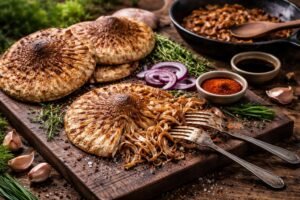
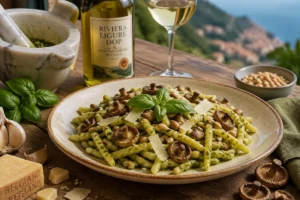
An advanced technical study in "Aromatic Friction and Lipid-Acid Contrast," utilizing a textured starch-herb crust to increase surface area for flavor adhesion, complemented by a high-frequency botanical emulsion.
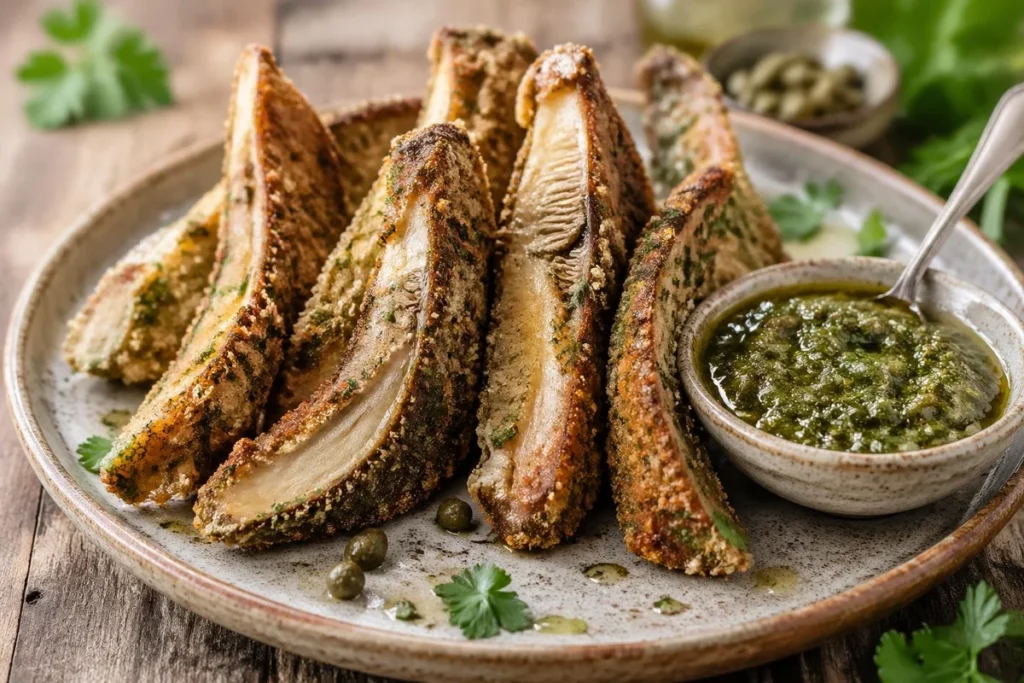
Herb-Crusted Parasol Mushroom Wedges with Salsa Verde
For our sixty-ninth technical formulation, we analyze the Surface-Area Maximization of the forest. Macrolepiota procera (Parasol Mushroom), locally known as Macrolepiota procera, is uniquely suited for wedges because its radial gills act as structural "ribs" during the breading process. At pure-umami.cc, we utilize a chlorophyll-infused crust. By integrating fresh parsley and basil directly into the breading matrix, we protect the mushroom's delicate almond-esters with a fragrant herbal shield. The Salsa Verde—a sharp, acidic emulsion—serves to "unlock" the heavy lipids of the crust, ensuring a balanced, high-resolution palate experience.
The Culinary Physics of This Dish
The engineering of this dish relies on Starch-Protein Crosslinking and Acidic Surfactants. Molecularly, the egg-wash acts as a biological glue, binding the breadcrumbs to the mushroom's chitinous skin. During frying, the water in the herbs evaporates, leaving behind concentrated chlorophyll and essential oils within the crust. The Salsa Verde functions as a chemical surfactant; its high vinegar and caper content breaks down the surface tension of the frying oil, allowing the mushroom's guanylates to interact more directly with the tongue's receptors, preventing "palate fatigue" from the fried exterior.
Terroir Narrative
This formulation is a tribute to the Piedmont region of Italy, where Salsa Verde is the traditional companion to rich proteins. We bridge this northern Italian heritage with the Balkan highland meadows, where the Macrolepiota procera thrives in the late summer humidity. The terroir is expressed through the choice of vibrant, sun-drenched herbs and the mineral salinity of Mediterranean capers. This follows the same technical rigor we apply to our Cantharellus cibarius (Chanterelle) and Boletus edulis (Porcini), treating the crust as a protective botanical envelope.
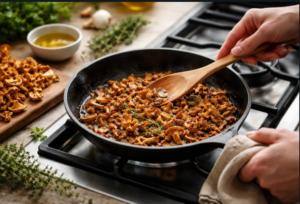
The Herbal Panure: Combine the breadcrumbs with the minced herbs. The herbs must be bone-dry to prevent the crumbs from clumping. This ensures an even, green-flecked crust.
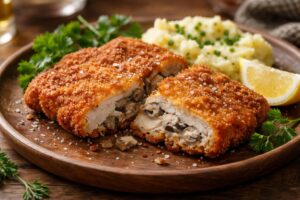
The Coating Sequence: Dredge the **Macrolepiota procera** wedges in flour, then egg, then the herb-crumb mixture. Press firmly to ensure the crumbs fill the spaces between the gills.
The Temperature-Controlled Fry: Heat oil to 175°C. Fry the wedges for 2-3 minutes per side. The temperature must be high enough to crisp the crumbs but not so high that the fresh herbs turn bitter and brown.
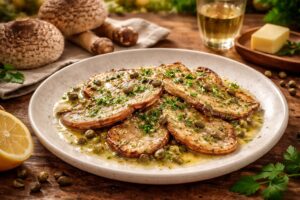
The Emulsion Synthesis: Pulse the Salsa Verde ingredients in a mortar or blender until a coarse, vibrant green sauce forms. The anchovies provide a "stealth umami" that bridges the forest and the sea.
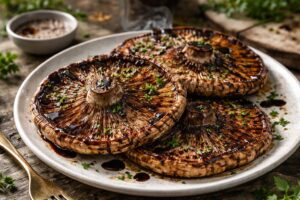
Plating: Arrange the crispy wedges vertically to maintain crunch. Serve the Salsa Verde in a separate vessel to allow for precise "dipping" ratios.
Shop Integration
The Macrolepiota procera provides the necessary structural volume, but its flavor can be layered. We recommend adding a fine dust of our dried Boletus edulis (Porcini) to the flour stage for an earthy depth. If you seek a brighter peppery contrast, garnish with sautéed Cantharellus cibarius (Chanterelle). For a luxury upgrade, finish the Salsa Verde with a few drops of Morchella conica (Morel) oil. If available, a side of raw Amanita caesarea (Caesar's mushroom) with a squeeze of lemon will provide a necessary mineral contrast to the fried wedges. For a visual and smoky depth, our Craterellus cinereus (Grey Chanterelle) can be minced into the Salsa Verde itself.
The Umami Profile
This dish features **Contrast-Driven Umami**. The Macrolepiota procera provides the guanylates, while the anchovies in the Salsa Verde provide the inosinates. When combined, these two molecules create a "synergistic umami" effect that is exponentially stronger than either alone. The fresh herbs provide "top-notes" that elevate the savory base, resulting in a flavor profile that feels light and garden-fresh despite being fried.
Sommelier’s Choice
A crisp **Gavi di Gavi (Cortese)** or a dry **Vermentino**. The high acidity and citrus-pith notes of these Italian whites are the technical requirement to match the Salsa Verde and cut through the crispy, lipid-rich crust of the Macrolepiota procera.
The Etymological Chronicle
The term Salsa Verde is **Italian**, meaning "green sauce." In **French**, this would be Coulemelles en Croûte d'Herbes et Sauce Verte. In **German**, it is Kräuter-Parasol mit Grüner Sauce. In **Spanish**, it is Galamperna Empanada con Salsa Verde. Regardless of the language, the **Parasol** mushroom herb-crusted wedges remain the definitive standard for technical botanical-mycological fusion.
Pure Umami | Mycological Research & Culinary Arts | 2026
To provide the best experiences, we use technologies like cookies to store and/or access device information. Consenting to these technologies will allow us to process data such as browsing behavior or unique IDs on this site. Not consenting or withdrawing consent, may adversely affect certain features and functions.
Functional
Always active
The technical storage or access is strictly necessary for the legitimate purpose of enabling the use of a specific service explicitly requested by the subscriber or user, or for the sole purpose of carrying out the transmission of a communication over an electronic communications network.
Preferences
The technical storage or access is necessary for the legitimate purpose of storing preferences that are not requested by the subscriber or user.
Statistics
The technical storage or access that is used exclusively for statistical purposes.The technical storage or access that is used exclusively for anonymous statistical purposes. Without a subpoena, voluntary compliance on the part of your Internet Service Provider, or additional records from a third party, information stored or retrieved for this purpose alone cannot usually be used to identify you.
Marketing
The technical storage or access is required to create user profiles to send advertising, or to track the user on a website or across several websites for similar marketing purposes.