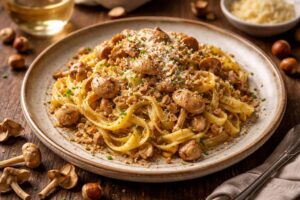
A technical study of mechanical herb emulsification and the stabilization of monounsaturated fats using Marasmius oreades. This post analyzes the role of fungal chitin in Genovese "Pesto" traditions.
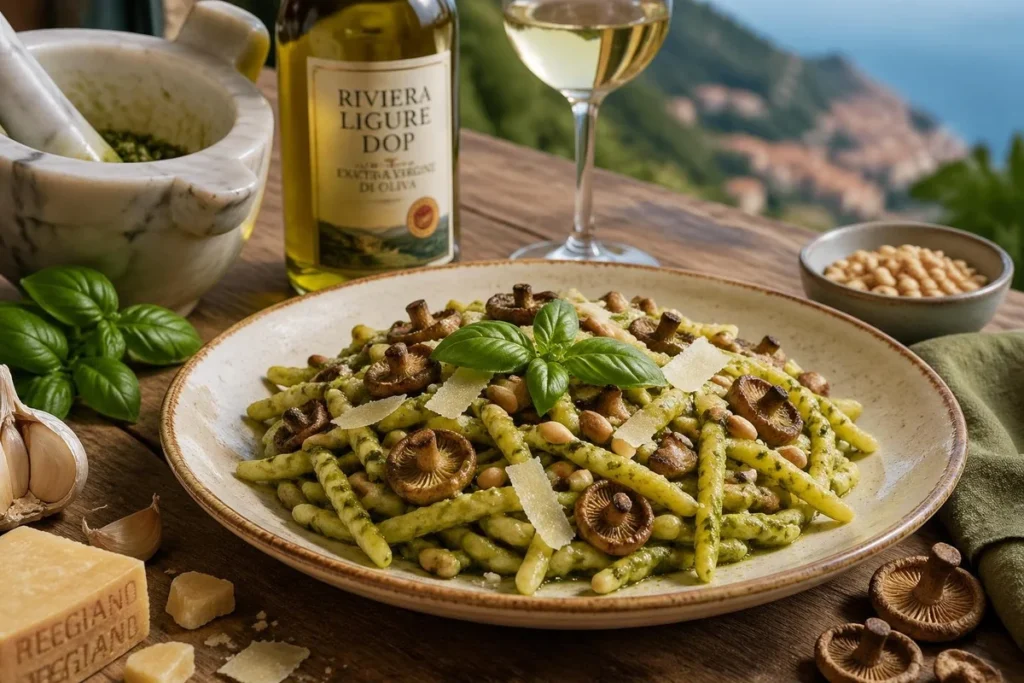
Liguria Trofie with Pesto and Fairy Ring Accents
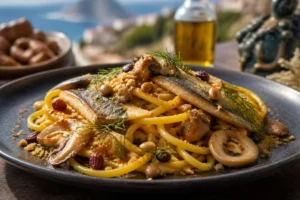
In the rugged coastal landscape of Liguria, the culinary identity is defined by the Mortaio (mortar and pestle). While Pesto alla Genovese is traditionally a purely herbal sauce, the integration of Marasmius oreades (Fairy Ring mushroom) provides a sophisticated earthy base that anchors the volatile aromatics of the basil. This dish utilizes the mushroom's benzaldehyde profile to mirror the nuttiness of the pine nuts, creating a seamless transition from forest floor to coastal garden.
The Culinary Physics of This Dish
The core science of this preparation is cold-phase lipid stabilization. Unlike most mushroom dishes, the Fairy Ring caps are sautéed separately and introduced to a raw, cold sauce. This prevents the heat-sensitive Basil esters (linalool) from oxidizing. The chitinous texture of the mushrooms acts as a "flavor carrier," holding onto the olive oil and garlic particles while providing a necessary "bite" to the hand-twisted Trofie pasta.
Furthermore, the polysaccharides in the mushrooms interact with the proteins in the Pecorino and Parmigiano cheeses. This creates a secondary emulsification that prevents the pesto from "bleeding" oil onto the plate. The result is a glossy, cohesive coating that maintains its vibrant green color and savory mycological depth through the entire service.
Terroir Narrative
Liguria is a land of vertical terraces squeezed between the Apennines and the Ligurian Sea. The Fairy Ring mushrooms found in the high-altitude meadows above the Cinque Terre are naturally small and exceptionally fragrant due to the maritime influence. By pairing these "pearls of the grass" with the world-famous Basilico Genovese DOP, we celebrate the vertical terroir of a region that masters both the mountain and the shore.
Prep Time
Cook Time
Complexity
Calories
Region
40 min
10 min
Grand Officier
360 kcal
Liguria, Italy
Master Recipe (1:10 Rule)
Following the 1:10 rule of professional pasta service, the ratio of sautéed mushrooms to the volume of the trofie ensures a balanced distribution of texture without the fungi becoming a distraction from the herbal pesto.
400 g Fresh Trofie (hand-twisted durum wheat pasta)
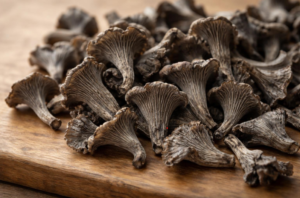
400 g Fresh Fairy Ring Mushroom caps (Marasmius oreades)
80 g Fresh Young Basil leaves (Basilico Genovese DOP)
50 g Pine Nuts (Pinoli di Pisa, lightly toasted)
60 g Parmigiano Reggiano (aged 24 months)
30 g Pecorino Sardo (maturo)
100 ml Extra Virgin Olive Oil (Riviera Ligure DOP)
1 clove Purple Garlic from Vessalico
The Technique
The Pesto: Using a marble mortar, crush the garlic and pine nuts into a cream. Add the basil and coarse salt, using a rotary motion to grind without bruising. Slowly incorporate the cheeses and the olive oil until a stable emulsion forms.
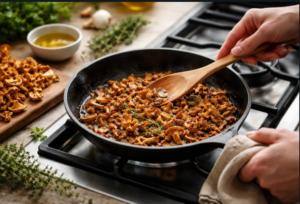
The Sauté: In a separate pan, flash-sauté the mushroom caps in a tablespoon of oil until golden and "secco" (dry). The goal is a concentrated flavor with zero residual water.
The Pasta: Boil the trofie in salted water. Traditionally, a sliced potato and a handful of green beans are added to the water to provide extra starch and texture.
Assembly: Drain the pasta (reserve 20ml of water). In a large bowl (never a hot pan), combine the pesto, the mushrooms, and the pasta water.
Mantecatura: Toss vigorously. The residual heat of the pasta will melt the cheese into the oil, while the mushrooms absorb the herbaceous essence without going limp.
"In Genoa, we say that pesto is made of air and patience. When you add the Fairy Ring mushroom, you add the soul of the mountain to the breath of the sea." – Master Pastaio, Camogli
The Umami Profile
The umami profile of Marasmius oreades is uniquely positioned to enhance the glutamates found in aged Parmigiano. This interaction creates a long, savory finish that balances the peppery bite of the fresh basil. Pure Umami offers the highest quality wild-harvested specimens, including Porcini, Caesar's mushroom, Chanterelle, Gray Chanterelle, and Morel, for your most demanding technical recipes.
Experience the precision of Ligurian forage with our Boutique Fairy Ring Mushrooms, selected for their aromatic clarity and structural resilience.
Sommelier’s Choice
The mandatory pairing is a Pigato di Albenga (Vermentino family). Its intense mineral character and notes of Mediterranean scrub (macchia mediterranea) mirror the pesto's herbs, while its structure supports the savory mushrooms. Alternatively, a Vermentino dei Colli di Luni offers a saline, floral profile that highlights the lightness of the dish.
The Etymological Chronicle
In the Italian tradition (Post B), the Fairy Ring mushroom is often celebrated in Ligurian dialect as Fonghi de prà. While the technically correct name is Gambesecche, the local term highlights the mushroom's total integration into the coastal meadows. It is a fungus that signals the return of the spring rain, a natural treasure that has been harvested by Ligurian families since the era of the Maritime Republics.
To provide the best experiences, we use technologies like cookies to store and/or access device information. Consenting to these technologies will allow us to process data such as browsing behavior or unique IDs on this site. Not consenting or withdrawing consent, may adversely affect certain features and functions.
Functional
Always active
The technical storage or access is strictly necessary for the legitimate purpose of enabling the use of a specific service explicitly requested by the subscriber or user, or for the sole purpose of carrying out the transmission of a communication over an electronic communications network.
Preferences
The technical storage or access is necessary for the legitimate purpose of storing preferences that are not requested by the subscriber or user.
Statistics
The technical storage or access that is used exclusively for statistical purposes.The technical storage or access that is used exclusively for anonymous statistical purposes. Without a subpoena, voluntary compliance on the part of your Internet Service Provider, or additional records from a third party, information stored or retrieved for this purpose alone cannot usually be used to identify you.
Marketing
The technical storage or access is required to create user profiles to send advertising, or to track the user on a website or across several websites for similar marketing purposes.