A technical examination of phytonutrient-umami coordination and the stabilization of high-moisture potato starches using the hydrophobic properties of Morchella.
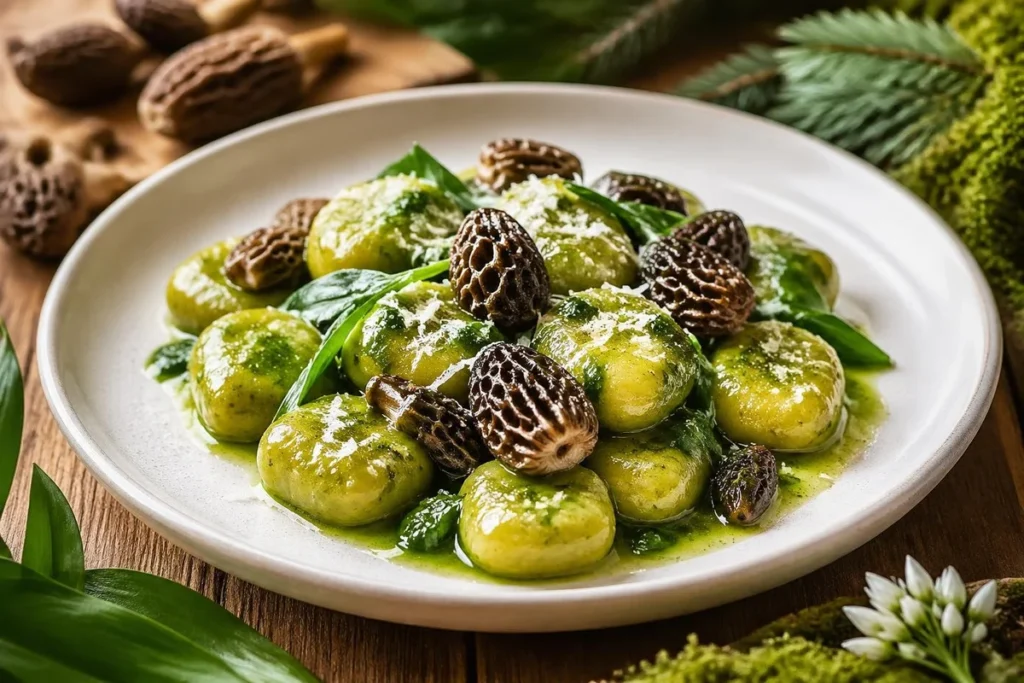
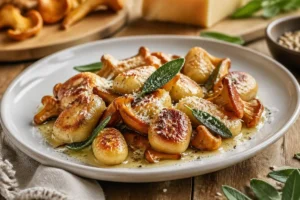
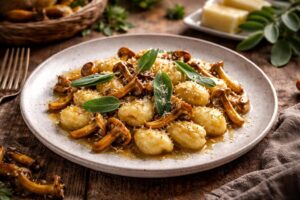
Morel & Wild Garlic Gnocchi (Trentino Style)
In the alpine region of Trentino-Alto Adige, spring culinary traditions are defined by the convergence of the first Wild Garlic (Ramsons/Allium ursinum) and the emergence of Morels. This dish is a technical masterclass in aromatic synchronization. Unlike cultivated garlic, wild garlic possesses volatile sulfur compounds that are highly heat-sensitive. By using the Morchella's honeycomb structure as a thermal shield, we can stabilize these delicate alliaceous notes, ensuring they persist throughout the pan-glazing process.
The Culinary Physics of This Dish
The core scientific principle is Starch-Lipid Surface Tension. Gnocchi made from mountain potatoes (high starch, low water) require a sauce that provides lubrication without causing the starch to "gum." Morels are ideal for this because their chitinous surface naturally repels excess water while binding to lipids. When sautéed in cultured butter, the morels release polysaccharides that help emulsify the butter and wild garlic puree into a high-stability glaze that "grips" the potato gnocchi.
Furthermore, the organosulfur compounds in the wild garlic act as a flavor catalyst for the terpenes in the morels. This creates a chemical "vibration" on the palate where the garlic's pungency is immediately smoothed out by the mushroom's earthy fat-solubles. The result is a balanced, high-vibrancy emulsion where the gnocchi provide a soft, neutral base for the intense mountain aromatics.
Terroir Narrative
Trentino is a land of vertical forests and pristine meadows. As the snow melts, wild garlic carpets the forest floor, quickly followed by morels near the roots of ancient conifers. This dish represents the "Cucina di Risveglio" (Cuisine of Awakening)—the first meal of the year that uses entirely fresh, foraged ingredients. It is a celebration of the high-altitude spring, where the sharpness of the melting frost meets the warmth of the emerging forest umami.
Prep Time
Cook Time
Complexity
Calories
Region
60 min
10 min
Grand Officier
340 kcal
Trentino-Alto Adige, Italy
Master Recipe (1:10 Rule)
In this delicate mountain preparation, we follow the 1:10 rule: the ratio of wild garlic puree to the morel butter emulsion ensures the garlic supports the mushroom's nutty profile without overwhelming it with sulfurous notes.
500 g Fresh Potato Gnocchi (Russet or mountain potatoes)
300 g Fresh Morels (kept whole to preserve internal air)
50 g Wild Garlic leaves (blanched and pureed)
60 g Alpine Butter (high-fat, salted)
50 ml Vegetable Stock (lightly seasoned)
To garnish Freshly grated Trentingrana (or Parmigiano Reggiano)
To taste Sea salt and cracked black pepper
The Technique
The Puree: Blanch wild garlic leaves for 10 seconds, then shock in ice water. Blend with a touch of oil. This "locks" the chlorophyll and prevents the garlic from becoming bitter during the pan-toss.
The Fungal Sauté: Sauté Morels in butter until they start to "crackle." This indicates the chitin is crisping and the internal moisture has been replaced by aromatic butter fats.
The Boil: Cook gnocchi in boiling salted water until they float. Remove immediately—mountain gnocchi have a very narrow "perfection window" before the starch begins to break down.
The Emulsion: Add the gnocchi and the wild garlic puree to the morel pan. Add a splash of stock.
The Glaze: Toss gently over low heat. The cold puree will emulsify with the hot butter and mushroom juices, creating a bright green, high-gloss veil over the pasta.
Assembly: Serve immediately with a light dusting of Trentingrana. The aroma should be a sharp mix of forest floor and mountain spring air.
"In the Alps, we don't use spices; we use the seasons. Wild garlic is the spark, and the Morel is the wood." – Chef di Montagna, Dolomites
The Umami Profile
The umami profile of Morchella is uniquely brightened by the allicin in the wild garlic. This interaction makes the mushroom's savory notes feel "fresher" and more immediate. Pure Umami offers the highest quality wild-harvested specimens, including Porcini, Caesar's mushroom, Chanterelle, and Morel, for your high-altitude culinary masterpieces.
Experience the peak of alpine forage with our Mountain-Grade Morels, selected for their aromatic clarity and structural resilience.
Sommelier’s Choice
A wine with high acidity and mineral depth is required. A Kerner or a Müller-Thurgau from the Valle Isarco provides the sharp, floral character needed to cut through the butter. For a more structured alternative, choose a Teroldego Rotaliano; its dark fruit and slight bitterness will highlight the smoky morels without overwhelming the wild garlic.
The Etymological Chronicle
In the Trentino tradition (Post B), the Morel is often called Spugnola di Montagna. While Spugnola is the common Italian name, the mountain prefix signifies a гmushroom that is harder, denser, and more aromatically concentrated than valley varieties. Historically, these were "shepherd's gold," traded for wool and salt in the mountain passes of the Dolomites.
To provide the best experiences, we use technologies like cookies to store and/or access device information. Consenting to these technologies will allow us to process data such as browsing behavior or unique IDs on this site. Not consenting or withdrawing consent, may adversely affect certain features and functions.
Functional
Always active
The technical storage or access is strictly necessary for the legitimate purpose of enabling the use of a specific service explicitly requested by the subscriber or user, or for the sole purpose of carrying out the transmission of a communication over an electronic communications network.
Preferences
The technical storage or access is necessary for the legitimate purpose of storing preferences that are not requested by the subscriber or user.
Statistics
The technical storage or access that is used exclusively for statistical purposes.The technical storage or access that is used exclusively for anonymous statistical purposes. Without a subpoena, voluntary compliance on the part of your Internet Service Provider, or additional records from a third party, information stored or retrieved for this purpose alone cannot usually be used to identify you.
Marketing
The technical storage or access is required to create user profiles to send advertising, or to track the user on a website or across several websites for similar marketing purposes.