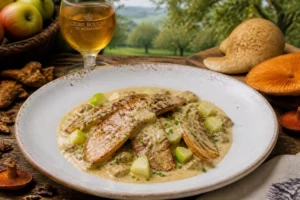
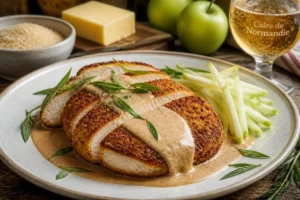
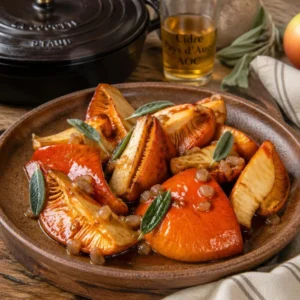
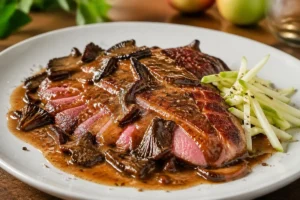
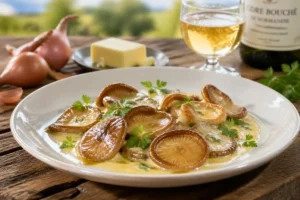
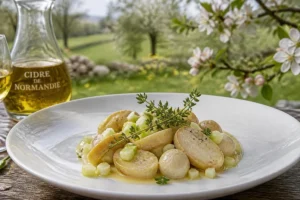
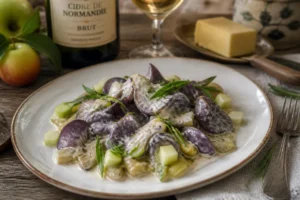
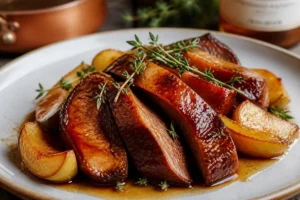
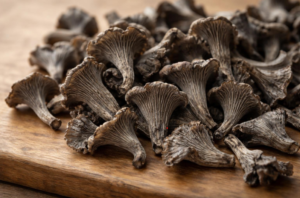
An advanced technical study in "Acid-Esthetic Balancing," utilizing the low-pH environment of fermented malic acid to soften fungal chitin, followed by a high-lipid dairy stabilization to encapsulate volatile orchard and forest aromatics.
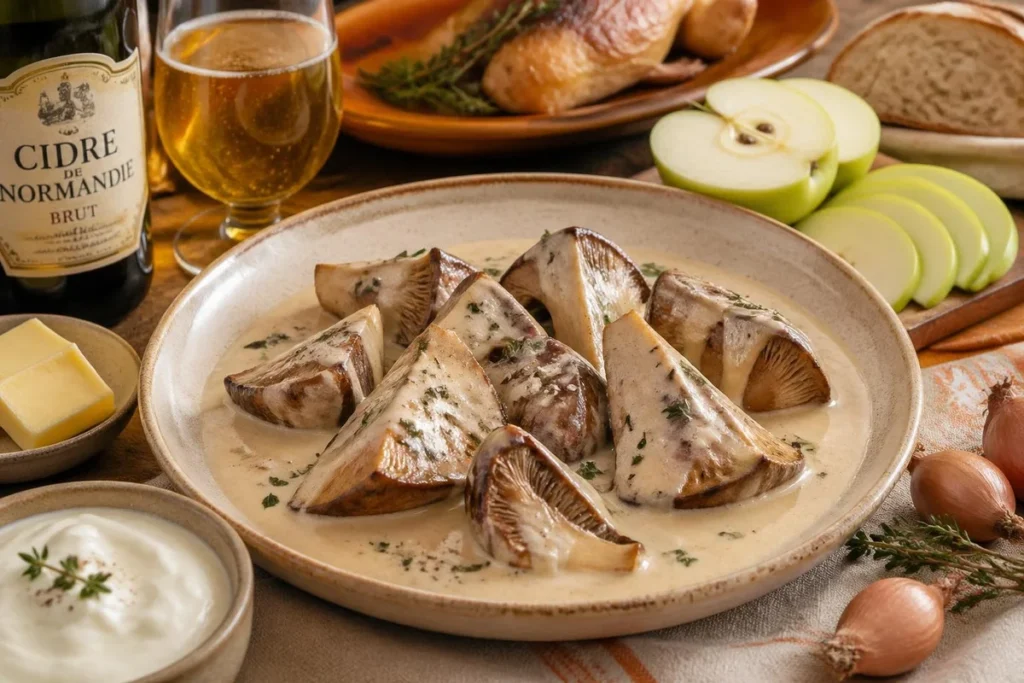
Normandy Cider-Braised Parasol Mushrooms with Crème Fraîche
For our sixty-second technical formulation, we analyze the Acid-Emulsion Synergy of the Normandy terroir. Macrolepiota procera (Parasol Mushroom), known as Macrolepiota procera, possesses a delicate, almond-like flavor profile that is often overwhelmed by heavy reductions. At pure-umami.cc, we utilize a traditional "Vallée d'Auge" approach. By braising the caps in dry, fermented apple cider, we allow the malic acid to act as a tenderizing agent. The final addition of Crème Fraîche provides a high-lipid buffer that captures the fleeting esters of both the apple and the mushroom, creating a sauce of profound silkiness.
The Culinary Physics of This Dish
The engineering of this braise relies on Polysaccharide Softening and Fat-Soluble Flavor Transport. The Macrolepiota procera has a relatively high fiber content in its "context." Molecularly, the mild acidity of the cider (pH 3.3–4.0) helps to partially break down these fibers during the slow simmer. As the cider reduces, its sugars concentrate, creating a bridge to the mushroom's natural nuttiness. The Crème Fraîche, being a fermented dairy product, contains specific lactic acid bacteria that enhance the "tang" of the cider while providing the saturated fats necessary to dissolve and carry the mushroom's aromatic ketones across the palate.
Terroir Narrative
This formulation is a tribute to the Normandy region of France, where the orchard meets the forest. In late autumn, the fallen apples provide a sweet, fermented backdrop to the emergence of the Macrolepiota procera in the damp pastures. The terroir is expressed through the use of Cidre Bouché and the world-renowned Isigny cream. This mirrors the technical rigor we apply to our Morchella conica (Morel) and Cantharellus cibarius (Chanterelle), treating the liquid medium not just as a cooking tool, but as a biological mirror of the mushroom's own habitat.
Quick Info Bar
Braise Temp
Reduction Time
Complexity
Region
95°C (Simmer)
15 mins
Grand Officier
Normandy, FR
Master Recipe (1:10 Rule)
Technical proportions for the "Orchard-Forest" emulsion:
1 small Tart Apple (Granny Smith style, finely diced)
Fresh Thyme and a splash of Calvados (optional)
Fleur de Sel and White Pepper
The Technique
The Aromatic Foundation: Sauté the minced shallots and diced apple in the butter until translucent. Add the **Macrolepiota procera** caps and cook until they begin to release their moisture and take on a light golden hue.
The Calvados Flambé (Optional): If using, add a splash of Calvados and ignite to burn off the alcohol, leaving behind a concentrated apple essence.
The Cider Braise: Pour in the dry cider. Reduce the heat to a bare simmer. Allow the mushrooms to poach in the bubbling liquid until the cider has reduced by two-thirds. This concentrates the malic sugars and infuses the mushroom tissue.
The Cream Stabilization: Whisk in the Crème Fraîche. Continue to simmer gently for 2-3 minutes. The sauce should thicken to a "nappe" consistency, coating the mushrooms in a glossy, ivory-colored glaze.
The Finishing: Season with Fleur de Sel and white pepper. Garnish with fresh thyme leaves. Serve immediately, ideally with crusty bread or over a simple poultry dish.
Shop Integration
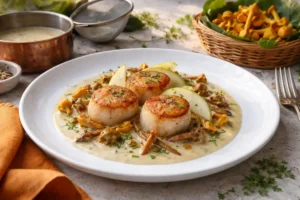
The Macrolepiota procera provides the necessary structural "bite" for this braise, but its flavor can be layered with our other offerings. For an even more complex forest profile, we recommend adding a few dried Boletus edulis (Porcini) slices to the cider reduction phase. If you seek a brighter peppery contrast, a few Cantharellus cibarius (Chanterelle) mushrooms can be sautéed alongside the Parasols. For a luxury upgrade, finish the dish with a few drops of Morchella conica (Morel) oil. If available, a few raw shavings of Amanita caesarea (Caesar's mushroom) provided as a garnish will offer a citrusy acidity that complements the apple notes. For a rustic, nutty baseline, our Marasmius oreades (Fairy Ring) can be added to the initial sauté for its intense almond-aroma.
The Umami Profile
This dish features **Acid-Synergistic Umami**. The malic acid from the cider and the lactic acid from the Crème Fraîche act as "flavor brighteners" for the Macrolepiota procera's guanylates. This prevents the savory compounds from feeling "muddy" or heavy. The presence of the apple provides a subtle sweetness that balances the earthy mushroom depth, resulting in a balanced, multi-tonal umami experience.
Sommelier’s Choice
A glass of the same **Dry Normandy Cider** used in the cooking, or a crisp **Chenin Blanc** from the Loire Valley. The high acidity and orchard-fruit notes of these beverages are the technical requirement to cut through the rich Crème Fraîche and match the fermented apple profile of the sauce.
The Etymological Chronicle
The term Cidre is **French**, derived from the Greek sikera. In **Italian**, this would be Mazza di Tamburo Brasata al Sidro. In **German**, it is In Apfelwein geschmorter Parasol. In **Spanish**, it is Galamperna a la Sidra. Regardless of the language, the **Parasol** mushroom braised in cider remains the definitive standard for technical Northern-French-mycological fusion.
Pure Umami | Mycological Research & Culinary Arts | 2026
To provide the best experiences, we use technologies like cookies to store and/or access device information. Consenting to these technologies will allow us to process data such as browsing behavior or unique IDs on this site. Not consenting or withdrawing consent, may adversely affect certain features and functions.
Functional
Always active
The technical storage or access is strictly necessary for the legitimate purpose of enabling the use of a specific service explicitly requested by the subscriber or user, or for the sole purpose of carrying out the transmission of a communication over an electronic communications network.
Preferences
The technical storage or access is necessary for the legitimate purpose of storing preferences that are not requested by the subscriber or user.
Statistics
The technical storage or access that is used exclusively for statistical purposes.The technical storage or access that is used exclusively for anonymous statistical purposes. Without a subpoena, voluntary compliance on the part of your Internet Service Provider, or additional records from a third party, information stored or retrieved for this purpose alone cannot usually be used to identify you.
Marketing
The technical storage or access is required to create user profiles to send advertising, or to track the user on a website or across several websites for similar marketing purposes.