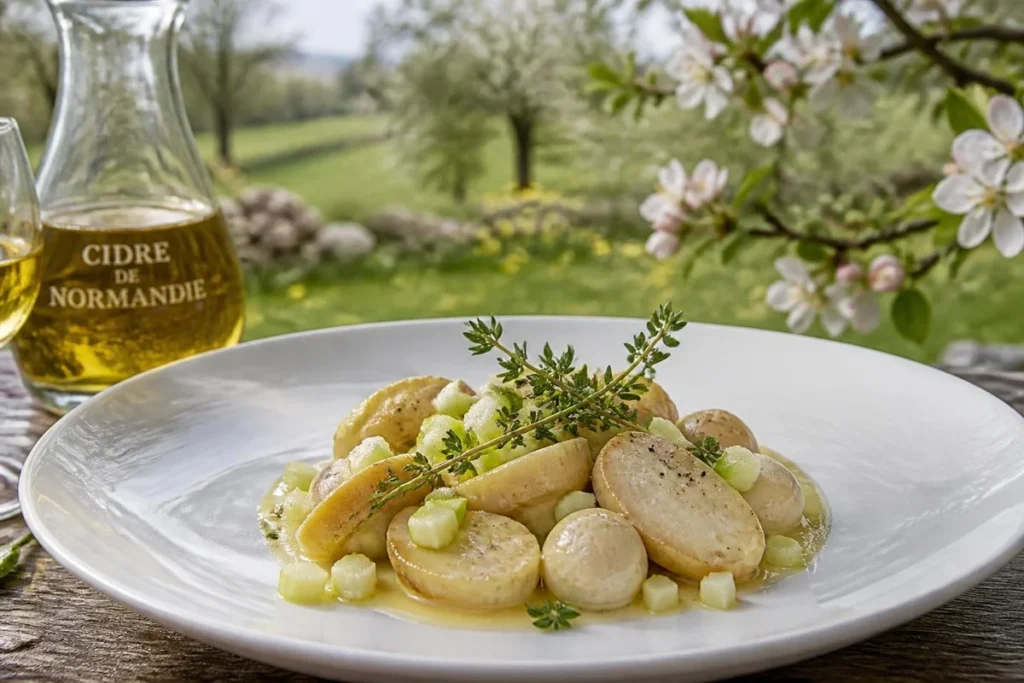
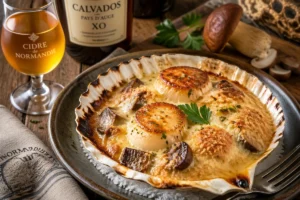
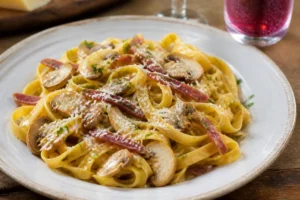
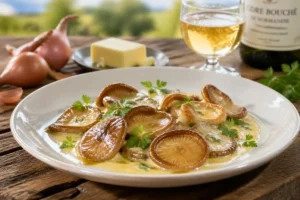
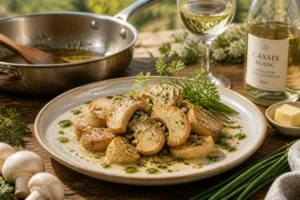
A sophisticated Norman technical execution involving fruit-acid maceration and low-temperature poaching to elevate the mealy aromatics of Calocybe gambosa.
Normandy Cider Poached Calocybe with Apple
In the mist-laden orchards of Northwest France, the Calocybe gambosa—familiarly known as the Saint George's Mushroom—emerges from the damp limestone soils precisely as the apple blossoms begin to fall. This biological synchronicity serves as the foundation for one of Normandy's most intellectually stimulating spring preparations. Unlike the darker, forest-heavy profiles of late-season fungi, the Calocybe gambosa offers a clean, floury, and almost cucumber-like scent that demands a cooking medium capable of preserving its crystalline freshness while adding a layer of crisp, orchard acidity.
The Culinary Physics of This Dish
The technical core of this dish relies on hydrophilic aromatic preservation and enzymatic inhibition. The Saint George's Mushroom contains a high concentration of trans-2-nonenal, a volatile organic compound that shares a molecular kinship with the aldehydes found in green apples and unripe pears. By using a dry, acidic Normandy cider as the poaching liquor, we achieve a dual mechanical effect: the acetic and malic acids in the cider act as a firming agent for the mushroom's delicate chitinous cell walls, preventing the "slimming" effect often associated with moisture-heavy cooking. Simultaneously, the low poaching temperature (sub-80°C) prevents the farinaceous esters from breaking down into heavier, less desirable sulfuric compounds, resulting in a mushroom that retains its spring-like "snap" and mealy integrity.
Terroir Narrative
Normandy is a terroir of hedgerows (*bocage*) and ancient limestone meadows. While the rest of France may look toward the hills for the first mushrooms, the Norman forager looks toward the apple trees. This preparation is a tribute to the *Pays d'Auge*, a sub-region where the marriage of dairy fat and fermented fruit defines the gastronomic identity. Traditionally, the Saint George's Mushroom was cooked simply with cream, but this contemporary evolution utilizes the cider of the region to cut through the density of the fungus, creating a dish that mirrors the bright, fluctuating weather of a Norman May.
Prep Time
Cook Time
Complexity
Calories
Region
40 Min
20 Min
Grand Officier
310 kcal
Normandy, FR
Master Recipe
500g Saint George's Mushrooms (Calocybe gambosa), cleaned with a natural bristle brush.
300ml Dry Artisanal Normandy Cider (Brut).
100g Granny Smith Apple, cut into precise 5mm brunoise.
60g Isigny Ste-Mère Butter (or a high-fat cultured butter).
20ml Calvados (Aged 2 years or more).
2 Shallots, finely minced.
1 sprig Fresh Lemon Thyme.
Pinch of fleur de sel.
The Technique
1. The Maceration: Begin by placing the apple brunoise in a small bowl with the Calvados. This technique, known as osmotic fruit-acid infusion, ensures the apple remains crisp while absorbing the spirit's oak and vanilla notes.
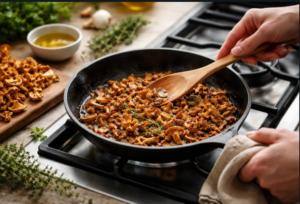
2. The Poaching Base: In a wide, shallow sauté pan, sweat the minced shallots in 20g of butter until translucent. Pour in the Normandy cider and bring to a bare simmer. Do not allow it to reach a rolling boil, as high heat will fracture the cider's delicate yeast esters.
3. Gentle Poaching: Submerge the Calocybe gambosa into the cider liquor. Cover with a cartouche (a parchment paper lid) to ensure the mushrooms are evenly steamed and poached. Maintain the temperature at 75°C for approximately 8–10 minutes.
4. The Reduction Emulsion: Remove the mushrooms and keep them warm. Increase the heat slightly to reduce the poaching liquid by half. Once a syrupy consistency is achieved, whisk in the remaining cold butter to create a beurre blanc style emulsion. Return the mushrooms to the pan, fold in the Calvados-soaked apples, and serve immediately.
Shop Integration
The pursuit of mycological excellence begins with the source. While the Saint George's Mushroom defines the early spring, our shop is the gateway to year-round gourmet research. Elevate your culinary repertoire by exploring our Porcini (Boletus edulis) for depth, or the delicate Scotch Bonnet (Marasmius oreades) for lighter infusions. For more regal preparations, consider the Caesar's Mushroom (Amanita caesarea), or experiment with the subtle textures of our Yellow Foot (Craterellus cinereus) and Chanterelle (Cantharellus cibarius). For the ultimate spring luxury, our Morels (Morchella conica) provide the perfect counterpart to the Calocybe gambosa.
The Umami Profile
This dish presents a biochemical layering of umami. The Saint George's Mushroom provides a moderate level of guanylate, which is significantly enhanced by the fermentation compounds found in dry cider. When these meet the lactic acids of the Normandy butter, a synergistic reaction occurs on the palate, creating a sensation of "creamy saltiness" without excessive sodium. The addition of raw apple provides a textural break, resetting the taste receptors to perceive the mushroom's mealy depth with every bite.
Sommelier’s Choice
Traditional wine rules are suspended for this dish. The logical and superior pairing is a Cidre de Normandie IGP, specifically one with high carbonation and a sharp, tannins-rich finish. If a wine is insisted upon, a Chenin Blanc from the Loire Valley (Savennières), known for its bruised apple notes and high acidity, will mirror the cider's profile and respect the mushroom's farinaceous character.
The Etymological Chronicle
French: Mousseron de la Saint-Georges.
Italian: Prugnolo.
German: Maipilz.
Spanish: Setas de San Jorge.
Pure Umami | Mycological Research & Culinary Arts | 2026
To provide the best experiences, we use technologies like cookies to store and/or access device information. Consenting to these technologies will allow us to process data such as browsing behavior or unique IDs on this site. Not consenting or withdrawing consent, may adversely affect certain features and functions.
Functional
Always active
The technical storage or access is strictly necessary for the legitimate purpose of enabling the use of a specific service explicitly requested by the subscriber or user, or for the sole purpose of carrying out the transmission of a communication over an electronic communications network.
Preferences
The technical storage or access is necessary for the legitimate purpose of storing preferences that are not requested by the subscriber or user.
Statistics
The technical storage or access that is used exclusively for statistical purposes.The technical storage or access that is used exclusively for anonymous statistical purposes. Without a subpoena, voluntary compliance on the part of your Internet Service Provider, or additional records from a third party, information stored or retrieved for this purpose alone cannot usually be used to identify you.
Marketing
The technical storage or access is required to create user profiles to send advertising, or to track the user on a website or across several websites for similar marketing purposes.