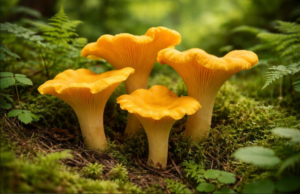
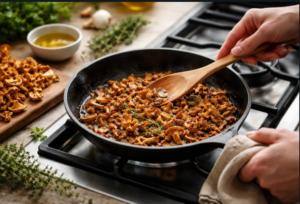
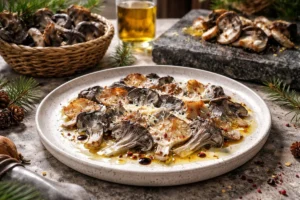
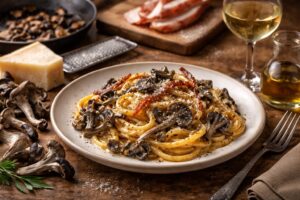
An advanced technical study in "Enzymatic Maceration," utilizing the raw, cellular structure of the Parasol mushroom as a substrate for lipid-acid infusion, where cold-pressed oils and organic acids tenderize the chitinous fibers without thermal degradation.
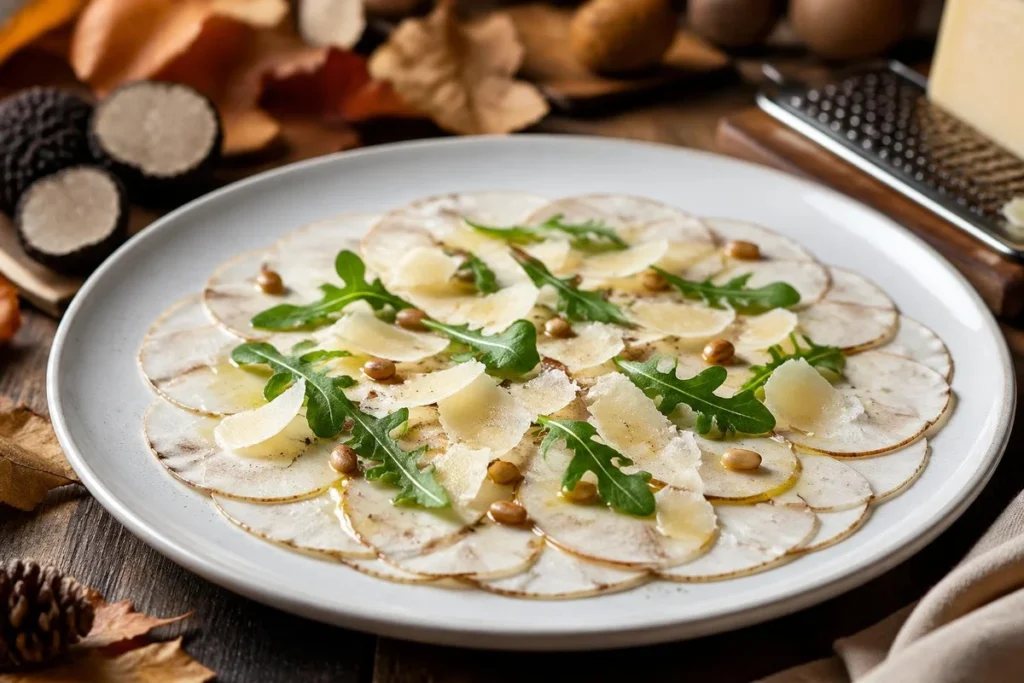
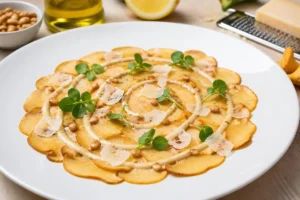
Truffle-Scented Parasol Mushroom Carpaccio with Shaved Pecorino Romano
For our fifty-fourth technical formulation, we shift our focus from thermal transformation to Cold-Acid Denaturation. Macrolepiota procera (Parasol Mushroom), known in Bulgaria as Macrolepiota procera, is one of the few wild fungi safe and delectable to consume in its raw state, provided it is harvested from pristine environments. The "context" of the Macrolepiota procera possesses a subtle, almond-like sweetness and a crisp, ephemeral texture that is often lost during cooking. At pure-umami.cc, we utilize a high-lipid marinade to encapsulate these fragile aromatics, creating a dish that mirrors the sophistication of classic beef carpaccio while introducing a distinct forest terroir.
The Culinary Physics of This Dish
The engineering of this carpaccio relies on Lipid-Acid Maceration. Unlike cooking, which uses heat to break down chitin (the fungal cell wall), maceration utilizes the osmotic pressure of salt and the solvent properties of lemon juice (citric acid). Molecularly, the acid begins to denature the fungal proteins, "softening" the texture while the cold-pressed olive oil acts as a carrier for the fat-soluble truffle ketones. By slicing the Macrolepiota procera to a precision of 1.5mm, we maximize the surface area for this enzymatic exchange, ensuring the mushroom remains structural yet becomes remarkably tender on the tongue.
Terroir Narrative
This formulation is a tribute to the Umbria and Tuscany regions of Italy, where the hunt for truffles and the autumn harvest of "Mazza di Tamburo" (Parasol) frequently overlap. The terroir is expressed through the marriage of the forest's "clean" earthiness with the sharp, salty minerality of Pecorino Romano. This reflects the same technical rigor we apply to our Amanita caesarea (Caesar's mushroom), treating raw fungal tissue as a delicate biological asset that must be protected from oxidation to maintain its ivory-white aesthetic.
Quick Info Bar
Prep Time
Chilling Time
Complexity
Calories
Region
20 mins
10 mins
Grand Officier
190 kcal
Tuscany/Umbria, IT
Master Recipe (1:10 Rule)
Technical proportions for the raw maceration:
200g Fresh, firm Macrolepiota procera caps (Macrolepiota procera) – must be pristine
30ml Extra Virgin Olive Oil (Tuscan or high-polyphenol)
5ml White Truffle Oil (infused with Tuber magnatum)
15ml Fresh Lemon Juice (strained)
40g Pecorino Romano (aged 12+ months)
10g Toasted Pine Nuts (for fatty contrast)
Micro-arugula and Fleur de Sel
The Technique
The Cryo-Prep: Place the Macrolepiota procera caps in the freezer for 15 minutes before preparation. This slightly firms the tissue, allowing for a higher precision of thin slicing without tearing the delicate gills.
The Precision Slicing: Using a mandoline or a razor-sharp sushi knife (Yanagiba), slice the caps vertically into 1.5mm thick translucent petals. Arrange them in a single, overlapping layer (the "shingle" pattern) on a chilled plate.
The Lipid-Acid Infusion: Whisk the olive oil, truffle oil, and lemon juice until a temporary emulsion is formed. Drizzle the mixture immediately over the Macrolepiota procera petals. The mushrooms will begin to absorb the lipids within seconds.
The Mineral Layer: Shave the Pecorino Romano into wide, paper-thin ribbons using a vegetable peeler. Distribute them evenly over the mushroom petals to provide structural saltiness.
The Aromatic Finish: Scatter the toasted pine nuts and micro-arugula. Season with Fleur de Sel just before serving to ensure the salt crystals provide a tactile "crunch" against the soft fungal tissue.
Shop Integration
The raw Macrolepiota procera offers a clean, nutty baseline, but its luxury can be amplified. For an elite presentation, we recommend garnishing with thin shavings of our fresh Amanita caesarea (Caesar's mushroom), which shares the raw-safe profile. If you seek a deeper, smokier contrast, a few drops of Craterellus cinereus (Grey Chanterelle) reduction can be dotted around the plate. For a nutty textural bridge, toasted Marasmius oreades (Fairy Ring) can be scattered alongside the pine nuts. If serving as part of a grand forest carpaccio, interleave the Macrolepiota procera with raw, marinated slices of our Boletus edulis (Porcini). For a final touch of sophistication, finish with Morchella conica (Morel) salt.
The Umami Profile
This dish features **Clean-Cell Umami**. By avoiding heat, we prevent the degradation of the mushroom's natural guanylates. These savory compounds are heightened by the high sodium content of the Pecorino Romano, while the truffle oil provides a "volumetric" aroma that fills the olfactory senses, making the subtle flavor of the Macrolepiota procera feel much more substantial and lingering.
Sommelier’s Choice
A chilled **Grechetto** or a crisp **Vermentino di Sardegna**. These wines possess a salty minerality and a hint of white almond that perfectly complements the raw Macrolepiota procera and the aged Pecorino cheese.
The Etymological Chronicle
The term Carpaccio is **Italian**, originally named after the Venetian painter Vittore Carpaccio, known for his use of red and white tones. In **French**, this is known as Carpaccio de Coulemelle. In **German**, it is Parasolpilz-Carpaccio. In **Spanish**, it is Carpacho de Galamperna. Regardless of the language, the **Parasol** mushroom carpaccio is the definitive standard for technical raw-mycological elegance.
Pure Umami | Mycological Research & Culinary Arts | 2026
To provide the best experiences, we use technologies like cookies to store and/or access device information. Consenting to these technologies will allow us to process data such as browsing behavior or unique IDs on this site. Not consenting or withdrawing consent, may adversely affect certain features and functions.
Functional
Always active
The technical storage or access is strictly necessary for the legitimate purpose of enabling the use of a specific service explicitly requested by the subscriber or user, or for the sole purpose of carrying out the transmission of a communication over an electronic communications network.
Preferences
The technical storage or access is necessary for the legitimate purpose of storing preferences that are not requested by the subscriber or user.
Statistics
The technical storage or access that is used exclusively for statistical purposes.The technical storage or access that is used exclusively for anonymous statistical purposes. Without a subpoena, voluntary compliance on the part of your Internet Service Provider, or additional records from a third party, information stored or retrieved for this purpose alone cannot usually be used to identify you.
Marketing
The technical storage or access is required to create user profiles to send advertising, or to track the user on a website or across several websites for similar marketing purposes.