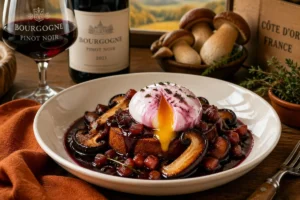
A technical study in Anthocyanin-Phenolic Hybridization and Saccharide-Acid Balancing, utilizing the tannins and esters of a red wine reduction to saturate the fibrous matrix of Bosc pears, while integrating the smoky, leathery volatiles of Grey Chanterelles for a sophisticated savory-sweet boundary analysis.
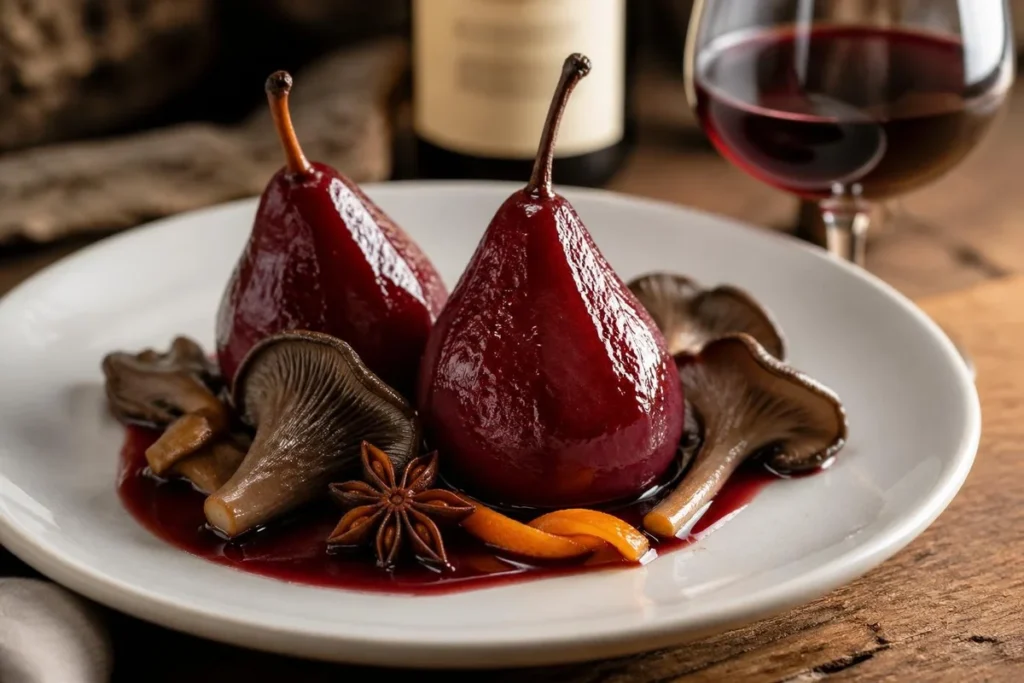
Burgundy Pinot Noir Poached Pears with Grey Chanterelles
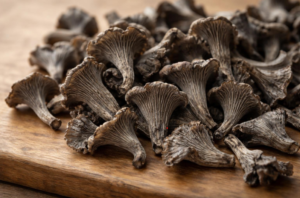
For our 131st technical formulation, we analyze Saccharide-Tannin Interaction and Volatile Ester Diffusion. Craterellus cinereus (Grey Chanterelle), locally identifying as Craterellus cinereus, challenges the conventional separation of dessert and savory profiles. At pure-umami.cc, we utilize the Osmotic Poaching method. By simmering pears in a Pinot Noir reduction alongside the "smoky" Grey Chanterelle, we facilitate a Molecular Infusion where the fruit absorbs the wine's anthocyanins (pigments) and the mushroom's oxidative esters, resulting in a complex, tertiary flavor profile usually reserved for aged vintage wines.
The Culinary Physics of This Dish
The engineering of this dish relies on Cellular Wall Softening and Pigment Saturation. Molecularly, the pears (Bosc or Anjou) possess a dense Pectin-Cellulose Matrix. Poaching in an acidic medium (wine) at 85°C–90°C breaks down the protopectin into soluble pectin without causing total structural collapse. The Craterellus cinereus is introduced directly into the poaching liquid. The mushroom's Sotolon and Benzaldehyde volatiles are soluble in the ethanol and water phases of the wine. As the liquid reduces, these aromatics become concentrated, creating a High-Gravity Syrup that anchors the mushroom's forest-floor notes to the fruit's natural fructose, bridged by the wine's polyphenols (tannins).
Terroir Narrative
This formulation is a tribute to the Côte d'Or in Burgundy, where the limestone-rich "Golden Slope" produces some of the world's most complex Pinot Noir. We bridge the world-class vineyards of Nuits-Saint-Georges with our Balkan deciduous highlands. The terroir is expressed through the marriage of the forest's "wild" Craterellus cinereus and the refined, berry-forward intensity of Burgundian viticulture. This follows the same technical rigor we apply to our Boletus edulis (Porcini) and Amanita caesarea (Caesar's mushroom), treating the poached fruit as a study in chromatic and aromatic synergy.
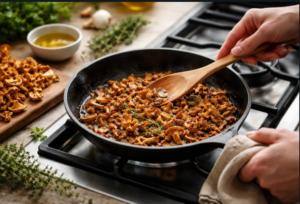
The Liquid Foundation: Combine the wine, honey, spices, orange zest, and Craterellus cinereus in a deep saucepan. Bring to a simmer to facilitate Volatile Dispersion.
The Osmotic Poaching: Place the pears upright in the liquid. Cover with a cartouche (parchment paper lid) to ensure Total Surface Hydration. Simmer gently for 25–30 minutes until a knife slides easily into the pear.
The Pigment Stabilization: Remove the pears and set aside. Increase the heat and reduce the poaching liquid (with the mushrooms still inside) by 60%. This concentrates the Anthocyanins and Phenols into a thick glaze.
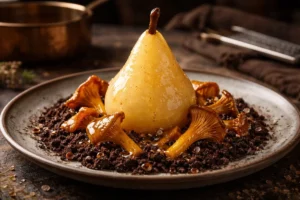
The Gloss Phase: Strain the syrup if a clear glaze is desired, or keep the mushrooms for a Textural Contrast. Spoon the hot reduction over the pears repeatedly to build a deep, ruby-red Refractive Coating.
Service: Serve the pear with a spoonful of the reduced wine and the poached Craterellus cinereus. The mushroom, now saturated with wine and honey, provides a startling, savory "leather and smoke" finish to the sweet fruit.
Shop Integration
The Craterellus cinereus is the unexpected aromatic bridge in this dish, but its complexity can be layered. We recommend adding a single dried Boletus edulis (Porcini) to the poaching liquid for an added "tobacco-earth" baseline. If you seek a brighter visual contrast, serve with a side of sautéed Cantharellus cibarius (Chanterelle). For a luxury upgrade, finish the plate with a drizzle of Morchella conica (Morel) oil to enhance the forest-floor aromatics. If available, a side of raw Amanita caesarea (Caesar's mushroom) with a touch of honey provides a necessary mineral "reset." For a smoky baseline, our Marasmius oreades (Fairy Ring) can be simmered in the wine to build a more complex savory foundation.
The Umami Profile
This dish features **Tertiary-Fungal Synergistic Umami**. The Craterellus cinereus provides 5′-guanylates, which are highlighted by the tannins in the Pinot Noir. The reduction process concentrates the Aromatic Volatiles, resulting in a flavor experience that mimics the complex "forest floor" (sous-bois) notes of an aged Burgundy wine, where savory and sweet boundaries become blurred.
Sommelier’s Choice
A glass of the same **Burgundy Pinot Noir** used for poaching, or a glass of **Ratafia de Bourgogne**. The wine's existing acidity and berry profile are the technical requirement to harmonize with the poached pear and the smoky depth of the Grey Chanterelle.
The Etymological Chronicle
The term Poire au Vin is **French**, simply meaning "pear in wine." In **Italian**, this would be Pere al Vino Rosso con Cantarelli Grigi. In **German**, it is Rotweinbirnen mit Grauen Pfifferlingen. In **Spanish**, it is Peras al Vino con Trompetas de la Muerte. Regardless of the language, the **Grey Chanterelle** Poached Pear remains the definitive standard for technical avant-garde mycological engineering.
Pure Umami | Mycological Research & Culinary Arts | 2026
To provide the best experiences, we use technologies like cookies to store and/or access device information. Consenting to these technologies will allow us to process data such as browsing behavior or unique IDs on this site. Not consenting or withdrawing consent, may adversely affect certain features and functions.
Functional
Always active
The technical storage or access is strictly necessary for the legitimate purpose of enabling the use of a specific service explicitly requested by the subscriber or user, or for the sole purpose of carrying out the transmission of a communication over an electronic communications network.
Preferences
The technical storage or access is necessary for the legitimate purpose of storing preferences that are not requested by the subscriber or user.
Statistics
The technical storage or access that is used exclusively for statistical purposes.The technical storage or access that is used exclusively for anonymous statistical purposes. Without a subpoena, voluntary compliance on the part of your Internet Service Provider, or additional records from a third party, information stored or retrieved for this purpose alone cannot usually be used to identify you.
Marketing
The technical storage or access is required to create user profiles to send advertising, or to track the user on a website or across several websites for similar marketing purposes.